

Eyes on Aleppo, papers point flaccid pens at world
The idea that the pen is mightier is belied as dailies are unable to do more than tsk-tsk over reports of horrors coming out of the Syrian city
 Add ToI as a Preferred Source on Google
Joshua Davidovich is The Times of Israel's Deputy Editor
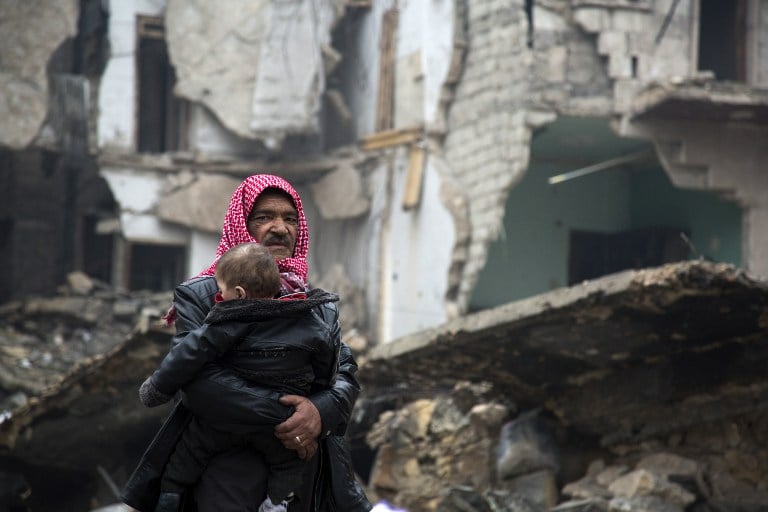
You know the reports of atrocities in Syria have gotten even more atrocious (as if that were even possible), when they are back on the front page of Israel’s Hebrew language print press, after nearly six years of daily tales of horror out of the war-sundered country.
The crushing of rebel-held parts of Aleppo, with reports of civilians being shot and killed and other terrible things, have brought the world’s attention – though not any action — back to the civil war there and neighboring Israel is no exception on both fronts.
“Reports piling up of war crimes in Aleppo,” reads the top headline of Haaretz, the only major daily to lead with the story, atop a picture of a dead woman in a wheelchair in a rubble-strewn Aleppo street, aside a crying man.
Analyst Zvi Bare’l writes in the broadsheet that it seems the Syrian regime army is just getting started and will now target other rebel areas for “cleansing.” Looking at the confluence of events that led to the rebels being routed, he sees it as a somewhat inevitable result of realpolitik on the world stage.
“One can argue that the international community should have operated on both fronts, against ISIS and to help the rebels and save the residents of Aleppo. But one cannot ignore the fact that such action could have led to a direct confrontation between the United States and Russia, thus undermining the war against ISIS. The tragic results now being seen in Aleppo are therefore the product of a policy that seems rational and of international priorities whose validity is hard to challenge,” he writes.
Others, though, don’t see any room for excusing the international community from responsibility for not stopping the killings, or at least not talking about stopping the killings.
“And the world was silent,” reads a tsk-tsking Yedioth Ahronoth, basing much of its report on opposition sources and civilians sending messages out on social media.
“Those residents who have managed to stay alive can’t understand why the world is silent in the face of the horror,” the paper’s Smadar Peri writes. “One of them, Lina Shami, published yesterday a call on Twitter to ‘save us’ and turned to the viewers of the world from her hiding place in Aleppo.”
Even worse than the supposed silence is the lack of action and Haaretz’s Amos Harel points an accusatory finger at the world for failing to actually do anything .
“The entire international community bears a responsibility for the massacres, due to its ongoing acquiescence in the face of the regime’s brutalities. According to human rights groups, Assad’s government and its allies are responsible for the murder of almost 90 percent of the civilians killed in this war, since the rebellion erupted in 2011,” he writes. “It’s Syria – not the inability to resolve the Israeli-Palestinian conflict – that reflects President Barack Obama’s greatest foreign policy failure. Aleppo is one more high point, not necessarily the last, in a string of continuous ethnic-cleansing operations.”
Harel includes Israel in this assessment, tying it to Jerusalem’s drive to cozy up to Moscow. One could detect part of that process in the fact that Israel Hayom, seen as a mouthpiece for Prime Minister Benjamin Netanyahu, buries the Aleppo story, at least compared to the other two papers, with the story receiving only a small reefer on the front page.
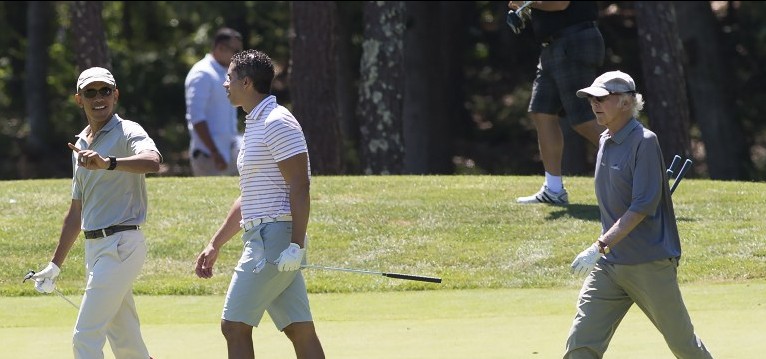
And true to Trump-loving form, the paper saves its harshest words not for Syrian President Bashar Assad or Vladimir Putin but rather US President Barack Obama, for playing golf “while Aleppo burns,” in the words of commentator Reuven Berko.
“In one of the latest photos taken of Obama in the White House, we see the outgoing US president managing to sink, at a critical moment, a golf ball in a glass cup laid on the ground in the Oval Office,” he writes. “This was a historically miserable finale for someone who committed to a red line and punitive actions against the Assad regime if it used chemical weapons against civilians and didn’t follow through on his threat.
“Alongside the abandonment of friends in the burning Middle East, he busied himself disproportionally with putting pressure on Israel.”
If putting Aleppo on the front page is a sign that things there have gotten worse than normal, is putting bad weather on the front page a sign of the same? According to Israel Hayom, which leads off with high winds and rainy downpours, the answer is yes.
The storm that began lashing Israel Tuesday isn’t in fact especially extraordinary, but the death of a Haifa-area man from hypothermia after his car got stuck in a flooded underpass is.
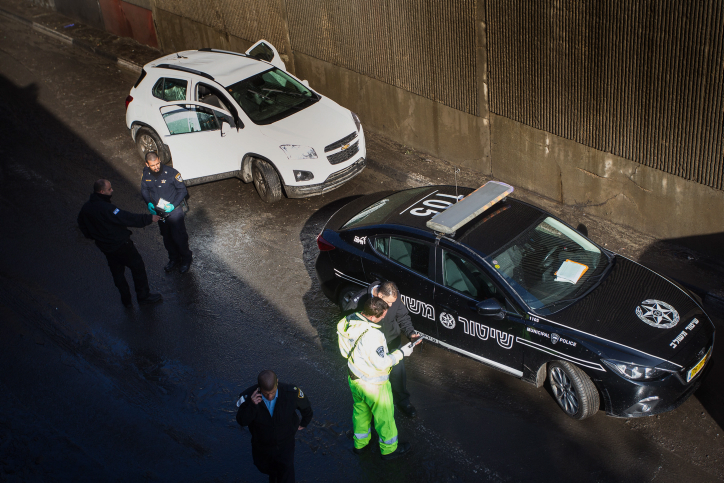
“This isn’t how we expected the winter to begin,” the paper’s lede reads, juxtaposing the death of Yosef Kilinksy with traffic jams elsewhere.
Much of the coverage in both Israel Hayom and Yedioth focuses on blame being leveled on firefighters for not seeing Kilinksy in the car as they pulled out stuck drivers.
“How did they not find only him,” reads a headline in Yedioth, ostensibly a quote from a loved one, but one not found in the story.
The paper does quote his widow calling for officials to investigate how firefighters sent to check the cars under the bridge missed him.
“Whoever is responsible for this tragedy needs to pay the price,” she’s quoted saying.
The papers note that Kilinsky was in the backseat, which is probably why the rescuers missed him, and Yedioth quotes firefighters saying they didn’t do anything wrong and blaming police for not sending a specialized diver. Police say they were never asked to send a diver.
Roped in
Haaretz’s front page leaves the weather out and includes a storm of another type, after an art student at Jerusalem’s Bezalel school was detained by police on incitement suspicions after displaying a painting with a picture of Netanyahu and a noose, ironically enough as part of an art project on the subject of incitement.
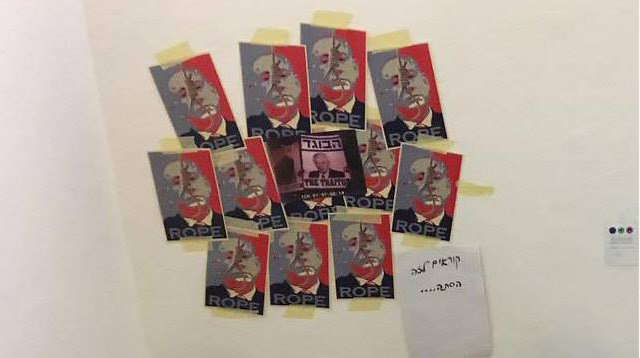
Both the paper and the student, whose name is left out, get hung up on the fact that the investigation was ordered by Attorney General Avichai Mandelblit. “She feels like if he hadn’t ordered it the police to do it, it would have over with already,” her lawyer is quoted saying.
Not surprisingly, the paper’s lead editorial also takes aim at Mandelblit, whom they accuse of helping politicians squelch free speech along with the five-oh.
“The need to reduce as much as possible the turning of free expression into a criminal offense stems from the futility of trying to prosecute such cases, as well as the chilling effect caused by opening criminal probes into the degree of freedom needed to maintain an open dialogue,” the editorial reads. “But nowadays the desire of government officials to silence people and undermine the freedom to protest has the cooperation of law enforcement. The trend of prosecuting for offenses like incitement to racism and violence, which began during Operation Protective Edge against Arabs who wrote things on social networks, is now being used as a political weapon against those who dare criticize the regime.”




The Times of Israel Community.