

Hungary’s Jobbik seeks to shun racist image ahead of poll
Far-right party known for anti-Semitic and anti-Roma rhetoric pushing to capture centrist vote in upcoming election
 Add ToI as a Preferred Source on Google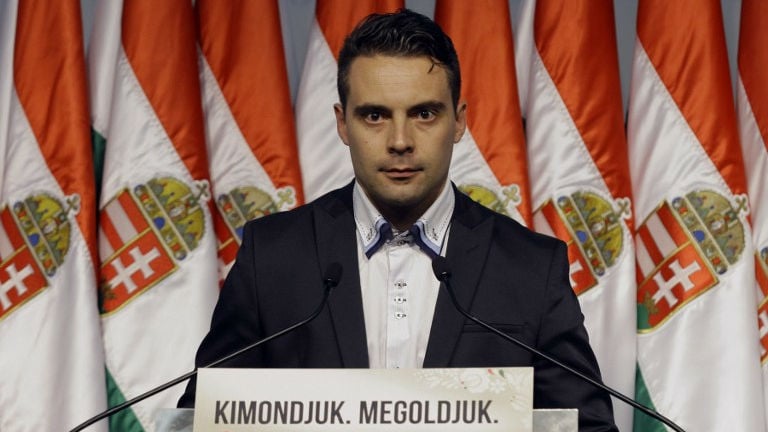
AJKA, Hungary — Once considered a far-right fringe party, Hungary’s Jobbik is seeking to clean up its racist image and move towards the center in an effort to challenge Prime Minister Viktor Orban’s ruling Fidesz.
Already the second largest party in Hungary, Jobbik wants to prove at a by-election on Sunday that with a weak and divided left wing, it represents the only viable alternative to Orban’s rule.
Jobbik’s leader Gabor Vona, 36, who once founded a paramilitary group that preyed on the Roma minority, is toning down the party’s rhetoric which stigmatized Roma as criminals.
Earlier this year, Vona distanced himself from a Jobbik member who called for the murder of Roma and ordered another Jobbik member to take flowers to a Holocaust Memorial in Budapest that the man had spat on.
“It is a campaign tactic in style aimed at voters who would like to see Jobbik leaning towards the center with a more conciliatory tone,” Attila Juhasz, analyst with Political Capital Institute, told AFP.
“Their remake does not concern the substance of their politics,” he added.
The tactic is working as Jobbik is closing in on Orban’s right-wing Fidesz, whose support has plunged in recent months.
Last month an Ipsos poll showed Fidesz at 21 percent and Jobbik at 18 percent. Only around 200,000 people separated the two, in a country of 10 million.
In a worry sign for Orban, Jobbik is already the most popular party among voters under 30.
At a town hall meeting on Thursday evening with local supporters in a small town where the by-election will take place on Sunday, Vona told AFP that allegations of racism against Jobbik were not true.
“One and a half a million people trust Jobbik, can you imagine that there are one and a half million racists in Hungary?” Vona told AFP.
He added: “The voters confirm that they see Jobbik’s effort to become a people’s party as genuine.”
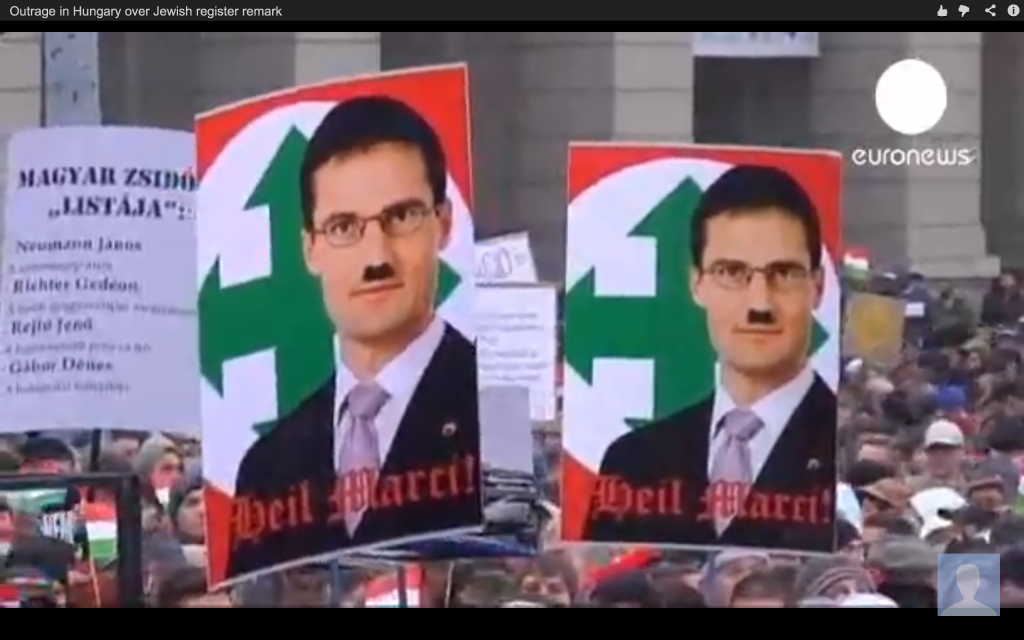
Yet not everyone is convinced — someone painted a Hitler-like mustache on the poster of the local Jobbik candidate.
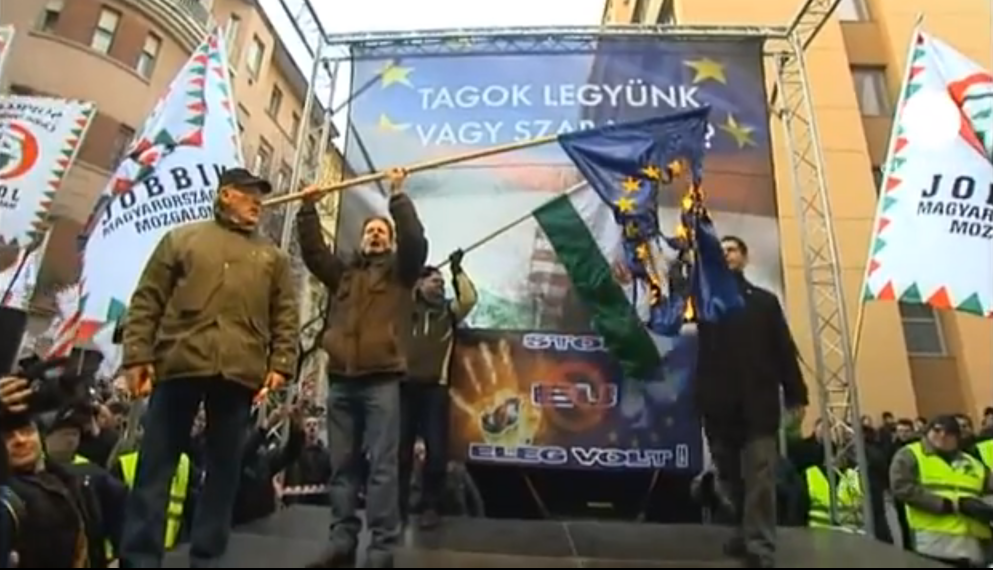
The party’s program still talks about a “Zionist Israel wanting to rule the world” and accused the European Union of having “colonial policies”.
But there was no talk of Israel or Roma at the town hall meeting.
Indeed, the main concern of locals was jobs.
Jobbik is tapping into a sense of disillusionment with the last 25 years since the fall of communism and anger against a political elite perceived as hopelessly corrupt.
Polls suggest the race for Sunday’s by-election is tied between Fidesz, Jobbik and the left-wing candidate.
Vona told the 100 supporters at the meeting that a victory on Sunday in Tapolca would make Jobbik the main challenger to Fidesz in the 2018 general election.
But that looks likely to happen anyway, as Jobbik is picking up voters who are turning away from Fidesz.
A recent Median poll suggested that a fifth of Jobbik supporters claim they voted for Fidesz in last year’s election.
Orban’s Fidesz has ruled out working with Jobbik.
But as Juhasz noted, the government has been borrowing ideas from Jobbik from the public work program to the “eastern opening”, a policy to open up markets in Asia.
“As we have seen from Western European examples, it is counter-productive in the long run when a large right-wing party tries to take the wind out of an extremist party’s sails, because it legitimizes the politics of the extremist party and makes it impossible to sideline it,” Juhasz told AFP.








The Times of Israel Community.