

In hindsight, Jeb Bush says, he wouldn’t have invaded Iraq
As he struggles in the shadows of his ex-president father and brother, likely 2016 contender tries to walk a fine line
 Add ToI as a Preferred Source on Google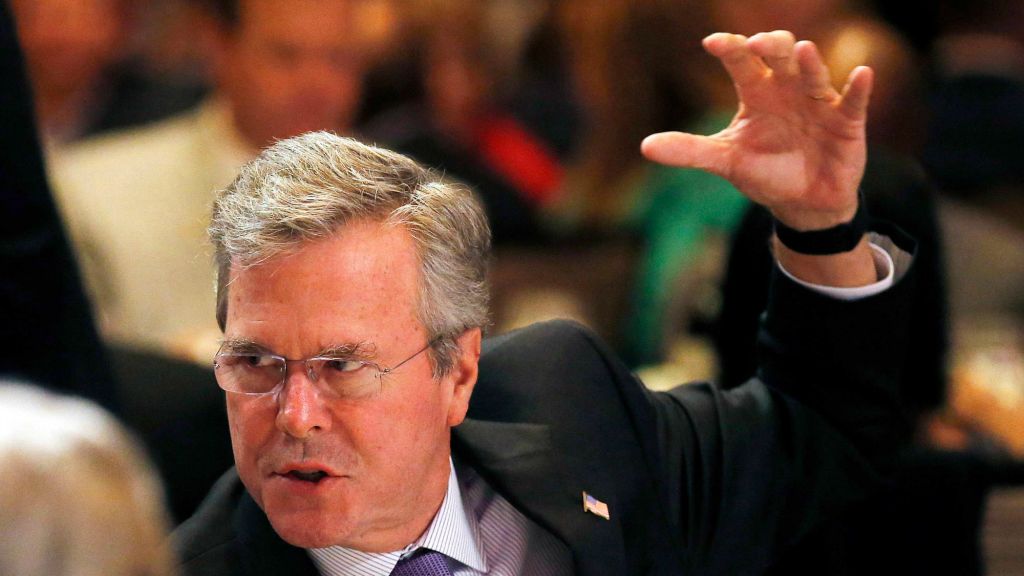
TEMPE, Arizona (AP) — After days of refusing to say whether, with the benefit of hindsight, he would have ordered the invasion of Iraq in 2003, Jeb Bush relented Thursday and said he would not have invaded.
“If we’re all supposed to answer hypothetical questions, knowing what we know now, what would you have done?” Bush said with a twinge of annoyance while campaigning in Arizona. “I would have not engaged. I would not have gone into Iraq.”
It was an answer the former Florida governor and likely Republican candidate for president had refused to give in several public appearances this week, even as most of his GOP rivals did so and criticized him for sidestepping the question.
Bush said Thursday his resistance was caused both by loyalty to his older brother, George W. Bush, who ordered the invasion as president, and to the families of those lost in the decade-long war.
“I’m not going to go out of my way to say that my brother did this wrong or my dad did this wrong,” Bush said later Thursday in a speech to the Republican National Committee’s spring meeting in Phoenix. “It’s just not going to happen. I have a hard time with that. I love my family a lot.”
That loyalty could cast a shadow over Bush’s all-but-certain presidential bid, where his family name is both his strongest political asset and liability. He would become the third member of his family to serve as president should he follow his father and brother to the White House.
The Iraq war is among the most defining aspects of George W. Bush’s presidency. More than 4,400 US service personnel died, with many more severely wounded, in a war that cost at least $1.7 trillion and was justified by faulty intelligence that Iraq possessed weapons of mass destruction. None were ever found.
The upcoming presidential contest will likely yield other moments when Bush is asked uncomfortable questions about his brother’s time in office. Among them: the No Child Left Behind education law and the federal government’s response to Hurricane Katrina.
Bush said he had not spoken to his brother before talking about Iraq on Thursday, but said the US needs “to re-engage (in Iraq), and do it in a more forceful way.” Bush and other Republicans in the presidential mix often argue that President Barack Obama erred by so completely withdrawing US forces from Iraq in 2011.
Obama has sent 4,200 military trainers and advisers back into the country to help the Iraqi military fight the Islamic State terror group, and the next president is sure to face ongoing issues of stability there and elsewhere in the Middle East.
“We can’t do this by remote control,” Bush said.
As Bush struggled this week to address the issue, several Republican presidential prospects said definitively they would not have invaded Iraq based on information known today.
They include Kentucky Sen. Rand Paul, Texas Sen. Ted Cruz, New Jersey Gov. Chris Christie, former technology executive Carly Fiorina, Ohio Gov. John Kasich and 2012 presidential candidate Rick Santorum.
“I don’t know how that was a hard question,” Santorum said shortly after addressing the Republican National Committee’s spring meeting in Phoenix.
Fiorina agreed.
“The intelligence was clearly wrong. What we know now about the intelligence, no, I would not have authorized the war in Iraq,” the former Hewlett-Packard CEO said after her speech to the RNC the night before. “We mismanaged going in and mismanaged going out.”
Democrats, meanwhile, suggested Bush on Thursday was trying to mask his support for the war and distance himself from his brother, the former president.
“It’s like a sequel to a terrible movie, only worse,” Arizona Democratic Chairwoman Alexis Tameron said during a conference call. “Most Americans agree the Iraq misadventure was one of the worst foreign policy mistakes of the new century.”
A September 2014 AP-GfK poll found that 71 percent of Americans said they think history will judge the war as a failure. Among Republicans, that assessment was even more prevalent, with 76 percent saying the war would be seen a failure.
Copyright 2015 The Associated Press.




The Times of Israel Community.