

New Passover haggadahs tell stories of Canadian, Australian Jewry
Works extend recent ‘national’ trend popularized by New American Haggadah
 Add ToI as a Preferred Source on Google
Renee Ghert-Zand is the health reporter and a feature writer for The Times of Israel.
Back in 2012, the “New American Haggadah” was published to great fanfare. Acclaimed young Jewish American writer Jonathan Safran Foer edited it, and his friend Nathan Englander, also a leading young Jewish American author, provided the translation of the traditional Hebrew text. Its commentaries were contributed by other well known Jewish American writers, such as The Atlantic’s Jeffrey Goldberg and Daniel Handler, also known as by his pen name, Lemony Snicket, under which he wrote several successful children’s book series.
In the book’s introduction, its creators wrote, “It is called New American Haggadah not because there is anything uniquely American about it, but in the tradition of naming a Haggadah after where it was made.”
Its authors may claim there is nothing uniquely American about it, but there is no escaping its obviously early 21st century American sensibilities. It is clear that the haggadah’s title is meant to reflect the time and place in which it was created.
Now, in a similar vein, two new “national” haggadahs have been published this year—one in Canada, and the other in Australia. While Foer and Englander may have said they saw nothing particularly American about their haggadah, the creators of the “Canadian Haggadah” and “The New Australian Haggadah” proudly admit to having deliberately set out to represent the uniqueness of their Jewish communities.
A modern trend
“These national haggadahs are a modern trend. In the past, Jewish communities did not think they were representing themselves through their haggadahs,” said Shalom Sabar, a Hebrew University professor of history of art and Jewish folklore and expert on historical haggadahs.
“They weren’t doing an ‘Italian haggadah’ in Venice, and the Sarajevo Haggadah was not originally the Sarajevo haggadah,” he said.
According to Sabar, it is only in retrospect that haggadahs, which traditionally aimed to tell the overall story of the Jewish people before and during the Exodus from Egypt, came to represent the Jewish communities in which they were produced or with which they were historically associated.
“The texts and illustrations merely reflected the reality around them at the time they were written,” he said.
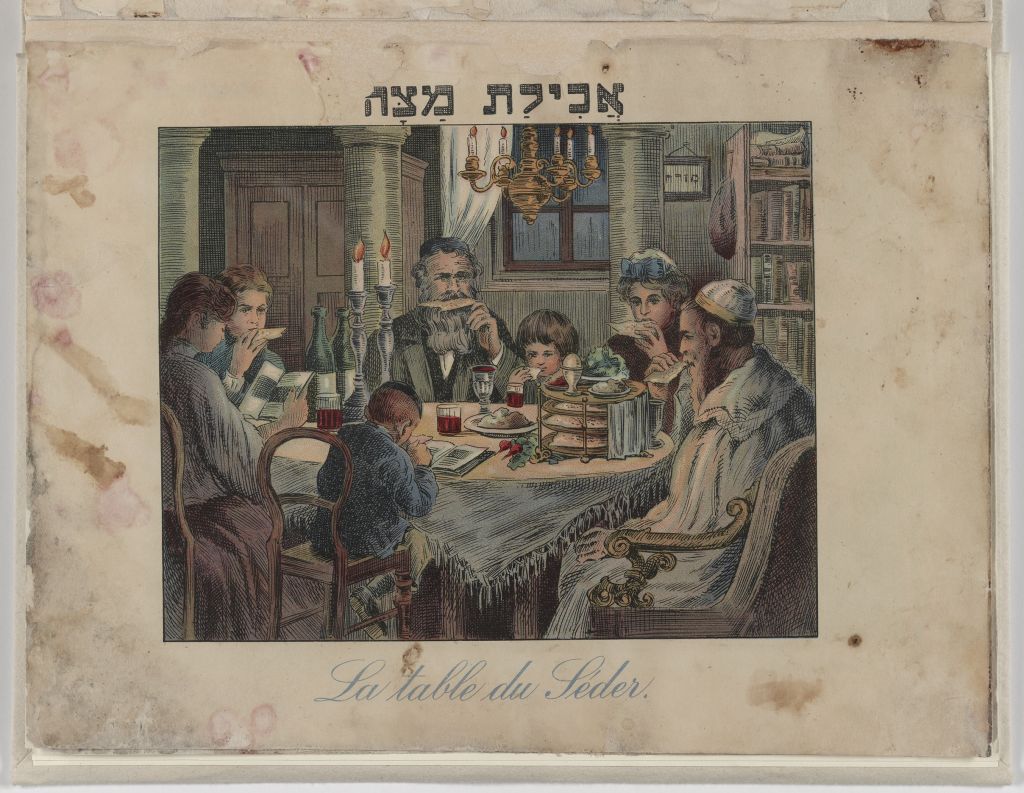
For instance, we can see that images of Jerusalem and the Holy Temple were meant to convey an ideal Jerusalem at the End of Days. In Medieval Germany, this concept was conveyed by an illustration of a tzadik (a righteous, spiritual man) in heaven pulling people upward. In Italian haggadahs, Jerusalem was depicted as an ideal Renaissance town. Later, Zionist haggadahs showed pictures of halutzim (Jewish pioneers) working the Land of Israel.
Sabar pointed to other examples, such as Abraham crossing the Jordan river in a gondola in the Venice Haggadah, as well as many historical haggadahs depicting the Wicked Son as a gentile soldier (and specifically as a Nazi official in the case of the Szyk Haggadah, illustrated in Poland in the 1930’s).
What’s different now is that Jewish communities are now intentionally presenting themselves to the world through their haggadahs. Sabar reads this trend as an attempt by contemporary Jews to look for their roots and define their identity.
“People are proud of their heritage today. The Canadian Jews love life in Canada and are proud of their Judaism. They have chosen not to go to make aliyah to Israel, and they want to tell the story of their life and community in Canada,” Sabar said.
“In the past, Jews didn’t have choices like they have today about where and how they will live as Jews.”
‘Canadian Haggadah’
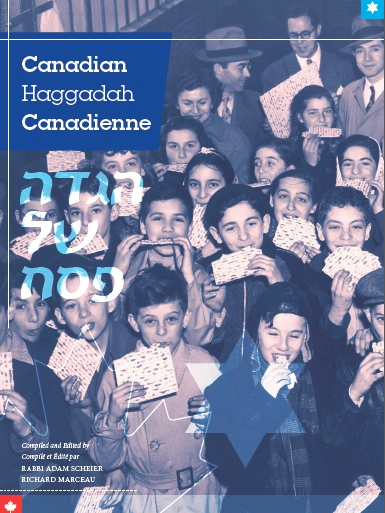
“Canadian Haggadah” co-compilers and editors Rabbi Adam Scheier and Richard Marceau both came to the realization around five years ago that a trilingual haggadah (in Hebrew, English and French) could prevent many Canadian Jewish families from having to juggle between several different haggadahs to accommodate the various linguistic needs of seder guests.
“We both had the same idea and wanted to work together on a trilingual haggadah, but we didn’t initially know what the scope of the project would be,” said Scheier, rabbi at Montreal’s historic Orthodox Congregation Shaar Hashomayim.
Scheier and Marceau, general counsel and senior government adviser for the Centre for Israel and Jewish Affairs in Ottawa, eventually produced a 168-page haggadah with the help of a team of advisers, designers and archivists. They used the traditional Hebrew text and adapted the English text from the “A Different Night” haggadah by Noam Zion; Marceau provided an original French translation.
Its first run of 2000 copies has sold out, and another printing is underway in anticipation of further sales before Passover begins on April 3.
“It’s generated a lot of excitement,” said Scheier, a relatively recent American transplant. “Once we put it out there, people found themselves and their stories in it.”
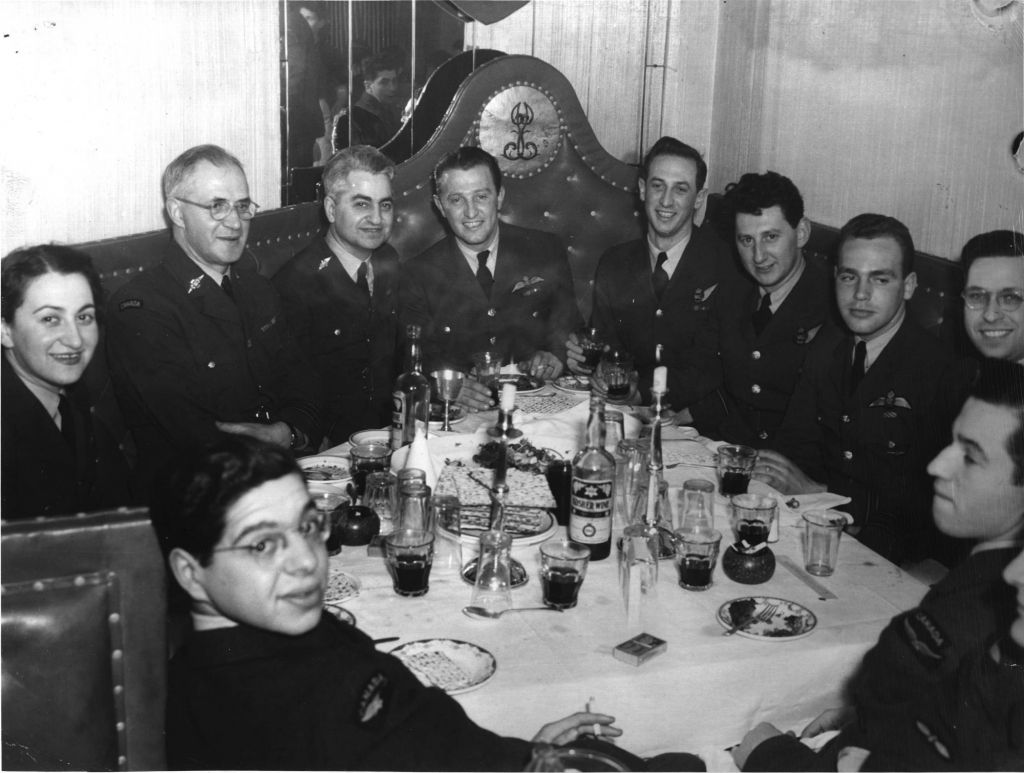
Marceau, who was born and raised in Quebec City, views the haggadah as having a uniquely Canadian character that arises from its many historical photographs, and also from the commentaries by Jewish clergy and academics not only from across Canada, but also from across the denominational spectrum.
“The Exodus is the same around the world. Chicken is chicken. It depends on the flavor you give it. We’re giving a Canadian flavor to a universal story,” said Marceau.

The Canadian Jewish community is the world’s fourth-largest after Israel, the US and France, yet its rich and complex history is relatively unknown.
“Canadian Jewish history goes back more than a quarter millennium. Lower Canada [now Quebec] gave Jews full rights in 1832—a full 26 years before they were given such rights by England,” said Marceau.
Scheier believes the haggadah reflects the diversity of Jewish immigrants to Canada, and also highlights the fact that the Jewish community in Canada includes French-speaking Jews from Arab lands as well as English-speaking Ashkenazi Jews.
“Our community is also very outspoken, and not as polite as the Canadian stereotype would have people believe. You can see this from our history of protesting on behalf of Soviet Jewry and other Jewish communities in danger, as well as our staunch Zionism,” said Scheier.
Other haggadahs have been published in Canada over the years, but none was meant to represent Canadian Jewry as this one does.
“To have something like this that is typically Jewish Canadian can be a community-building tool,” said Marceau.
‘The New Australian Haggadah’
“The New Australian Haggadah” was recently published by Stand Up, a Melbourne-based Australian Jewish social justice organization that has been existence for 20 years (and was formerly known as Jewish Aid Australia).
The sole Australian Jewish organization with a universal focus and mission, it deals with issues such as refugees, poverty, homelessness, and aboriginal rights through educational programming and advocacy activities. It aims to strengthen social justice through Judaism, and vice versa.
“In late 2012 we started thinking about how Pesach [Passover] relates to the themes and subjects Stand Up works with,” said Joel Lazar, a law student, who serves as the organization’s educational coordinator and edited the haggadah.
Initially, Lazar and the handful of others who worked on the project thought about producing only a haggadah insert, but eventually they decided that an entire haggadah was warranted.
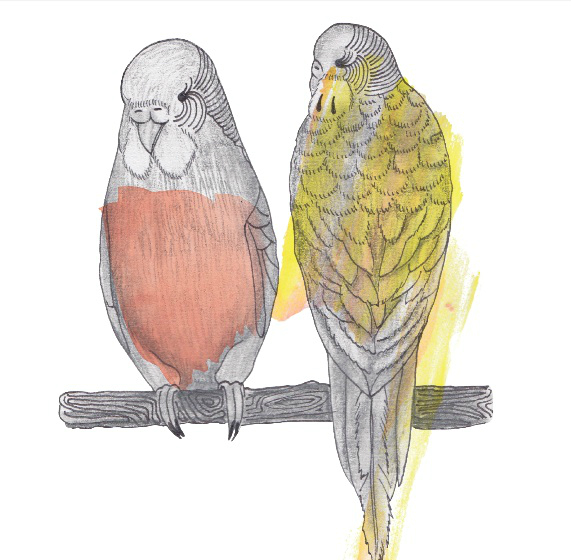
They wanted the book’s design and artwork to differ from the famous and admired “The Australian Haggadah” by Jewish Australian artist Victor Majzner. That haggadah, published in 1992, bursts with vibrant color, both in terms of illustrations and text. In contrast, Lazar charged artist Talia Lipshut with creating minimalist illustrations that reflected the blue, brown and green hues of the natural Australian landscape and included images of native Australian flora and fauna.
Just as Scheier and Marceau believe their haggadah is uniquely Canadian in that it includes commentaries from Jewish leaders from all over Canada, Lazar contends that “The New Australian Hagaddah” is unmistakably Australian based on the commentaries it offers from Jews of a range of ages and backgrounds living in various Jewish communities Down Under.
“It’s a snapshot of a time and place,” said Lazar, referring to the commentaries, some of which deal directly with contemporary Australian topics such as feminism, asylum seekers, the fight for indigenous rights, and Australia’s large Holocaust survivor population.
“The Holocaust is impossible to ignore. It permeates the discourse of Australian Jews,” said Lazar. “There is also a huge Zionist and Israel focus in our community.”
The haggadah employs the traditional Hebrew text and Nathan Englander’s English translation from “The New American Haggadah,” which Lazar admired for its poeticism, gender neutrality, and balance between the mystical and the modern.
“We received no responses to requests to use Englander’s texts, but our legal counsel said it was okay to use it as long as we attributed it to Englander and made some changes,” said Lazar.
The commentators, be they rabbis, activists, Holocaust survivors or school children, are initially identified only by their names. One has to flip to a section at the end of the haggadah that provides short biographies of the commentators to find out more about them.
“We decided to just print the names—without titles or positions—next to the commentaries so that everyone would be on equal footing,” said Lazar. “It’s part of our ethic of egalitarianism.”






The Times of Israel Community.