

Obama warns of military showdown if Iran talks fail
US president urges Congress not to jeopardize diplomatic efforts, vowing to veto additional sanctions
 Add ToI as a Preferred Source on Google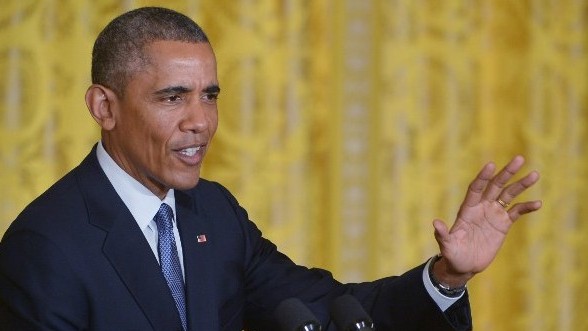
WASHINGTON (AP) — President Barack Obama came out swinging Friday against congressional attempts to slap fresh sanctions on Iran, warning such a move would likely destroy nuclear talks and increase prospects for a military showdown. Vowing to veto any sanctions that reach his desk, Obama pleaded, “Just hold your fire.”
In an unusual move by a foreign leader, British Prime Minister David Cameron said he was personally calling US senators to say that new sanctions would drive a wedge through international unity.
Standing side by side with Cameron at the White House, Obama said world powers would be sympathetic to Iran and would blame the US if Congress moved ahead with more sanctions while fragile negotiations are under way. At that point, Obama argued, the world would lose its best chance to prevent Iran from obtaining a nuclear weapon.
“Congress should be aware that if this diplomatic solution fails, then the risks and likelihood that this ends up being at some point a military confrontation is heightened — and Congress will have to own that as well,” Obama said in his most impassioned rebuke yet of the sanctions effort.
Clinching a nuclear deal would be a major foreign policy victory for Obama, who for years has fended off accusations of naiveté in engaging diplomatically with countries like Iran. Obama said prospects for a deal are still 50-50 at best, insisting he wouldn’t agree to any deal that fails to ensure that world powers can verify Iran’s actions or to protect Israel’s security.
Iran maintains that its program is solely for energy production and medical research purposes. Under the interim deal, Tehran agreed to some restrictions to its program in exchange for billions of dollars in relief from US economic sanctions.
The US, Britain and other world powers are struggling to reach a framework accord with Iran by March, with hopes of finalizing a longer-term deal by July that would limit Iran’s ability to produce a nuclear weapon. Secretary of State John Kerry has spent much of the week holed up in European hotels with his Iranian counterpart, Foreign Minister Mohammed Javad Zarif, as both countries seek to infuse the talks with fresh urgency.
But in Washington, many lawmakers are so skeptical of the negotiations that they have insisted the US move forward with additional sanctions to keep tightening the screws on Tehran.
A tense exchange between Obama and a top Democrat this week illustrated the degree to which Obama’s diplomacy with Iran has rattled even members of his own party.
At a closed-door strategy meeting with Senate Democrats, Obama and Sen. Bob Menendez, a Democrat, traded arguments about whether fresh penalties would undermine or bolster the negotiations. It was then that Obama renewed his longstanding vow to veto sanctions legislation passed by Congress while talks are still ongoing.
“We just have a fundamental disagreement,” Menendez told reporters Friday in New Jersey. “It is counterintuitive to understand that somehow Iran will walk away because of some sanctions that would never take place if they strike a deal.”
Menendez, who until recently chaired the Senate Foreign Relations Committee, has been working across partisan lines with Sen. Mark Kirk, a Republican on new sanctions on Iran’s economy that would kick in only if Iran fails to sign or live up to a nuclear deal in time.
Yet Obama argued that Iran would rightfully interpret any new sanctions — even ones that don’t kick in right away — as violating the terms of the interim deal reached in 2013 that made the current talks possible. He said the likelihood that Iran would pull out of the talks was “very high.”
“They would be able to maintain that the reason that they ended negotiations was because the United States was operating in bad faith and blew up the deal,” Obama said. “And there would be some sympathy to that view around the world.”
Cameron, who was holding two days of meetings with Obama, took the rare step of calling another nation’s lawmakers to lobby them against proceeding with more penalties. Cameron said his calls Friday to US senators were intended not to tell them what to do, but to convey that sanctions have already had their desired effect.
“We remain absolutely committed to ensuring that Iran cannot develop a nuclear weapon,” Cameron said.
“The best way to achieve that now is to create the space for negotiations to succeed. We should not impose further sanctions now.”
The US, UK, Russia, China, France and Germany are part of the P5+1 diplomatic council meant to negotiate a comprehensive solution to Iran’s nuclear program.
The Iranians, who insist they are enriching uranium to develop a peaceful, civilian nuclear program, will continue discussions throughout 2015 in an effort to reach an accord by the July 1 deadline.
Jerusalem has expressed a great deal of doubt over Iran’s intentions and actively maintains the position that Tehran is seeking a nuclear weapon.
Justin Jalil contributed to this report.


The Times of Israel Community.