

All-out strike looms as treasury, unions battle over civil service pay
Widespread work stoppage at schools, public transport, hospitals, and government offices poised to paralyze country Wednesday
 Add ToI as a Preferred Source on Google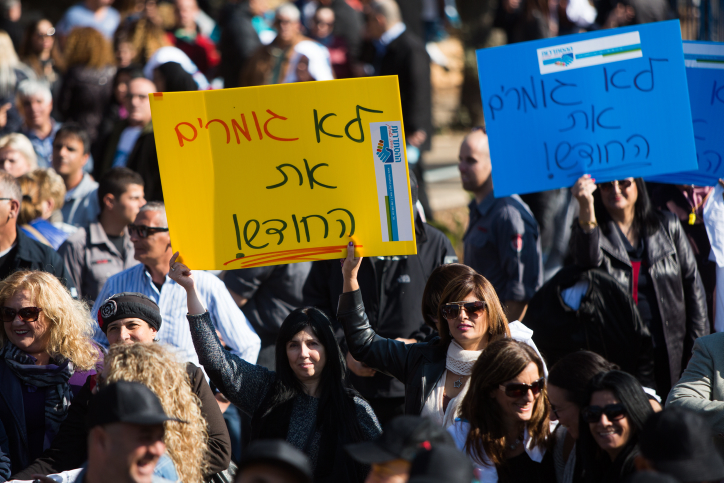
The government and the Histadrut labor federation struggled to reach a deal on public sector salaries Tuesday evening, with less than 12 hours to go until the start of a threatened general strike that would paralyze most services throughout Israel.
The Histadrut is threatening a strike that will close all schools and government offices, hit air, rail and bus transport, and put hospitals and clinics on a skeleton staff.
The government petitioned the labor court to stop teachers taking part in the stoppage saying previous accords signed with them preventing them from striking, Ynet reported.
The government improved Monday’s offer of a 5.5-6.5 percent raise to an offer of 7.5% over five years, Channel 2 reported, but this was still far from the union’s demand for an 11% raise.
The teachers’ unions have said that they would join the strike, but the government claims they are prohibited from doing so by previous agreements, Army Radio reported Tuesday.
Clause 57 of a collective wage agreement signed with the Secondary School Teachers Associaion in August 2011 specifically bans strike action.
Israeli airlines El Al and Arkia have changed their flight line-ups for Wednesday, scheduling more than 20 flights to take off before 6 a.m. when the anticipated strike will officially begin.
All passengers with flights scheduled for Wednesday were asked by the company to arrive at the airport at least three hours before the new departure times.
The company says the schedule update will now remain in effect even if the strike is averted at the last minute.
Army Radio reported Tuesday that the Magen David Adom ambulance service would join the work stoppage and operate a minimal service only. The head of the Health Ministry’s labor organization emphasized that vaccinations, medical committees, services for the handicapped and services connected to rabies would operate as normal, and that life-saving medicines would be available as usual, Maariv reported.
Finance Minister Moshe Kahlon warned Monday that a general strike would cost Israel’s economy NIS 600 million ($154 million) per day.
“A strike declaration at the climax of negotiations is completely unnecessary and will harm the general public,” Kahlon told Channel 2. “There’s no reason or need to punish the citizens of Israel.”
The Finance Ministry is opposed to a blanket raise, and wants an agreement based on shekels — rather than on percentages — to ensure that poorer earners get bigger raises to help close socio-economic gaps.
The agreement under negotiation will cover the period 2013-2018. It will be paid retroactively to the day on which the agreement takes effect, and will include a one-time compensation payment for the delay in reaching a deal.
The last wage agreement, sealed in November 2010, provided for a 6.25% increase over three and a half years, plus a one-off sum of NIS 2,000 for each worker.
“We are at a one-time window of opportunity to narrow social gaps,” Kahlon said, “and therefore we insist that the pay increases get to those who really need them, not as happened in previous years. We insist that people earning the lower salaries get more. Anything else will lead to widening of social gaps. There is no point in the wage raises going again to high earners, and we’re sure that in the Histadrut they understand this too.”
Channel 2 said Monday the government was already prepared to submit a court injunction against any strike.
Histadrut Chairman Avi Nissenkorn said Monday the labor federation would “not lend its hand to the effort to separate one group of workers from another. The strike isn’t the end, but the means to give a voice to approximately one million wage earners who don’t [have enough money to] get through the month. The state has to look after the weak and the middle classes.”










The Times of Israel Community.