

Despite defeat, it’s calm on the couch with Psycho in Caesarea
England’s no-nonsense Under-21 soccer coach Stuart Pearce keeps the press onside, the day after his team lost 1-0 to Italy

 Add ToI as a Preferred Source on Google
David Horovitz is the founding editor of The Times of Israel. He is the author of "Still Life with Bombers" (2004) and "A Little Too Close to God" (2000), and co-author of "Shalom Friend: The Life and Legacy of Yitzhak Rabin" (1996). He previously edited The Jerusalem Post (2004-2011) and The Jerusalem Report (1998-2004).
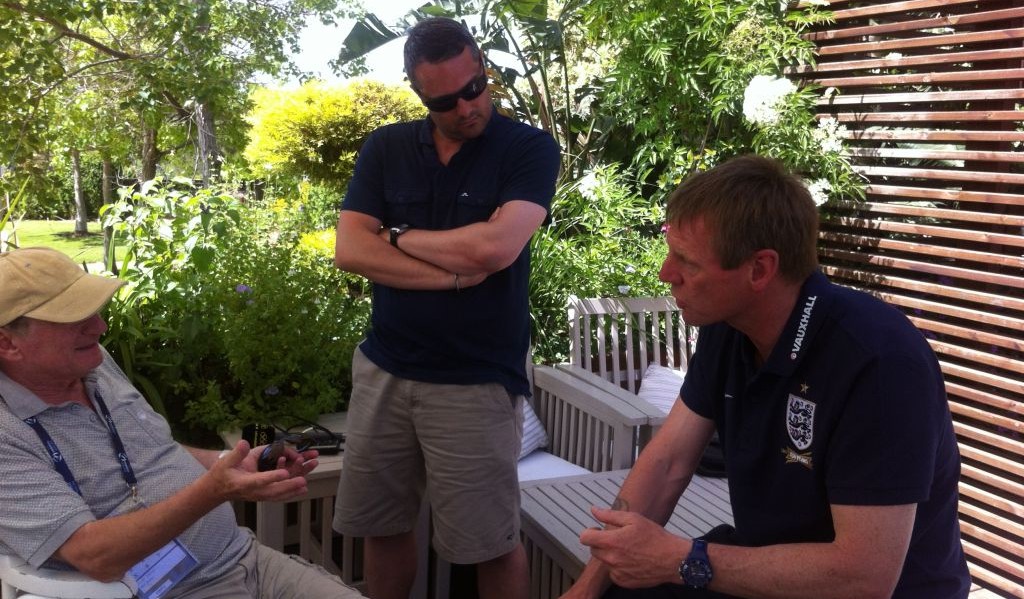
Seven years ago, when Stuart Pearce was coaching top English Premiership side Manchester City, his 7-year-old daughter assured him that her cuddly toy horse could serve as his lucky mascot if he kept the toy with him on the touchline during a game against West Ham United.
Pearce, a hard-tackling defender whose grit and determination had earned him the nickname “Psycho” before he switched from playing to management, attracted quite some derision as he placed the small horse — variously named in the press as Beanie, Beenie, and Beany — alongside him on the grass for the duration of the game. But he had the last laugh: Manchester City won.
“Before the match,” he subsequently explained to the BBC, “my daughter said: ‘Beenie the horse wants to sit next to you by the drinks holder on the touchline.’ It is difficult to tell a 7-year-old: ‘This is the Premiership, I’m known as Psycho, and I’m a hard man.'”
It is difficult, too, not to warm to a soccer tough guy who is plainly a big softie at heart, at least where his family is concerned. And the English soccer writers who have accompanied Pearce to Israel this week with the England Under-21 side he now coaches have plainly warmed to him too over the years.
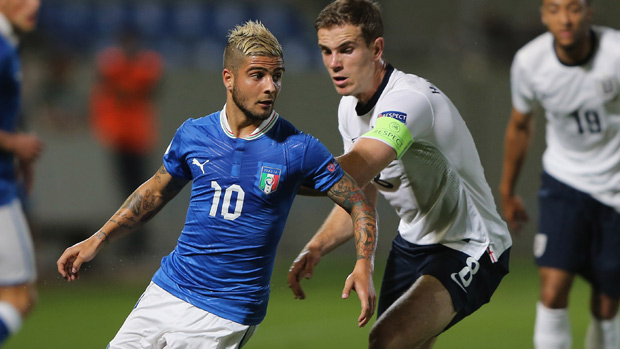
His England youngsters played remarkably poorly in their opening game of the UEFA European Championship in Netanya on Wednesday, going down by 1-0 against Italy. Watching back in England, former England national team coach Glen Hoddle, once a silkily skilled midfield player who went on to a rather unsuccessful career in management, savaged Pearce’s approach. Hoddle criticized what he termed the team’s “long ball” game — hitting crude passes in the improbable hope of finding a forward in a good position to score, rather than building up, slowly and patiently, from the back. “I think it is very disappointing the way we played,” declared Hoddle. Another ex-England manager, Steve McClaren, weighed in too: “England looked very nervous and the inexperience showed.”
But the dozen or so reporters who surrounded Pearce on Thursday afternoon, as he chatted with them in a circle of sofas and chairs at the club house of the Caesarea Golf Course, were notably not giving Pearce the nasty treatment. The English press can be far more vicious than jealous ex-managers, and have hounded many top coaches out of their jobs, but if anything it was Pearce himself, rather than the reporters, doing most of the complaining in the sunny tranquility of Caesarea.
The defeat to Italy means England will probably have to win their two remaining group games, against Norway and Israel, if they are to progress to the championship’s semi-finals. But the press pack barely questioned Pearce’s tactics or his team selection, and mused rather than interrogated as to whether England were good enough to compete on the international stage against some of the world’s top soccer-playing nations. No voices were raised. Nobody asked Pearce, who has said he’d like to stay on in the job when he comes up for review after this tournament, whether he was contemplating resignation — a de rigueur question for English soccer managers after high-profile defeat.
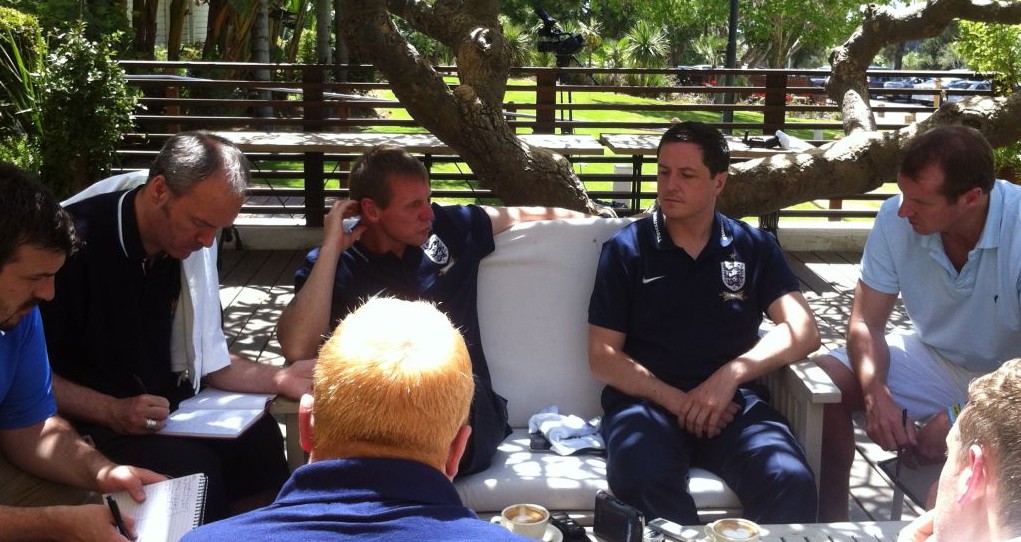
As an ex-defender, perhaps it was no surprise to hear Pearce getting his defense in first. In the space of barely half an hour, he acknowledged perhaps a dozen times that his team had disappointed in the Netanya stadium, admitting variously that “we didn’t play well yesterday,” that the performance was “poor” and that “we played very badly apart from the odd spell.” He complained that his young charges “conceded the ball far too readily to the opposition,” said “too many of our players didn’t perform,” and summed up with “we played pretty awfully… I don’t think we’ll play that badly again.”
He said all this calmly and in the softest of voices, taking intermittent sips on his cappuccino as he did so. In answer to questions from The Times of Israel, kindly invited to an otherwise thoroughly English soccer gathering, Pearce also proved gracious and diplomatic. He said Israel could prove a strong opponent, given its home advantage, and noted that his team played Israel in a recent friendly match — but didn’t stress that England thrashed Israel 4-1 in that September 2011 game. He said pre-tournament boycott pressure from pro-Palestinian groups had made no impression — “We are football people, not politicians.” And he praised the tournament’s Israeli organizers, said the hotel and training facilities were excellent, and only wished we could somehow keep the traffic off the roads. Pearce said he’d been to Israel two or three times before, and toured around, including in Jerusalem, though there’d be no time for sightseeing this time.
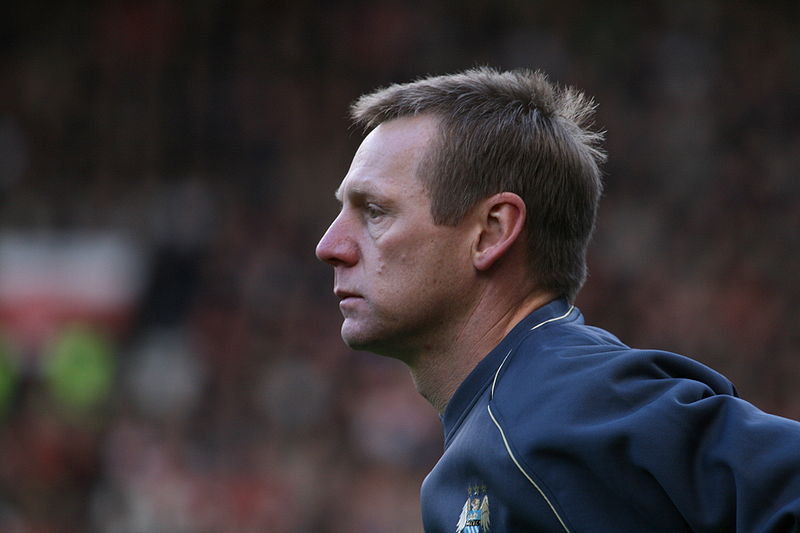
Pearce the soccer manager in repose is a far cry from Pearce the unflinching pro — who made almost 750 professional appearances at club level, and played 78 times for the England national team — and distinctly at odds too with Pearce the exuberant punk rock fan, not to mention Pearce the brother of a far-right political activist.
But his ease with the press, his evident smarts, and his candor would not be enough to keep the journalists on his side after defeat. Two of the traveling reporters explained, rather, that Pearce came into this tournament on the back of nine straight victories dating back to February of last year, that he has led the England youngsters into the last stages of four successive Under-21 championships, and that he was acutely hamstrung Wednesday by the absence of not one or two key players but, by the coach’s own reckoning, 17: thirteen who were not available for selection for the tournament, two who are suspended, and two who are injured.
Speaking after Pearce had gone, Peter Lansley, the man from the Times, ran through a quick list of key stars who would certainly have boosted England’s prospects of victory, had they not been called up by the senior squad or kept home by their club sides — top players such as Phil Jones, Danny Welbeck, Alex Oxlade-Chamberlain, Jack Wilshire and Jack Rodwell.
Henry Winter of the Telegraph identified a deeper malaise, saying that soccer stars in England are so well-paid and so pampered from such a young age that they never learn to take responsibility off the field of play, or on it. When things go awry during a match, they just don’t have the commitment and tenacity to fight back, he suggested.
How poor is the nation that likes to think it taught the world to play Association Football, and certainly set up its rules? England is ranked seventh in the world today, said Winter, but that’s absurdly too high. “We’re just not good enough,” he said, rather sadly, complaining that the sport’s ruling body recently spent hundreds of millions “on a new stadium no one needed” but had to “look behind the couch” for the spare cash for a training center.
Pearce, with his determination and his controlled passion, is evidently perceived by those who write about him as part of a potential solution, not part of the problem. Unlike most pros, he actually began his career in a relatively minor, amateur side, while also training and working as an electrician and plumber. When the iconic manager Brian Clough brought him to Nottingham Forest, where Pearce first really made his mark as a player, Clough joked that now he’d have someone in the team who’d be useful if the floodlights broke. Clearly, he’s someone who didn’t have it all too easy, too young.
If they win their two remaining matches, Pearce and his players will still qualify for the semi-final stage of this championship, and the traveling press hasn’t given up on him. But for the Norway game on Saturday, and what could then be the crunch game against Israel on Tuesday, it might be time to bring back that cuddly horse.









The Times of Israel Community.