

Egypt political violence jumps the gun
Ahead of planned June 30 demonstrations, riots around Cairo already cause deaths; major clashes could prompt the army to end Islamist rule
 Add ToI as a Preferred Source on Google
Michael Bassin is a founding member of the Gulf-Israel Business Council, a co-founder at ScaleUpSales Ltd, and the author of "I Am Not a Spy: An American Jew Goes Deep In The Arab World & Israeli Army."
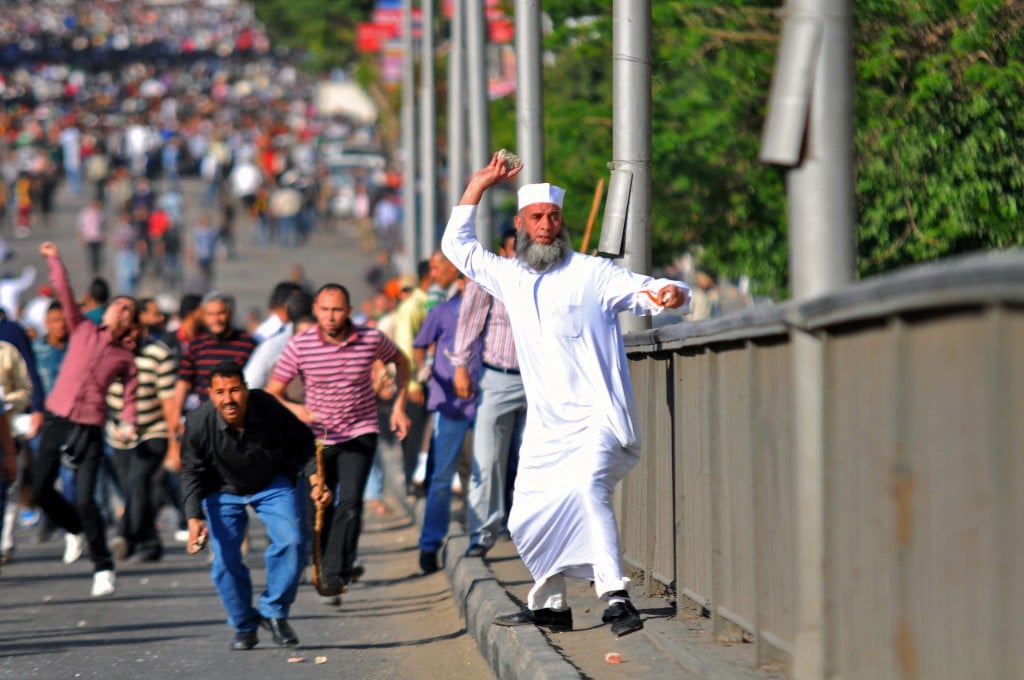
Egypt is plagued with severe tension as the first anniversary of Mohammed Morsi’s election as Egyptian president arrives on June 30. Calls by the emboldened Egyptian opposition for mass demonstrations if Morsi refuses to resign or call for new elections are sparking fears that a wave of politically motivated violence may be about to erupt, all Arab media outlets report.
However, the London-based pan-Arab daily Al-Hayat reports that pandemonium has already begun. In clashes that took place in Cairo suburbs Sunday night between supporters and opponents of Egypt’s Muslim Brotherhood, two supporters of the president were shot dead. Morsi quickly issued a statement calling the victims “martyrs” and condemned the “thugs that brought on their demise.”
Leaders of the opposition did not issue an official apology as it could not be proven it was supporters of their cause who committed the killings. This incident, though, is leading to wider fears of many more deaths when millions of Egyptians take to the streets on June 30. The opposition claims that 15 million signatures calling on Morsi to resign have already been collected, more than the 13 million votes he received when he was elected president in the first place.
The pressure on the Muslim Brotherhood’s Freedom and Justice Party, as well as other Salafi and Islamist political parties that are allied with it, is causing a backlash by their adherents against other Egyptian religious sects. According to the London-based Al-Quds Al-Arabi, Salafist activists attacked Shiite residents in a village near Giza, killing four and wounding five, including prominent Shiite leader Hassan Shehata.
Reportedly, assailants surrounded a house owned by Shehata, threatening to burn it down unless he and his adherents came outside. Sunni neighbors that were interviewed later stated that Shehata was targeted because of a speech he made on a satellite channel insulting Aisha, a wife of the Prophet Muhammad. Consequentially, they had a moral and religious obligation to kill him for blasphemy, residents said.
“Of course, the police arrived too late and did nothing,” said Baha Anwar Mohammad, a spokesman for the Shiite community in Egypt, which represents less than 1 percent of the total national population. “President Morsi makes Shiites a scapegoat in order to take the pressure off the Salafis.”
The anger against Morsi and the Muslim Brotherhood for the awful condition of Egypt is no longer being expressed only on the streets and the newspapers, but also in the halls of the legislature itself.
The Dubai-based media network Al-Arabiya reports that Abdul Rahman Haridi, a member of Egypt’s Current Party, a more liberal Islamist party that broke away from the Freedom and Justice Party after the Egyptian revolution, walked into a meeting on Sunday of the Shura Council, the upper house of the Egyptian legislature wearing a scarf with the words “A new president is wanted” written on it.
The heads of the Shura Council quickly expelled him from the meeting, calling his actions a “direct provocation and unconstitutional.”
“The continuation of Mohammed Morsi as president is unacceptable and the Muslim Brotherhood is nothing more than a fascist regime,” Haridi said after he left the meeting of Shura Council members.
All this governmental instability is sure placing a lot of worry on the minds of Egypt’s military leaders, who are threatening to directly intervene if a solution to the political crisis is not found. The Doha-based media network Al-Jazeera states that Defense Minister Abdul-Fattah al-Sisi is holding regular meetings with Morsi and emphasizing to him that the army will not stand by while Egypt falls into a dark tunnel of internal strife and a collapse of state institutions.
The Saudi-owned daily A-Sharq Al-Awsat features an analysis of the Egyptian political situation, unveiling the possibility that the military could take advantage of the instability and seize power. It is no secret that relations between Islamists and the military have been strained since the Islamists’ rise to prominence. If millions of people do show up to mass demonstrations next week, the military may see it as justification to end the Islamist honeymoon once and for all.
In an editorial published Monday morning called “The June 30th test,” A-Sharq Al-Awsat’s editorial board urges all Egyptian actors “not to ignore the importance of finding a political formula that satisfies large segments of the country, so as not to damage the building blocs of the state or lead to bloodshed.”
Unfortunately, nearly all Egyptian actors agree that this scenario is next to impossible.






The Times of Israel Community.