

For GOP underdogs, foreign policy offers new promise
With concerns about the Islamic State on the rise, frontrunners Trump and Carson struggle as Republican hawks try to surge
 Add ToI as a Preferred Source on Google
Rebecca Shimoni Stoil is the Times of Israel's Washington correspondent.
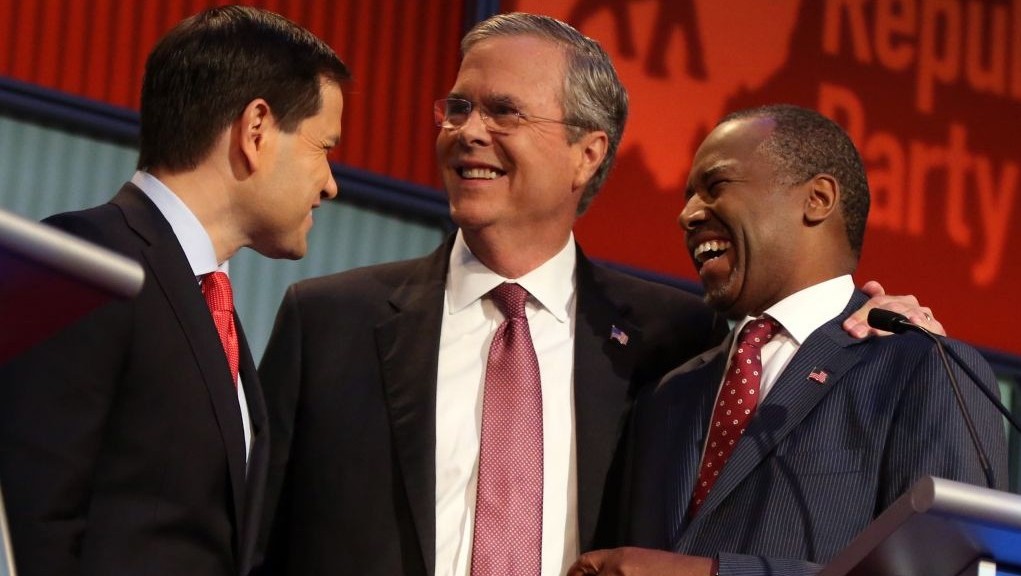
WASHINGTON – After two weeks in which jihadist terror attacks dominated US headlines, public focus on the spread of the Islamic State and the Syrian refugee crisis seems to be taking its toll on GOP “outsider” presidential candidates, while providing an opening for the party’s foreign policy hawks who had previously struggled in the polls.
The Sunday political talk shows – an institution of American punditry – played up candidates’ foreign policy positions, hosting foreign policy hawk and bottom-tier presidential candidate South Carolina Senator Lindsay Graham, while Ohio Governor John Kasich also hammered away at his opponents’ foreign policy positions.
In an effort to bolster a campaign that has faced increasing challenges in the past month, Dr. Ben Carson appeared on multiple shows, offering interviews from Jordan, where he was visiting Syrian refugee camps. Carson, who previously compared the refugees to rabid dogs, has faced criticism for his relative lack of foreign policy credentials.
Speaking on CNN’s “State of the Union”, the retired neurosurgeon said that his trip was “about fact-finding — about getting an opportunity to see firsthand without having things reinterpreted.”
Carson said that “there’s so many people who think the ideal for everybody is to come to America and be resettled here, but that is not the ideal for everybody.”
After visiting the Zaatari Refugee Camp, Carson told interviewers that “the thing that I really learned in listening to the refugees themselves is their intense desire is to return to their country and be repatriated.” The refugees, he said, told him that “their true desire is to be resettled in Syria” but that “they are satisfied to be in the refugee camps if the refugee camps are adequately funded.”
“Recognize that in these camps, they have schools, they have recreational facilities that are really quite nice. And there are all kind of things that make life more tolerable,” he added.
Following a run of high-profile terror attacks in November including the downing of a Russian airliner that killed 224, the coordinated attacks in Paris that killed 130 and the hostage crisis in a hotel in Mali, support for Carson, who has tended to struggle on questions of foreign policy faded in recent polls.
Earlier this week, Carson’s campaign released a campaign advertisement on the “war on ISIS” – in which he said that US leaders should consult experts and advisers to determine a better policy.
But speaking on CBS Sunday, Carson ducked questions on why he thought the US “was not winning,” advising instead that journalists talk to some of the “generals who retired early” to hear how they were being “micromanaged.”
Carson hit a high-water mark in the key early caucus state of Iowa in late October, when he led current front-runner Donald Trump by some 14 points. But after a number of questions were raised regarding Carson’s version of his personal history and the growing emphasis on foreign policy, Carson’s lead dissolved. While Trump recovered the front-runner status that he held prior to Carson’s peak, Texas Senator Ted Cruz, a strong foreign policy candidate, seems to have picked up Carson’s missing votes to edge into second place.
The latest poll in the bellwether state, which will hold its caucus on February 2nd, shows Trump retaining a narrow two-point lead over the ascendant Cruz.
In the only national poll conducted over the Thanksgiving holiday week, Trump also fell nationally following comments in which he claimed that he had witnessed US Muslims celebrating the 9/11 attacks and suggested that Muslims be entered into a government database.
The Reuters/Ipsos poll released Friday showed that Trump had suffered a 12-point drop in support among Republicans in a week-long period. In a poll released November 22, the real estate developer was the favorite of 43 percent of Republicans, but by the November 27 poll, he had plummeted to 31 percent.
With a field that appears to be the least stable for Republican candidates since Trump’s July entry into the race, candidates who were teetering on the brink of electoral extinction face a new window of opportunity.
The resurgence of the War on Terror benefitted New Jersey Governor Chris Christie, who is languishing in the low single-digits in national polling but received a key endorsement Saturday night from the influential New Hampshire Union Leader.
The paper’s publisher Joseph McQuaid declared that Christie “is right for these dangerous times,” because “he has prosecuted terrorists and dealt admirably with major disasters” as well as because “he tells it like it is and isn’t shy about it.”
Christie has emphasized that as US attorney for New Jersey, he pursued terror cases following the 9/11 attacks.
South Carolina Senator Lindsay Graham, a candidate who has long talked up his foreign policy know-how as part of a hawkish platform, appeared together with former GOP presidential candidate
Senator John McCain in a broadcast from the US Embassy in Baghdad Sunday to plug his own expertise fighting terror.
Advocating a coalition of ground forces that draws 10 percent of its force from western powers and 90 percent from Middle Eastern states’ armies, Graham said on CBS’s Face the Nation that “the region is ready to fight. The region hates ISIL.… The entire region wants Assad gone, so there’s an opportunity here with some American leadership to do two things — to destroy ISIL before we get hit at home and also to push Assad out.”
Graham warned that “if we don’t destroy ISIL in Syria, which is their headquarters, we’re going to get attacked at home.”
At the same time, the candidate, who polls with an average of 0.7 percent support among Republican voters, also warned about the need to counter Iranian influence in the region.
“I can’t overemphasize enough the influence of Iran,” Graham cautioned. “We have been here for a day-and-a-half. Iran is all over Iraq. They filled in the vacuum that was created when we left, and the region is very worried about Iranian dominance as much as ISIL.”
Graham and Carson were not alone in trying to get ahead of the foreign policy debate Sunday.
Ohio Governor John Kasich appeared on ABC’s This Week, criticizing President Barack Obama’s strategy to combat ISIS as one that demonstrated American weakness rather than strength.
Kasich, like Graham, advocated for a coalition of ground forces that “would involve our friends in the Middle East who want to contribute, [and] also our NATO allies.”
“We’re not going to solve this problem with ISIS by just sitting back and delaying or dithering, which is what we’ve done,” the governor warned.
Similarly, former Florida governor Jeb Bush also touted his anti-ISIS strategy, listing “[establishing] a no-fly zone, creating safe zones in Syria, directly arming the Kurds in Iraq, reengaging both politically and militarily with the Sunnis, the Sunni tribal leaders that were effective partners in the creation of the surge, have our troops be embedded with the Iraqi military.”
Bush used his time on the pre-recorded interview also aired on CBS to criticize the Obama administration, Hillary Clinton, and Donald Trump on the basis of their foreign policy records.
“Hillary Clinton only traveled to Iraq one time during her four years,” Bush complained. “That lack of commitment created the instability that now has created a caliphate.”
Trump, he said, has been wrong on Syria and on the refugees pretty consistently.”
“He first said we had no interest in being involved in Syria. Then he said, let the Russians take out ISIS. Then he said, let ISIS take out Assad. Back and forth it goes,” Bush complained. “The net effect of this is, in these really serious times, he’s not a serious leader.”
“If I’m commander in chief, my first order is, give me options, and if the military says that we need a fighting force of X- thousand, and this is the best way to destroy ISIS, then I would take that under advisement for sure,” said the candidate once believed to be the GOP nominee-presumptive. “I believe most people that I have talked to, military leaders, think that we can’t do this alone, but it’s going to require more effort than we have right now.”


The Times of Israel Community.