

Scientists confirm God particle, sort of
Discovery of new subatomic particle consistent with Higgs boson announced
 Add ToI as a Preferred Source on Google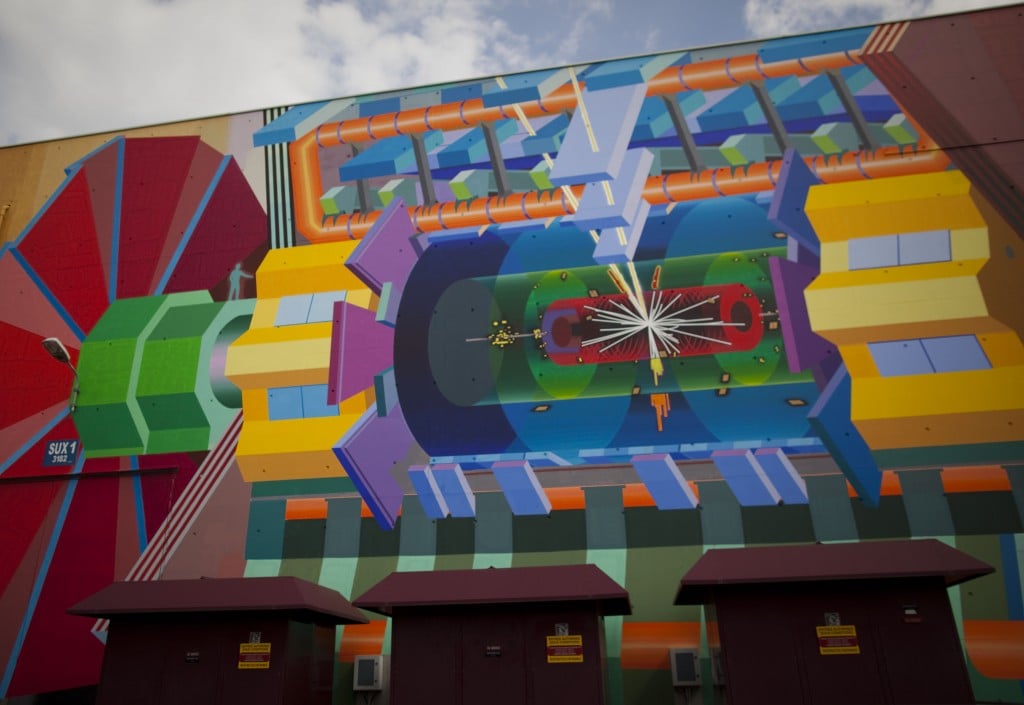
GENEVA (AP) — The head of the world’s biggest atom smasher says they have discovered a new particle that is consistent with the long-sought Higgs boson known popularly as the “God particle,” which is believed to give all matter in the universe size and shape
Rolf Heuer, director of the European Center for Nuclear Research, or CERN, says “we have a discovery” of a new subatomic particle, a boson, that is “consistent with a Higgs boson.”
Higgs boson’s existence was predicted decades ago to help explain how the universe works.
He spoke after two independent teams at CERN said they have both “observed” a new particle.
But the teams stopped just shy of claiming outright discovery of the Higgs boson itself that is key to our understanding of why matter has mass, which combines with gravity to give an object weight.
“I agree that any reasonable outside observer would say, ‘It looks like a discovery,’” said British theoretical physicist John Ellis, a professor at King’s College London who has worked at CERN since the 1970s. “We’ve discovered something which is consistent with being a Higgs.”
CERN’s atom smasher, the $10 billion Large Hadron Collider on the Swiss-French border, has been creating high-energy collisions of protons to investigate dark matter, antimatter and the creation of the universe, which many theorize occurred in a massive explosion known as the Big Bang.
The phrase “God particle,” coined by Nobel Prize-winning physicist Leon Lederman, is used by laymen, not physicists, more as an explanation for how the subatomic universe works than how it all started.
Rob Roser, who leads the search for the Higgs boson at the Fermilab in Chicago, said: “Particle physicists have a very high standard for what it takes to be a discovery,” and he thinks it is a hair’s breadth away. Roser compared the results that scientists will announce Wednesday to finding the fossilized imprint of a dinosaur: “You see the footprints and the shadow of the object, but you don’t actually see it.”
Fermilab, whose competing atom smasher reported its final results Monday after shutting down last year, said its data doesn’t settle the question of the Higgs boson, but it came tantalizingly close.
“It’s a real cliffhanger,” said Gregorio Bernardi, a physicist at the University of Paris who helped lead one of the main experiments at Fermilab. He cited “strong indications of the production and decay of Higgs bosons” in some of their observations.
Fermilab theorist Joseph Lykken said the Higgs boson “gets at the center, for some physicists, of why the universe is here in the first place.”
Though an impenetrable concept to many, the Higgs boson has until now been just that — a concept intended to explain a riddle: How were subatomic particles, such as electrons, protons and neutrons, themselves formed? What gives them their mass?
The answer came in a theory first proposed by Scottish physicist Peter Higgs and others in the 1960s. It envisioned an energy field where particles interact with a key particle, the Higgs boson.
The idea is that other particles attract Higgs bosons and the more they attract, the bigger their mass will be. Some liken the effect to a ubiquitous Higgs snowfield that affects other particles traveling through it depending on whether they are wearing, metaphorically speaking, skis, snowshoes or just shoes.
Officially, CERN is presenting its evidence this week at a physics conference in Australia but plans to accompany the announcement with meetings in Geneva. The two teams, known as ATLAS and CMS, then plan to publicly unveil more data on the Higgs boson at physics meetings in October and December. Each of the teams involves thousands of people working independently to ensure accuracy.
The scientific threshold for discovery is high. Scientists have to show with complex formulas that there’s a less than 1 in 1.7 million chance that the findings are a statistical fluke. With two independent experiments showing that there’s less than 1 in 16,000 chance of being wrong, it’s a matter of how their work is put together.
Scientists with access to the new CERN data say it shows with a high degree of certainty that the Higgs boson may already have been glimpsed, and that by unofficially combining the separate results from ATLAS and CMS it can be argued that a discovery is near. Ellis says at least one physicist-blogger has done just that in a credible way.
CERN spokesman James Gillies said Monday that he would be “very cautious” about unofficial combinations of ATLAS and CMS data.
“Combining the data from two experiments is a complex task, which is why it takes time, and why no combination will be presented on Wednesday.” he said.
But if the calculations are indeed correct, said John Guinon, a longtime physics professor at the University of California at Davis and author of the book “The Higgs Hunter’s Guide,” then it is fair to say that “in some sense we have reached the mountaintop.”
Sean M. Carroll, a California Institute of Technology physicist flying to Geneva for Wednesday’s announcement, said that if both ATLAS and CMS have independently reached these high thresholds on the Higgs boson, then “only the most curmudgeonly will not believe that they have found it.”










The Times of Israel Community.