

American-Jewish, Finnish economists win Nobel for contract theory
Groundbreaking work on financial agreements from CEO bonuses to insurance deductibles earns professors Oliver Hart and Bengt Holmstrom prestigious award
 Add ToI as a Preferred Source on Google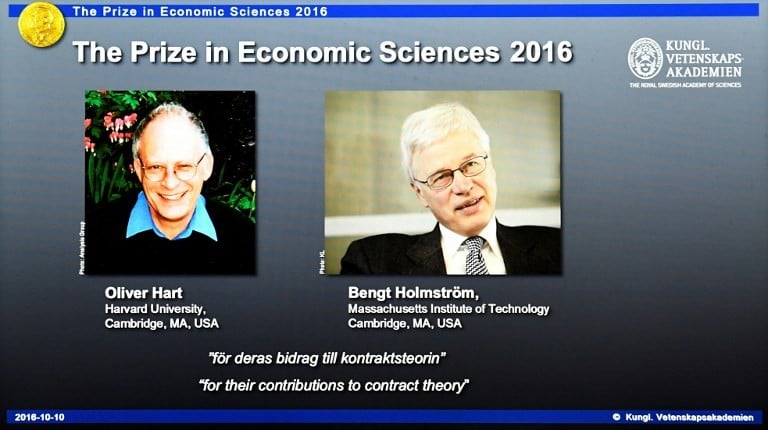
STOCKHOLM — American-Jewish economist Oliver Hart and Bengt Holmstrom of Finland on Monday won the Nobel Economics Prize for their work on contract theory, shedding light on how contracts help people deal with conflicting interests.
Born to a prominent British-Jewish family in 1948, Hart is an economics professor at Harvard University in the United States, while Holmstrom is a professor of economics and management at Massachusetts Institute of Technology.
The two were awarded the joint prize for work on contractual relationships that can deal with anything from CEO bonuses to the deductibles and co-pays for insurance, the Royal Swedish Academy of Sciences said Monday.
“This year’s laureates have developed contract theory, a comprehensive framework for analyzing many diverse issues in contractual design, like performance-based pay for top executives, deductibles and co-pays in insurance, and the privatization of public-sector activities,” it said.
“The new theoretical tools created by Hart and Holmstrom are valuable to the understanding of real-life contracts and institutions, as well as potential pitfalls in contract design.”
Their groundbreaking work has laid “an intellectual foundation” for designing policies and institutions in many areas, from bankruptcy legislation to political constitutions.
BREAKING 2016 Prize in Economic Sci. to Oliver Hart @Harvard & Bengt Holmström @MIT “for their contributions to contract theory” #NobelPrize pic.twitter.com/xosZ27WVee
— The Nobel Prize (@NobelPrize) October 10, 2016
The pair will share the eight million kronor (826,000 euros, $924,000) prize.
Hart is the son of Philip D’Arcy Hart, who was a leading British medical researcher and scion of a prominent London Jewish family.
His wife is Rita Goldberg, a Harvard literature professor who last year published a book exploring her mother’s experiences during the Holocaust and her own relationship to her.
Hart made fundamental contributions to a new branch of contract theory in the mid-1980s. His findings on “incomplete contracts” shed new light on the ownership and control of businesses, the academy said.

“His research provides us with theoretical tools for studying questions such as which kinds of companies should merge, the proper mix of debt and equity financing, and which institutions such as schools or prisons ought to be privately or publicly owned,” the academy said.
Speaking to reporters in Stockholm by telephone, Holmstrom said he felt “very lucky” and “grateful.”
In the 1970s Holmstrom showed how a principal, for example a company’s shareholders, should design an optimal contract for an agent, like the CEO. His “informativeness principle” showed how the contract should link the agent’s pay to information relevant to his or her performance, carefully weighing risks against incentives, the academy said.
The economics prize is not an original Nobel Prize. Formally called the Nobel Memorial Prize in Economic Sciences, it was added to the others in 1968 by Sweden’s central bank. The others were all set up through the 1895 will of Swedish inventor and philanthropist Alfred Nobel.
Last year, the award went to US-British researcher Angus Deaton for his groundbreaking work on poverty.
The economics prize is the fifth of the six Nobel prizes to be announced this year.
Last week, the awards for medicine, physics, and chemistry were announced, as well as the peace prize, which went to Colombia’s President Juan Manuel Santos for his efforts to end a half-century war with the FARC rebels.
The final prize, for literature, will be announced Thursday.
For that award, the Swedish Academy could tap a superstar novelist such as Philip Roth of the United States or Haruki Murakami of Japan, or a lesser-known writer such as Norwegian playwright Jon Fosse or Syrian poet Adonis.
The Nobel prize consists of a diploma, a gold medal and a check, which the laureates will receive at a ceremony in Stockholm on December 10.










The Times of Israel Community.