

Most Palestinians favor Iran’s policies, poll finds
55% in West Bank and 57% in Gaza supportive of regime’s approach; strong backing too for Hezbollah, Islamic Jihad
 Add ToI as a Preferred Source on Google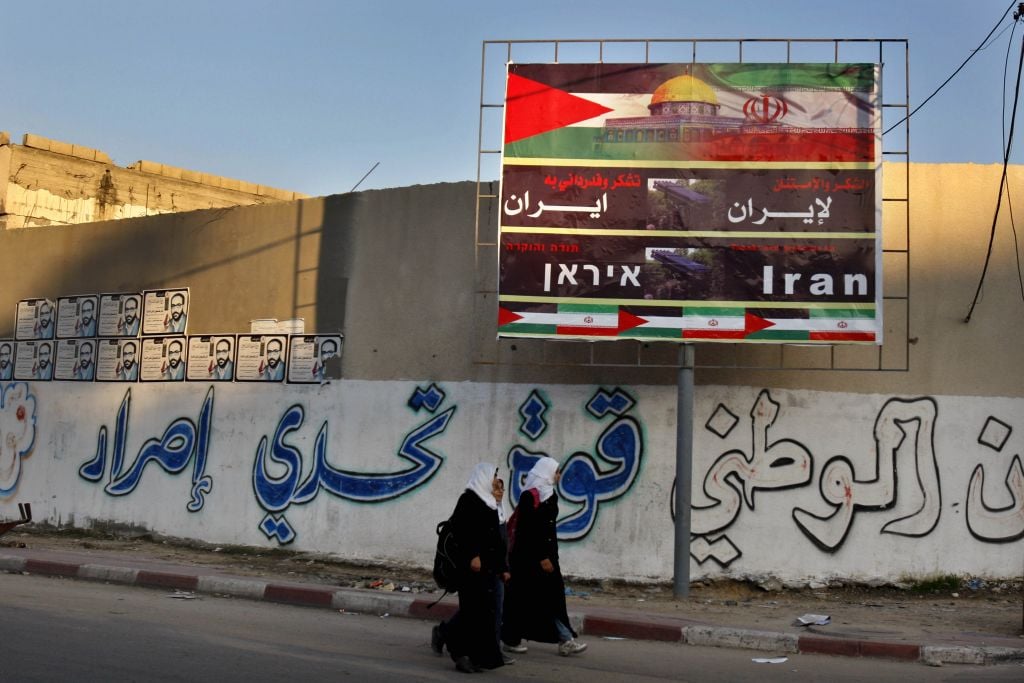
A majority of Palestinians in the West Bank and Gaza have a favorable view of Iran’s policies, according to a poll conducted at the height of international negotiations on Iran’s nuclear program.
The survey of 919 Palestinians commissioned by The Washington Institute for Near East Policy found that 55 percent of Palestinians in the West Bank and 57 percent in Gaza viewed Iran’s policies favorably, with 29 percent in the West Bank and 13 percent in Gaza rating them as “very good.”
Forty-five percent of West Bank respondents and 43 percent in Gaza gave Iran’s policies a “fairly bad” or “very bad rating.”
The poll was conducted June 7-19, with respondents interviewed on their views of Iran and neighboring countries.
Iran has financed the Hamas terror group in the Gaza Strip, and the Supreme Leader Ali Khamenei has repeatedly urged the arming of West Bank Palestinians. The Palestinian Authority was recently attempting to strengthen its diplomatic relations with Iran, as ties between the Islamic Republic and the PA’s main Palestinian rival, Hamas, grow increasingly chilly. PA President Mahmoud Abbas was slated to visit Tehran in the coming months.
Two Iran-backed terrorist groups enjoyed high approval ratings, the poll found. The Lebanon-based Hezbollah received a 69 percent approval rating in the West Bank and 57 percent in Gaza. The Palestinians’ Islamic Jihad was given a 71 percent favorable rating in the West Bank and 84 percent in Gaza, eclipsing Hamas’ popularity there.
David Pollock and Ghaith al-Omariboth of The Washington Institute wrote in a paper published last week on the Fikra Forum blog: “The most plausible explanation is that many Palestinians still focus on and admire Hezbollah’s past record of uncompromising, violent opposition to Israel, while many other Arabs have come to resent Hezbollah’s subservience to Iran and support for anther Iranian client, Bashar al-Assad’s brutal dictatorship in Syria.”
Poll respondents were also asked their opinions of other Arab and Muslim-majority countries. Egypt and Jordan were viewed favorably, as were Iran’s regional competitors Qatar and Saudi Arabia. Turkey was the most popular for its efforts to provide aid to Gaza.
Pollock and al-Omariboth in their paper said the Palestinian street is up for grabs.
“Palestinians respond to whichever party they see as reflecting their priorities or meeting their needs, and they have both moderate and radical impulses,” they wrote. “Whether Iran can exploit the latter is probably a function of what alternatives the Palestinians think they have.”










The Times of Israel Community.