

Palestinians call to strip Druze poet of awards for attending soldier grandson’s funeral
Arab Israeli author Suleiman Daghash was considered an ambassador of Palestinian poetry — until his eulogy for his grandson, who fell fighting for IDF in Gaza
 Add ToI as a Preferred Source on Google
Gianluca Pacchiani is the Arab affairs reporter for The Times of Israel
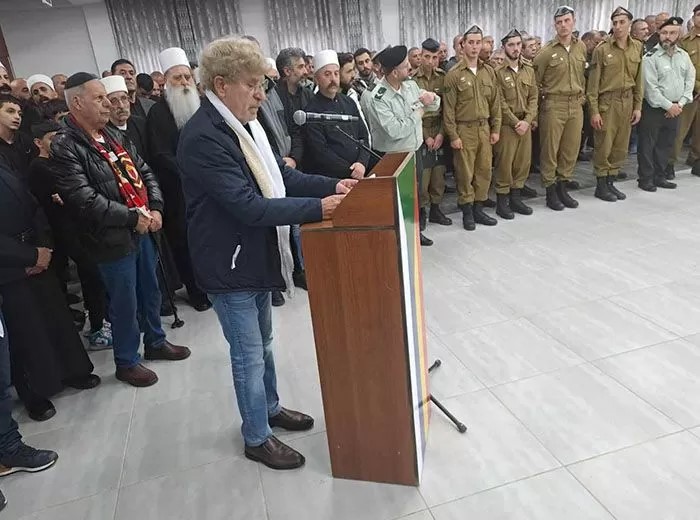
The Palestinian Authority Ministry of Culture condemned the Israeli Arab poet Suleiman Daghash on Saturday for participating in the funeral of his grandson Sufian, an IDF soldier who was killed in Gaza last week at age 21.
The ministry called for the withdrawal of all honors conferred on the poet, an Israeli citizen from the Druze minority, mentioning in particular an award bestowed upon him by the General Union of Arab Writers in 2017.
Daghash hails from the Druze-majority city of Maghar, in northern Israel, and is considered an outsider figure among Israeli Druze. Unlike the vast majority of his community, he rejects the idea of allegiance to the State of Israel, and throughout his work he asserted his Palestinian national identity.
In the Druze minority, all men are drafted and serve in combat units at a higher rate than Jewish Israelis – about 80% versus 50%. Daghash refused to serve in the Israeli army and so did two of his sons, according to Palestinian journalist Younis Tirawi.
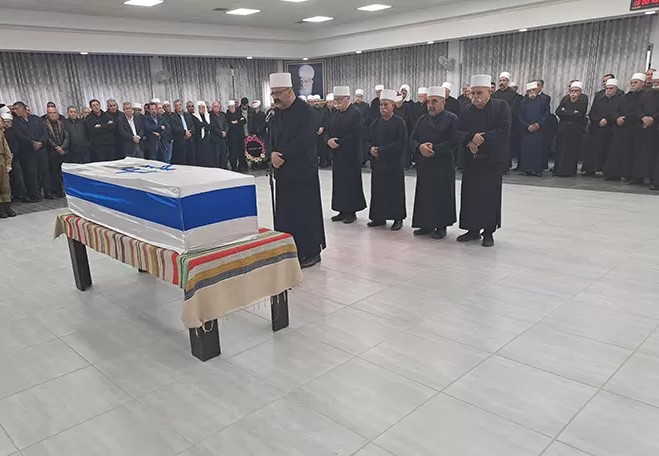
A video circulated on social media showed Daghash at the funeral, eulogizing his grandson, whose coffin was covered in an Israeli flag. A number of IDF officers and soldiers were also present at the ceremony and carried the coffin.
In his speech, the poet said: “How can I accept that I will carry your pure coffin, and that you will be buried before me? Wouldn’t it be fair for me to be in your place, and you in my place?” He then added: “I hope that Sufyan’s blood will be the last blood that falls in this war or in any other, and that a just and comprehensive peace will be achieved in our region.”
????A shock from within!
Today, Palestinian Ministry of Culture condemned Palestinian Poet Solaiman Daghsh's actions, announcing the suspension of all awards and appreciation bestowed upon him, citing his participation in his grandson's funeral, a IOF soldier killed in Gaza! -> pic.twitter.com/HCl8LhJJiX
— Younis Tirawi | يونس (@ytirawi) January 6, 2024
Druze clerics, including the sect’s spiritual leader in Israel, Sheikh Muakfak Tarif, also attended the funeral.
Daghash was the first author to be awarded a special literary award for “1948 Palestinian writers,” assigned to Arab citizens of Israel by the General Union of Arab Writers in Algeria in 2017 to celebrate their “steadfastness” as Palestinian citizens of Israel, according to the Palestinian news agency Wafa.
Palestinian intellectuals reacted with outrage to Daghash’s presence at a military event.
Murad al-Sudani, Secretary-General of the Union of Palestinian Writers, wrote on the Union’s official page that the body rejects the eulogy by a Palestinian poet for “a soldier who contributed to the killing of our people in Gaza… Whoever is awarded the literary prize for 1948 Palestinians [i.e. Arab Israelis] must respect Palestine and its culture of resistance, and be humble in the face of the blood spilled in Gaza and the West Bank.”
The secretary-general called for stripping Daghash of his awards, saying: “The author removed himself from the cultural context of Palestine.”
Various Palestinian authors also condemned Daghash’s appearance at the funeral next to IDF soldiers, lambasting him for presenting himself in his Facebook profile as “an ambassador of Palestinian poetry in the global poets’ movement.”
Author Yassin Ezz El-Din, quoted by the UK-based daily Al-Quds al-Araby, wrote that “many Palestinians live this dichotomy: Their hearts are with Palestine and their swords are with Israel. The excuse is always that there are specific personal circumstances. But today, there is no room for ambiguous positions or for standing in the middle. If you are not with Palestine in words and deeds, you are with Israel.”



The Times of Israel Community.