

Rising seas? Let cities control coasts, activists say
Responsible urban planning for coastal areas may sound like a bore, but it is essential to stave off rising seas from climate change
 Add ToI as a Preferred Source on Google
Melanie Lidman is an AP reporter and former Times of Israel reporter
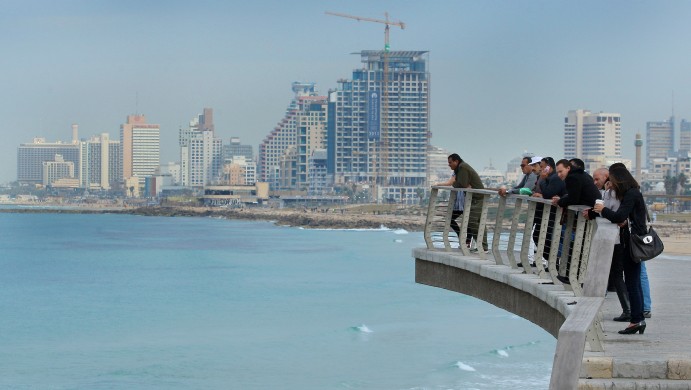
When the Environmental Protection Ministry warns that Ibn Gvirol Street in Tel Aviv could soon be beachfront property if global temperatures rise as little as 1.5 degrees Celsius, people sit up and take notice. But behind the screaming headlines, it’s the small changes that local governments will implement in the coming years, dealing with safe development and conserving the natural ecosystems, which will determine whether coastal cities across the Mediterranean will sink or swim in the coming century.
The secret to enabling coastal cities to effectively protect and develop their coastlines lies in transferring authority to local councils — rather than national government ministries — and connecting these cities with other coastal cities in the region for resource and knowledge sharing, according to researchers and government officials gathered in Tel Aviv for a beach-focused session from the annual DLD technology conference from September 24 to 29.
In Tel Aviv, beach-goers may not have noticed it this summer, but for the first time since the foundation of the city 107 years ago, all of the city’s beaches between the borders of Bat Yam and Herzliya are now managed by a single entity – the Atarim company, which is partly under the auspices of the municipality.
Atarim’s work to unite all of the beaches under a single management, instead of the previous situation where the Jaffa Port, the Tel Aviv marina, and various beaches were under different authorities, is mostly behind-the-scenes, including managing sanitation, renovations, and drainage. There are some perks for beach-goers, though, like a concentrated effort to avoid price gouging. Atarim regulated prices for umbrellas and beach chairs at a number of locations, and requires restaurants and bars to sell water, coffee, hummus, popsicles, soda, and other basics at a fixed price.
The uniting of Tel Aviv beaches is part of a larger international trend to have cities take responsibility for their coastal areas in an effort to develop waterfronts to integrate with cities while still preserving the important ecological system.
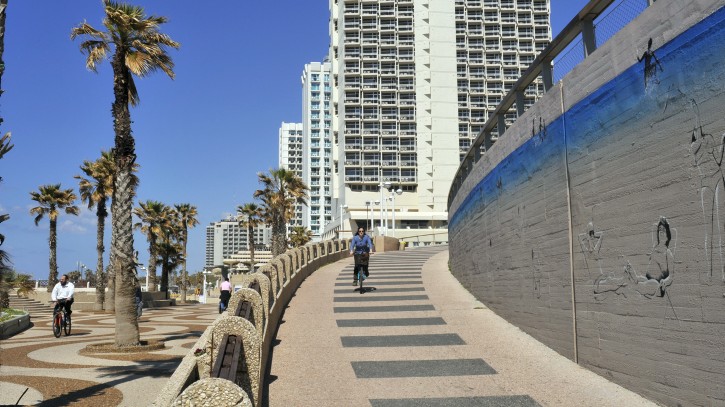
Development for coastal cities is essential, as climate change could create a rise in sea level in the coming years. According to the United Nations Environmental Programme, about half of the world’s population lives within 60 kilometers of the sea, and three-quarters of all large cities are located on the coast. In Israel, 2.5 million people live in the coastal plain or along Israel’s 196 kilometers of beachfront.
But despite the importance of protecting and safely developing the coast that borders these bodies of water, authority over beaches and seas is often a confusing patchwork of local and national government bodies.
For example, in Israel, the Ministry of Energy has the most authority over waterways, according to former interior minister Ophir Pines-Paz, who now oversees the Coastal Authorities Forum, which is advocating for coastal municipalities to take control of their beachfront. “But they have no interest in protecting beaches, so it makes it impossible for local authorities to do anything,” he said. “We see the separation between ‘sea’ and ‘beach’ as ridiculous,” he said.
Adam Teva V’Din and Zalul, two local environmental groups, are advancing similar laws in the Knesset that would give authority to the 15 municipalities along Israel’s coast to advance projects to protect and safely develop the coast. Adam Teva V’Din’s law is also advocating for an independent Marine and Coastal Authority.
Pines-Paz’s Coastal Authorities Forum will be organizing a “Blue Communities” conference for mayors from cities across the Mediterranean in Israel in December, echoing a trend of international cooperation on this issue. “Cooperation is really important, and it’s good that it is happening because there’s a lot of work to do,” said Maya Jacobs, managing director of Zalul. “Israel really needs to learn from the international world because we have the same problems.”
Rachelle Alterman, a professor of urban development at the Technion, was the director of Mare Nostrum, an EU-sponsored $4.8 million project to create international regulations to manage the coastline across the Mediterranean. “Along the Mediterranean, people are less obedient to planning laws and abiding by laws of urban planning,” she said. “Every country has planning laws and agencies, however there’s an issue of how to enforce it, what legal incentives and disincentives to use.”
She noted that urban planning enforcement is “not a sexy subject” and usually consists of “officials sitting in a dusty corner” of the municipality office. But Alterman hopes providing an international forum those responsible for enforcing responsible urban planning along coastal areas will empower these government workers to bring the issue to the forefront.
“Each country has similar issues but a different set of laws,” Alterman said. “The only way to exchange knowledge is getting those in charge of enforcement to talk to each other.” Alterman is hoping to plan the first opportunity for these enforcement officials to network with each other this winter in Barcelona, in a natural continuation of the Mare Nostrum project.
And the activists and researchers feel like they’re in a race against time. According to National Geographic, sea levels have been rising by 3.5 millimeters per year since the 1990s. Oceans could rise as much as 0.8 to 2 meters by the year 2100, which would flood many major cities around the world.
Many participants at the DLD conference cited Barcelona as an ideal model of city/coastal integration. Since 1993, following the 1992 Summer Olympics, the city has tripled the number of tourists to 8 million visitors per year, and increased the number of cruise visitors by 16-fold, making it the fourth-most popular cruise destination in the world, according to Marc Darder, the Chief of the Enforcement Unit in the Catalan Government’s Ministry of Territory and Sustainability.
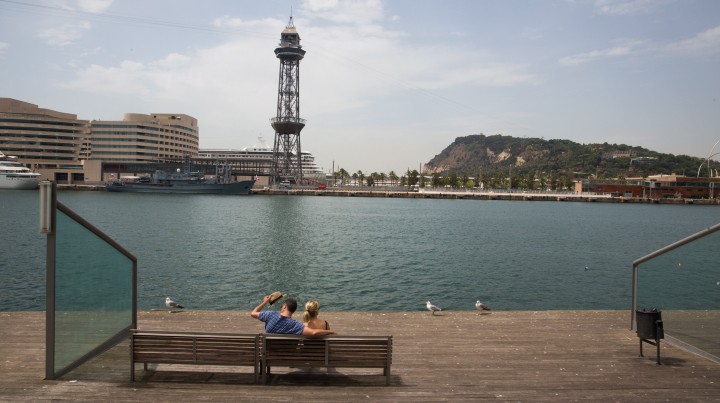
He cited the waterfront renewal project, one of the “most successful and ambitious urban developments in the city,” as the reason the city was able to become so popular with tourists. Before the renewal project, the city’s waterfront was filled with storage depots, railroad tracks, and illegal shacks on the beach. But it hasn’t been all smooth sailing.
“Private economic interests have filled the waterway with casinos, hotels, marinas, and restaurants,” he said. “The waterfront has been the battleground between various government agencies trying to get authority.”
What enables Barcelona’s waterfront success is open green spaces and public use buildings that act as corridors to allow easy access to the sea, integrating it with the rest of the city, said Darder. Public parks along the waterway are not only beneficial to the people who want to enjoy the beaches, they’re also an important physical barrier to roads and buildings if and when the sea level begins to rise.
“The waterfront of the city should not be like a necklace, of just a thin line,” said Darder. “Rather, it must be more like a comb, a thick line, full of intensity that is connected to the rest of the city.”








The Times of Israel Community.