

What’s Jewish about this year’s Academy Awards? Lots of controversy, of course
As Hollywood gears up to give itself its annual pat on the back, there’s a top-notch crop of films to pique The Tribe’s interest – and a healthy dose of off-screen drama, to boot
 Add ToI as a Preferred Source on Google
Jordan Hoffman, a member of the New York Film Critics Circle, is The Times of Israel's long-time film reviewer and the co-host of The Reel Schmooze.


NEW YORK — It is time, once again, for Hollywood to put on its makeup and give itself a round of applause. Viewership of the annual Academy Awards telecast is less than half of what it was 25 years ago, but the event is still a substantial mile marker, and a way for mainstream audiences to familiarize themselves with the previous year’s quality cinema offerings. (That doesn’t mean they’ll actually watch them, but at least they can say, “Oh, yeah, I’ve heard of that.”) And there is a nice mix of Jewish stories among this year’s nominees.
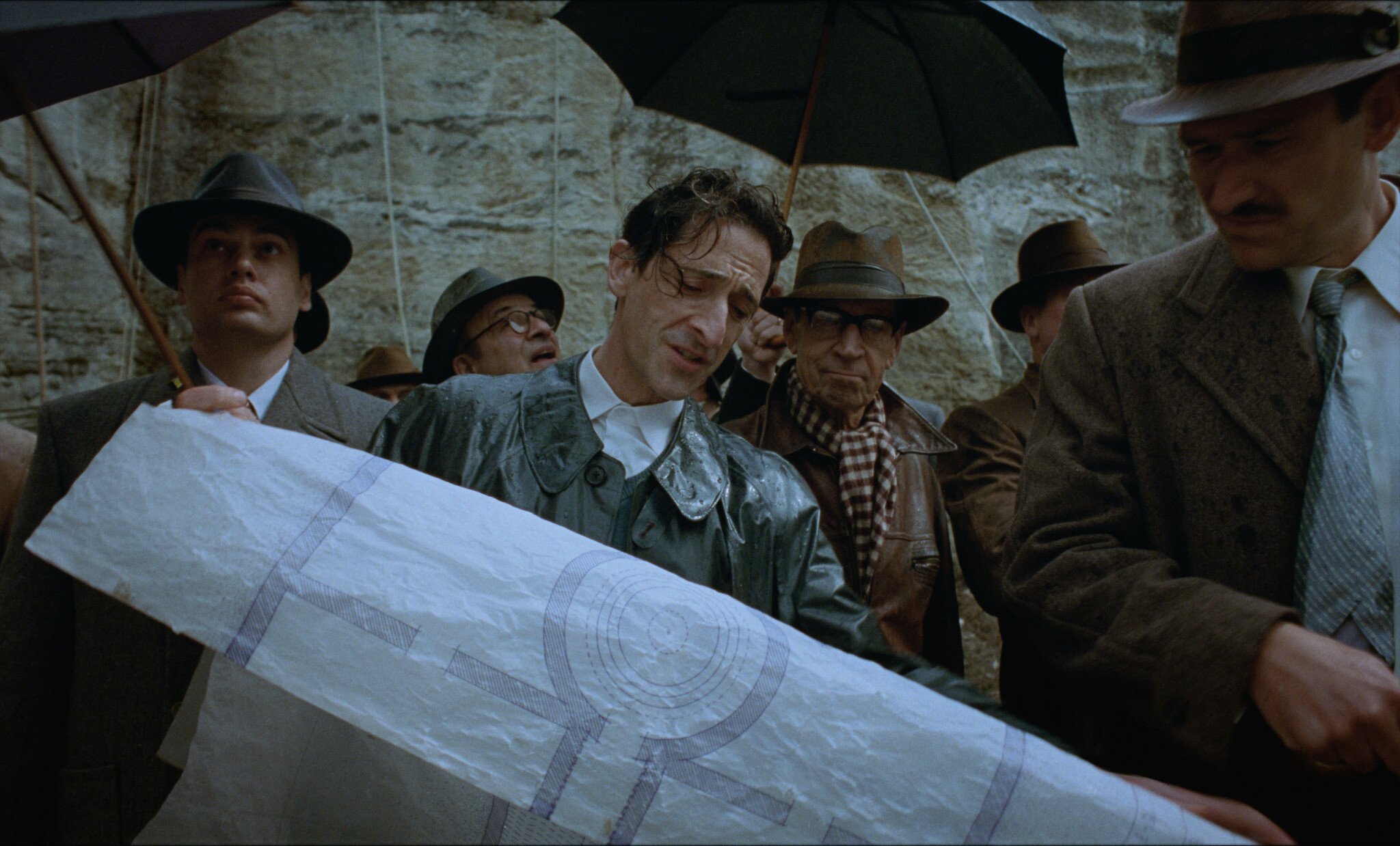
The most notable is “The Brutalist,” a massive concrete slab of a movie from director and co-writer Brady Corbet. The film, which has 10 nominations in total, stars Adrien Brody as a Hungarian-Jewish concentration camp survivor who comes to America to discover a new shade of antisemitism. Brody’s character, László Tóth, is a brilliant and uncompromising architect who, through a series of twists and turns, finds himself commissioned by a Pennsylvania industrialist with the intensely goyische name of Harrison Lee Van Buren (played with tremendous gusto by Guy Pearce.) The relationship between patron and artist takes on weighty symbolism over the course of the movie’s 215-minute run time. (Fear not, there is an intermission baked in; “The Brutalist” isn’t too brutal to the bladder.)
A leitmotif of “The Brutalist” is the existence of Israel. During an early sequence in which Tóth is first returning to his passion — forging, hammering and building — we hear a radio announcing the formation of the Jewish state. At several points in the narrative the idea of moving to Israel comes up, as it would for any displaced Jew and his family in the mid-20th century. Opinions vary on the notion — it means giving up on an American dream, but maybe it is the only logical endpoint. Sympathetic characters in the movie call emigrating to Israel “coming home,” a reverberating phrase from the film’s first scene when Toth’s niece is seen questioned by Soviet-aligned forces as a displaced person.
The movie is ambivalent in its messaging concerning Israel, which has brought great consternation to some viewers. Corbet, who is not Jewish, is a hero to many young cinephiles — his deployment of the VistaVision process, the first use of this anamorphic technique for a feature film since 1961, immediately wins him credibility points. But his refusal to have a character turn to the camera and say “Israel is a settler colonial project and must be denounced” has caused many who otherwise love the movie to gnash their teeth. What’s more, there have also been some who interpret the film’s final scene as being slyly anti-Zionist. Sadly, there’s no way for me to explain that further without spoiling the ending of the movie, so skip over the next paragraph if you’d prefer not to know.
“The Brutalist” opens with an overture sequence and concludes with an epilogue. The epilogue is set in the 1980s, with Tóth accepting an award for his life’s work in Venice. (Amusingly, the film stock switches to a rather dated video look.) Tóth is in a wheelchair, too old and feeble to speak. His Zionist niece speaks on his behalf, and reveals that her uncle’s first major work — the civic center commissioned by Van Buren that took decades to complete — was actually a commentary on the Bergen-Belsen camp where he and his wife were imprisoned. We learn that the agonies of the Holocaust were what inspired Tóth’s noble art. However (some say) this is an unreliable narrator. We’ve been watching this movie for hours now, and never did Tóth indicate that this was his plan all along. Some believe that the niece represents Israel exploiting the silenced voices of Holocaust victims for its own propaganda gains. It’s an interesting theory, but it’s also a bit of a stretch. Corbet himself has only stated that he likes elements of ambiguity in his art.
Listen to Jordan Hoffman talk about his Oscar pix here:
Anyhow “The Brutalist” has a fair shot at winning best picture. It’s not a lock, but it’s possible. Brody, who already won a best actor trophy for playing a Holocaust survivor in the 2002 film “The Pianist,” is much more of a safe bet. Brody is remarkable as the mercurial protagonist and is very deserving of a win. Of course, he won for a similar role as a young man and may now do so again at age 51, so this means he’s gonna have to round this out one more Holocaust film when he’s 80. I also think composer Daniel Blumberg is likely to earn the best original score Oscar. (If he doesn’t, it’s a crime!) Guy Pearce is nominated for best supporting actor, but he’s probably going to lose to Kieren Culkin for his performance in “A Real Pain.”
“A Real Pain” is almost the inverse of “The Brutalist.” Both films explore the aftermath of the Holocaust, but “The Brutalist” is an 800-pound gorilla and “A Real Pain” is an impeccable Chopin sonata. Written and directed by Jesse Eisenberg, he and Culkin play two very different cousins who, after the death of their grandmother, go to Poland to explore their family’s origins. The visit takes them to some very photogenic destinations as well as the Majdanek Nazi extermination camp. Along the way, the movie contemplates concentration camp tourism and the contours of history. It may not sound like it, but it’s also extremely witty and clever — just an onslaught of unexpected jokes that deftly turn into moments of true poignancy. (Eisenberg has been nominated for best original screenplay, and he’s got a shot at winning.)
While there is no shortage of essays concerning “generational trauma,” the push-pull between Eisenberg and Culkin’s characters takes the generalities of psychology and turns them into flesh and blood. This 90-minute movie is a major addition to Jewish cinema (more so, in my opinion, than “The Brutalist”) and an absolute must-see. Somehow this was not nominated for best picture, which is criminal considering some truly lousy movies (“The Substance,” “Emilia Perez”) were.
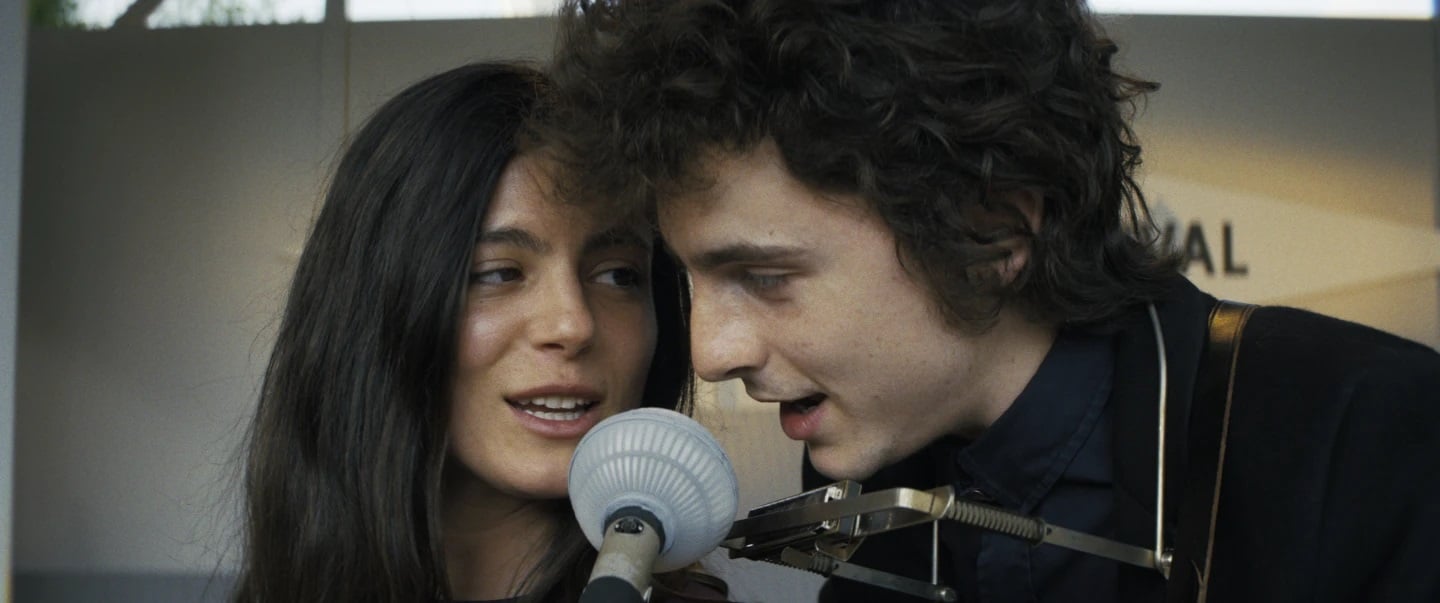
Less essential, but still a great deal of fun, is “A Complete Unknown,” a look at the young Bob Dylan during the key moment in the early 1960s when he transformed from a folk artist into a rock n’ roll icon. The Jewish-American heartthrob Timothée Chalamet (who also stars in the best picture-nominated space opera “Dune Part Two”) is really quite splendid as Dylan. I’ll admit I was skeptical, but he didn’t just do his homework (you can check out his Instagram to see him reading Dylan’s memoir years ago) and get the voice down, he walks the line between being charismatic and totally obnoxious.
The title (a lyric from the song “Like a Rolling Stone”) sums up the movie quite well — here is someone who won’t let anyone, even the women who love him, know anything about the “real” him. There’s a moment in which Elle Fanning’s character (based on Dylan’s early girlfriend Suze Rotolo) sees a piece of mail and asks, “Who’s Robert Zimmerman?” Dylan doesn’t answer, and that’s about all you’ll see in this movie that examines his Jewish heritage.
Of course, many of the ancillary characters in the story — Mike Bloomfield, Al Kooper, Albert Grossman, Harold Leventhal, Theodore Bikel, Peter Yarrow and probably a few others I’m forgetting — were Jewish. And even critics who don’t much care for this film (sticks in the mud, all of them!) admit that it succeeds best in capturing the “vibe” of the folk revivalist era in Greenwich Village. And that vibe was substantially Jewish.
“A Complete Unknown” is, however, unlikely to win any of the awards it was nominated for, which includes best picture, best actor for Chalamet, best supporting actress for Monica Barbaro (fantastic as Joan Baez), and best director for James Mangold, a Jewish-American journeyman who has made some great pictures (“Ford v Ferrari,” “3:10 to Yuma”) and some real stinkers (the most recent Indiana Jones picture, which I’d like to pretend never happened).
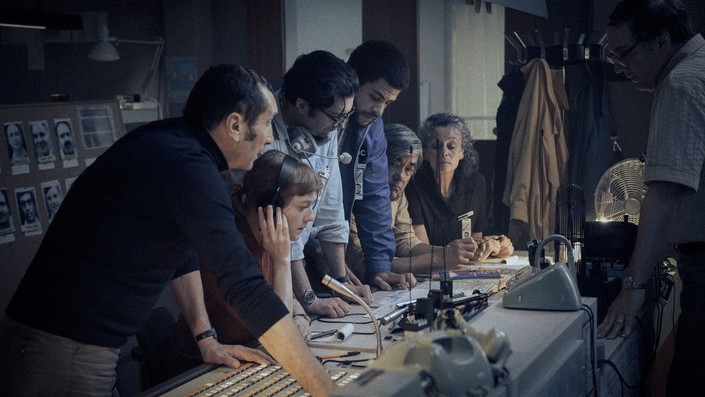
Ten years ago a movie like “September 5” would have a slew of nominations, but for 2024 into 2025 it will have to settle for one, best original screenplay. The film is a day in the life of a news team, though in this case it is ABC Sports in Munich covering the 1972 games when the Israeli team was attacked by Palestinian terrorists. The movie is simply a look at journalists using every tool at hand to get the story — it’s a process film, similar, in a way, to the best picture-winner “Spotlight.” And it really zooms along, too. But because it is about Israelis getting killed and dares to suggest that this is bad, the film has been shrugged off by most tastemakers and even scorned by some critics. In a way it’s a miracle it even has this one nomination, which it will not win.
If you think I am joking about the ludicrous reaction to this movie, know that there was a petition, signed by something close to 1,000 people, from cinema employees angry that they might be exposed to Zionist propaganda during working hours. For its part, the movie bends over backward to show how professional journalists are impartial, debating whether or not to use the word “terrorist” and stopping the movie dead in its tracks to remind the audience that, of course, #NotAllArabs. Anyway, the film, which stars John Magaro, Peter Sarsgaard and Leonie Benesch is extraordinary, and it would be just as good if it were about an event that wasn’t about Jews. However, Jews seem to be the ones most commonly on the receiving end of atrocities like this.
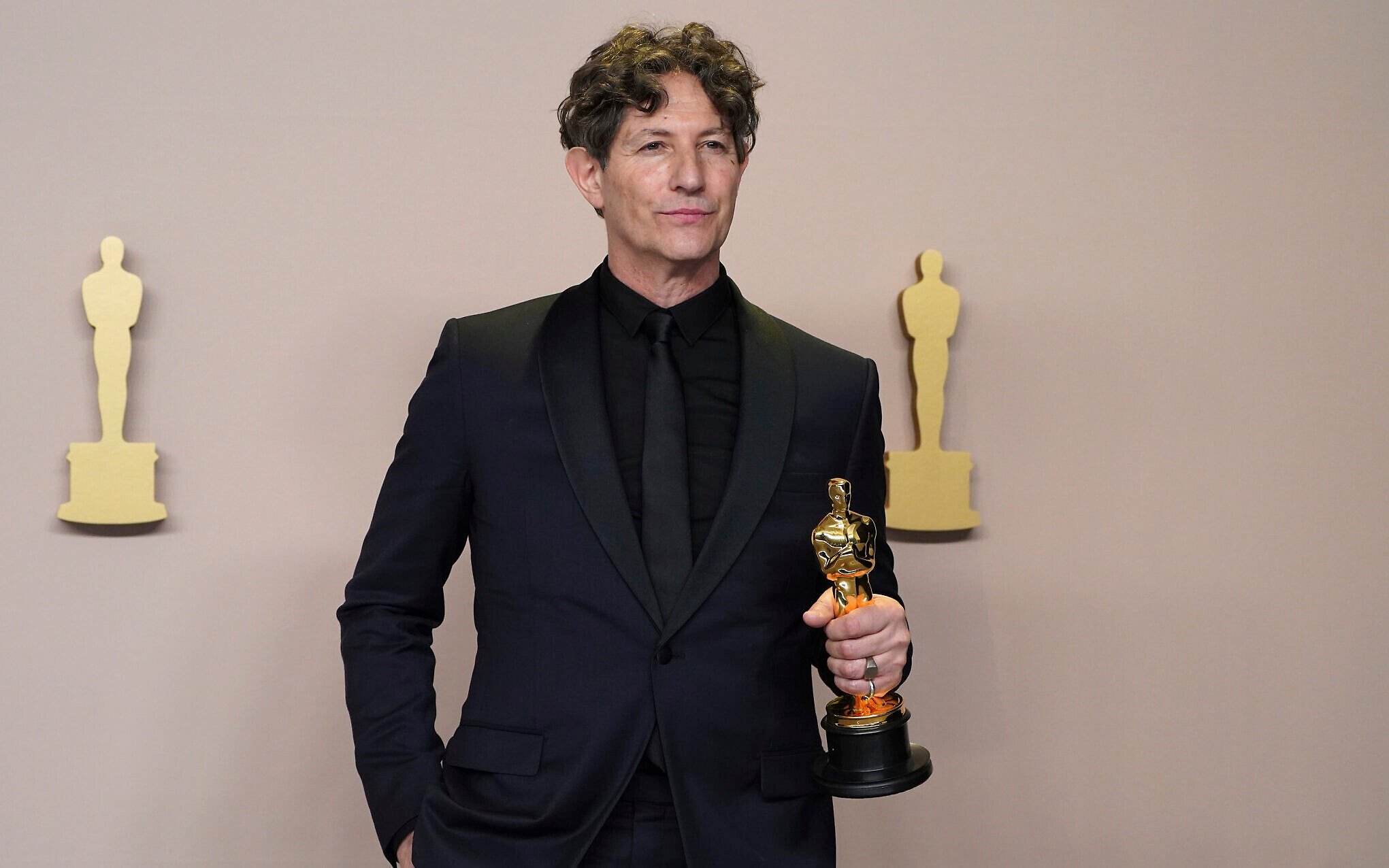
The most consequential moment from last year’s Academy Awards telecast was when British-Jewish director Jonathan Glazer went a little off-book while accepting the best international feature film prize for his Auschwitz-set film “The Zone of Interest.” With two producers by his side, he declared, “We stand here as men who refute their Jewishness and the Holocaust being hijacked by an occupation which has led to conflict for so many innocent people,” a sharp criticism of Israel’s reaction to the October 7, 2023, Hamas-led terror onslaught in southern Israel. This was news to one of the producers, Len Blavatnik, a billionaire and philanthropist deeply involved with many Israeli causes. His spokespeople later confirmed what many suspected, that Glazer did not “clear his speech” beforehand, and Glazer’s statement led to open letters from Jewish creatives in Hollywood both supporting and denouncing him. (Alas, there was no letter to sign that said “This enormously talented gentleman has a right to his opinion, but he’s also a bit of a putz.”)
If there were to be a repeat of any fiery speeches, it would come during the best documentary feature award. The film that has received the most attention this year is “No Other Land,” shot in the West Bank village of Masafer Yatta. It comes from a collective of four directors — two Israeli, two Palestinian. It is a very effective piece of propaganda — and I do not mean that in any negative context. Basel Adra, one of the directors and our main subject, has been documenting the difficulties of his village his whole life — as has his father. Here’s a guy who just wants to pump gas and live quietly, but the area is zoned “Area C” and the IDF periodically rolls in the tanks to perform military maneuvers. For decades the people have been told they must leave. The people don’t leave. It leads to violence.
Watching the movie is certainly upsetting, if you, like me, would prefer peaceful solutions to this seemingly endless crisis. But as with all documentaries, there is editing. We see a man, Harun Abu Aram, arguing with soldiers about a power generator. He is shot and paralyzed and later dies. The movie suggests that he was left to rot in a cave. In reality, many Israelis raised money for an ultimately failed rehabilitation attempt at a hospital. Either way, the man is still dead, which is awful, but if you bring up this additional cul-du-sac in the story, people look at you like you are crazy (believe me, I’ve experienced it.) I suppose it’s just important to always keep your guard up when watching a documentary about any contentious topic.
“No Other Land” is likely to win the prize not just on its merits (and, let me reiterate, it is an effective, upsetting work) but due to a meta-narrative surrounding the film’s release. The movie has been on the international scene for a full year, after a win at the 2024 Berlin Film Festival. It was unable, however, to secure a distributor in North America. (Several smaller companies wanted it, but the producers held out for a bigger deal.) This kicked off a series of articles suggesting that this was something The System didn’t want you to see. It is probably true that some larger companies didn’t want the headache of getting involved with such a lightning rod, but there quickly emerged a sense that there was some censorship conspiracy at play, which is unprovable.
The filmmakers and their American sales agent decided to use the added publicity and release the movie independently — where it did gangbusters in a pretty wide release for this sort of thing. I’d go so far as to say it had a stronger reach as an “unreleased” movie than if it went through typical channels. One must salute the team for lemons into lemonade here.
So even if the rumors are true and Hollywood is run by center-left Jews with private allegiances to Israel, they also hate anything reeking of censorship and respect a good business hustle. I also think the movie is likely to win because the competition in this category is a little soft. We’ll know for sure on Oscar night!









The Times of Israel Community.