

Egypt votes in 2nd stage of parliamentary elections
Two-day vote will produce country’s first legislature since 2012; low turnout expected amid public apathy
 Add ToI as a Preferred Source on Google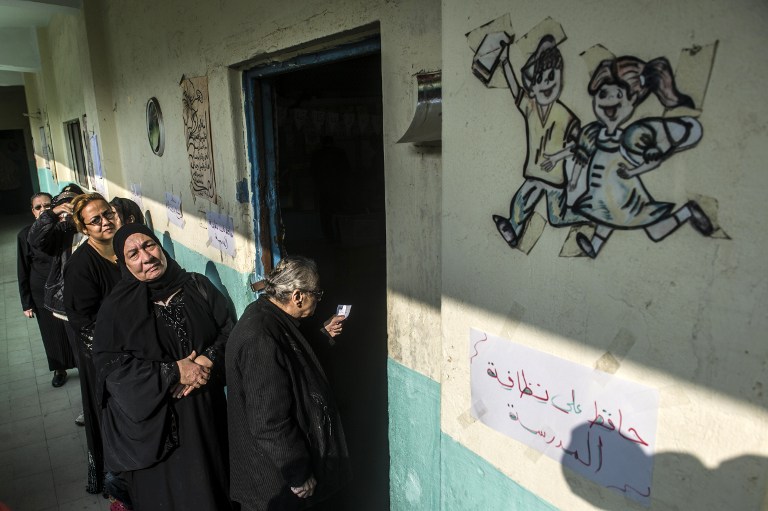
CAIRO — Egyptians in nearly half the country, including the capital Cairo, were voting on Sunday in the second stage of parliamentary elections that will produce the country’s first legislature since a chamber dominated by Islamists was dissolved by a court ruling in 2012.
Tens of thousands of troops and policemen were deployed to safeguard the two-day vote, reflecting growing security concerns less than a month after a suspected explosive device brought down a Russian airliner over Egypt’s Sinai Peninsula, killing all 224 people on board.
The extremist Islamic State group’s local affiliate claimed responsibility for the Oct. 31 attack, dealing a crushing blow to Egypt’s vital tourism sector and leading to an overhaul of security at Egyptian airports.
The new, 596-seat legislature is due to hold its inaugural session next month after a runoff is held in early December. Egyptians voted last month in 14 of Egypt’s provinces, the vote’s first phase, with a turnout of nearly 27 percent.
That was the lowest turnout in any vote, except one for a toothless upper chamber in 2012, since the ouster of autocrat Hosni Mubarak in a 2011 popular uprising.
Turnout in the second phase is not likely to be much higher given the widespread apathy over the political process under President Abdel-Fattah el-Sissi, a career army officer who led the military’s ouster of Egypt’s first freely elected leader in 2013, the Islamist Mohammed Morsi, following a wave of mass demonstrations against his rule. Sissi was elected last year.
Since Morsi’s ouster, authorities have launched an all-out crackdown against his supporters in the Muslim Brotherhood, his now-banned Islamic group, jailing thousands and killing hundreds in a series of street clashes with security forces in 2013.
Young liberal and pro-democracy activists have not been spared either, with authorities detaining dozens of them, mostly for breaching a law adopted in November 2013 that effectively bans street demonstrations.
With street politics eradicated and severe restrictions on the public sphere in place, political apathy has become widespread. Moreover, a personality cult around Sissi, though slowly eroding, has led many to believe that only the retired general, not lawmakers, can lift the country from its deepening economic woes and suppress an insurgency by Islamic militants in Sinai.
“You can’t think straight when you are hungry. That is why they (voters) are not coming out,” Ismail Hamed, a 38-year-old father of six, said as he alternated between smoking a hookah and cigarettes at a Cairo cafe. “If you didn’t eat in a day, would you care about elections?” he said.





The Times of Israel Community.