

Elections are here and the gloves are off
Hebrew papers abandon all sense of impartiality, urging their readers to vote one way or another
 Add ToI as a Preferred Source on Google
Ilan Ben Zion is an AFP reporter and a former news editor at The Times of Israel.
Elections are upon us, and it comes as no surprise that the mudslinging and vitriolic recriminations that have characterized the three-month campaign season have reached fever pitch in the Hebrew press as the country goes to the polls.
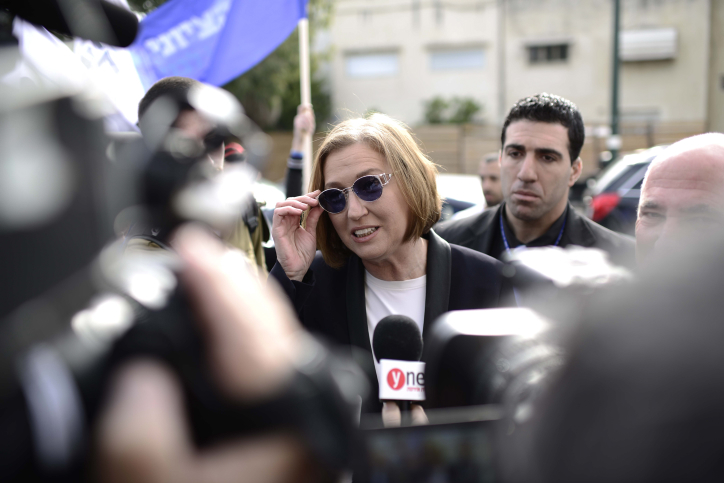
Zionist Union No. 2 Tzipi Livni’s announcement on the eve of elections that she’d forgo rotating the premiership with Isaac Herzog dominates the headlines. Haaretz quotes Livni saying that the move was not orchestrated for the day before polls opened, but at the same time “was not a new decision.” She says there was no indication the decision would increase electoral support for the front-running center-left party. The paper cites unspecified centrist Yesh Atid party and right-wing party members saying, however, that it makes the possibility of a unity government with Prime Minister Benjamin Netanyahu’s Likud party and the ultra-Orthodox parties more likely.
Israel Hayom, however, calls the move by the Zionist Union a “zigzag,” and says that despite the party’s denial that the deal to split the leadership was “just on paper,” the power-sharing agreement was “dissolved before a single ballot was cast.” Naturally, Netanyahu’s response to the Zionist Union’s announcement takes center stage in the paper’s coverage. He calls the move an “exercise in deceit aimed at increasing the margin between Labor [Zionist Camp] and Likud.”
Keeping up its elections coverage style, Yedioth Ahronoth publishes reams of op-eds and political analyses, forgoing hard news coverage. Inside the cover, the paper leads off with a massive composite image of Herzog and Netanyahu flanked by Sima Kadmon’s and Nahum Barnea’s opinion pieces.
Barnea writes that what characterizes both party leaders is that they’ve both panicked in the final leg of the campaign – Netanyahu ditched the notion of giving Kulanu party leader Moshe Kahlon the finance minister post, or Jewish Home party leader Naftali Bennett the defense minister position, along with his commitment to a two-state solution as expressed in his 2009 Bar-Ilan University speech. Herzog, meanwhile, jettisoned Livni’s rotation as prime minister should the Zionist Union win, he writes.
More than that, he says the spin factor has been a huge part of both campaigns: “Everyone involved in politics knew that there’s no significance to the guarantees Netanyahu gave: they were written on ice on a hot day. Everyone involved in politics, including Livni, knew that the rotation deal between Herzog and Livni had no chance of really taking place. Best-case scenario it was wishful thinking, a fantasy.”
The cancellation of the Zionist Union premiership rotation, he says, won’t unduly influence the vote: “On the whole, when the voter stands behind the curtain he’ll [still] find Livni’s name written upon the Labor slip.”
He concludes with an anti-Netanyahu bottom line, saying that “I listen to what Netanyahu says about my profession, my workplace. I can only conclude that something bad has happened in his relationship with reality. Like some of his predecessors, he came to the point where personal accounts, dislikes, fears become the principle. This does not bode well for another term, if that’s what the election results dictate.”
Moti Tuchfeld writes in Israel Hayom, however, that the “mega-zigzag” by Herzog and Livni over the premiership is a “mega-hit to trustworthiness” and “casts a heavy shadow over the judgment and reliability of all politicians.” He contends that the move came amid reports that the gap between Likud and the Zionist Union shrunk over the weekend, and that “Livni was indeed harming the campaign” as party strategists knew all along. At that point “they were left with no choice” but to drop her from the premiership, he says.
Instead of a campaign sharpening the differences between the right- and left-wing camps, Tuchfeld says, there is “a pile of spin, a struggle over image, and a bizarre agenda wavering between recycled bottles [a scandal involving the prime minister’s wife] and mistakes by tired politicians during nonstop interviews [referring to slip-ups by Netanyahu and Herzog on air].”
“One of the reasons for this is a campaign of tens of millions [of shekels] by [foreign] foundations, [non-governmental] organizations and disgruntled generals, which aside from empty and arrogant slogans didn’t contribute anything to the debate about the real gap separating the camps,” he says.
Despite his thinly veiled criticism of the left, he encourages all voters to “disconnect momentarily from the din of the billboards and media” and choose according to their conscience.
Haaretz, meanwhile, exhorts its readers to “Go vote out Netanyahu” in the headline of its editorial. The paper writes that election day is a “real chance to change the depressing direction that Israel is marching in.”
It catalogs what it perceives as the Netanyahu government’s litany of failures, from housing to the cost of living to Iran’s nuclear program to Hamas and the rule of law. “Above all, over the years of Netanyahu’s rule the occuption [of the West Bank] deepened its roots, the word peace became an empty symbol and the future of the state was abandoned for the sake of building the settlement enterprise,” the paper says. “The time has come to offer new hope to the citizens of Israel,” it writes.






The Times of Israel Community.