

Firms push tech solutions to fortify US airport perimeters
Sophisticated systems have been used successfully at Israel’s Ben Gurion Airport to ward off potential terror attacks
 Add ToI as a Preferred Source on Google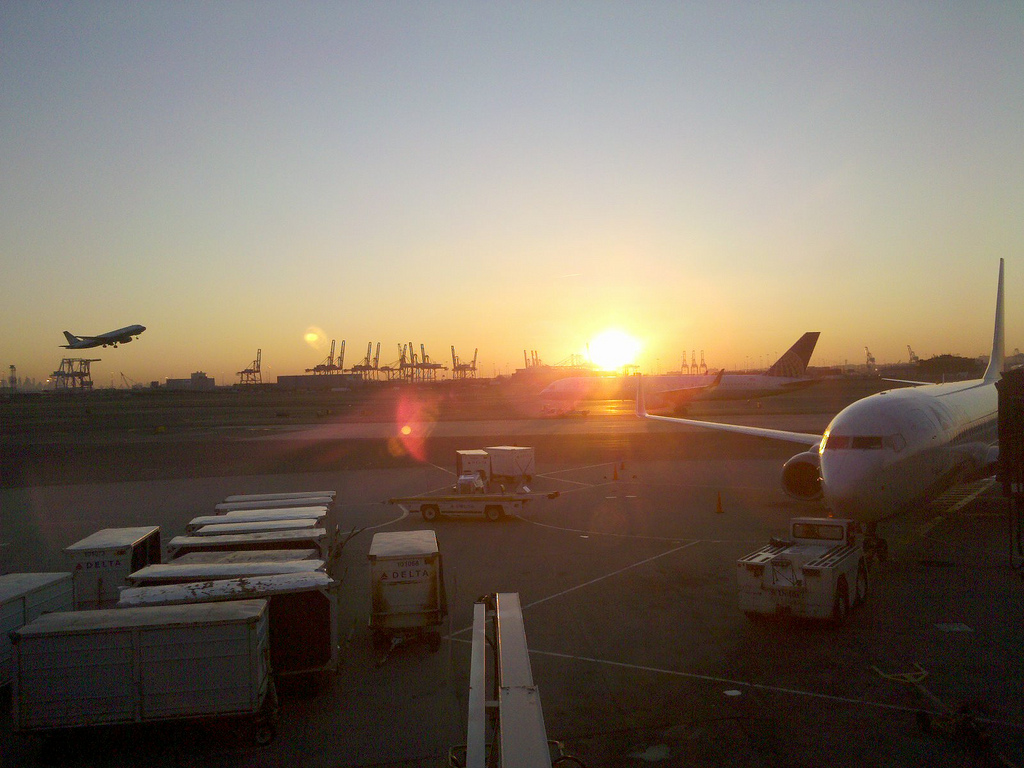
Technology firms increasingly pitch new sensors and software to US airports as a way to bolster exterior security and keep intruders out, but such digital barriers come with a hefty price tag and don’t always work.
An Associated Press investigation this week documented 268 instances in which people hopped over, crawled under, drove cars through or otherwise breached the fences and gates protecting the perimeters of 31 of the busiest US airports from January 2004 through January 2015.
How to address the problem is up for debate.
Fencing — typically a minimum of 6 feet (nearly 2 meters) high — surrounds US airports, and it often is topped with barbed or razor wire. Additionally, security gates help restrict access to airfields.
Most major airports also use video cameras, and guards are supposed to patrol regularly — but staffing varies.
Differences in the facilities themselves present other security challenges: Some are edged by water, others busy business districts. In Las Vegas, the rowdy Strip is nearby, and Philadelphia’s main airport is adjacent to a road that’s the scene of illegal drag racing.
Some facilities do go beyond the basics. Located near the Texas-Mexico border, McAllen-Miller International Airport installed optic fibers in its fences in 2009 over concerns about violence spilling across the Rio Grande. The technology, which also is used at US nuclear facilities, can immediately detect an intrusion and send an alert, said Samuel Kassey, vice president of one supplier, LaseOptics Corp.
Thermal imaging firms claim several major US airports as clients, though they won’t name which. By detecting heat, thermal cameras can serve as a virtual trip wire and also improve nighttime visibility.
In 2006, the Port Authority of New York & New Jersey, which oversees John F. Kennedy International, Newark Liberty, LaGuardia and Teterboro airports, awarded Raytheon a $100-million contract for a much-touted “perimeter intrusion detection system.”
The system includes motion-detection cameras, “smart-fence” sensors, night-vision cameras, perimeter alarms — even a power subsystem to bypass outages, according to Raytheon’s promotional materials.
The system has failed at least once. In that 2012 incident, a man whose watercraft ran out of fuel swam to shore, climbed an 8-foot (2.4 meter) fence at Kennedy and crossed two runways undetected before asking an airline employee for help.
The Port Authority eliminated perimeter patrols by airport police cars when the technology came online, but then reinstated them in response to the criticism, said Port Authority police union spokesman Bobby Egbert. He said that a lack of manpower remains a concern because there are gaps in the hours that police boats patrol around Kennedy and LaGuardia, both with waterfront runways.
Patrick Gannon, chief of police at Los Angeles International Airport, which had 24 perimeter breaches since 2004, said that in addition to regular patrols, his agency has upgraded fencing to make it harder to scale.
While airport security analysts predict that spending on physical perimeter barriers will decline in coming years, they said the market for high-tech solutions is on the rise.
The biggest stumbling block may be money. An overhaul linking fences and video feeds to software systems would cost between “a few million to less than $10 million,” said Chris Wooten, vice president of security at surveillance software provider NICE Systems.
Expensive technology is used at several airports outside of the US, including two that say they’ve never seen a perimeter breach.
Narita International Airport near Tokyo is considered one of the world’s most secure. Its perimeter is protected by vibration sensors, which immediately alert security if tripped. That’s in addition to 11.5-foot-high (3.5-meter-high) double-fencing of concrete, video surveillance and patrols. The prison-like security was built in the late 1960s and early ’70s amid clashes between police and militants supporting farmers who refused to yield their land for runway construction.
The other secure airport is Israel’s Ben Gurion, which had a string of Palestinian terrorist attacks on planes in the 1970s. It runs a ground radar system between two electronic fences, with hundreds of sophisticated observation systems and hundreds of highly trained armed police and soldiers assigned strictly to the perimeter, said Shmuel Zakay, the airport’s managing director, who said the cost totals more than $200 million annually.
“Of course, the terrorist organizations are always trying to do whatever they can to hit aircraft. For them it doesn’t matter if it is with explosive material in a passenger’s suitcase or by firing a machine gun or anti-tank missile at a plane,” Zakay said. “This is why we pay such close attention to perimeter security.”
Copyright 2015 The Associated Press.









The Times of Israel Community.