

Gaza funds could take decades to reach people, NGO warns
Oxfam: Unless blockade is lifted, $5.4 billion pledged to rebuild enclave will make little difference in short term
 Add ToI as a Preferred Source on Google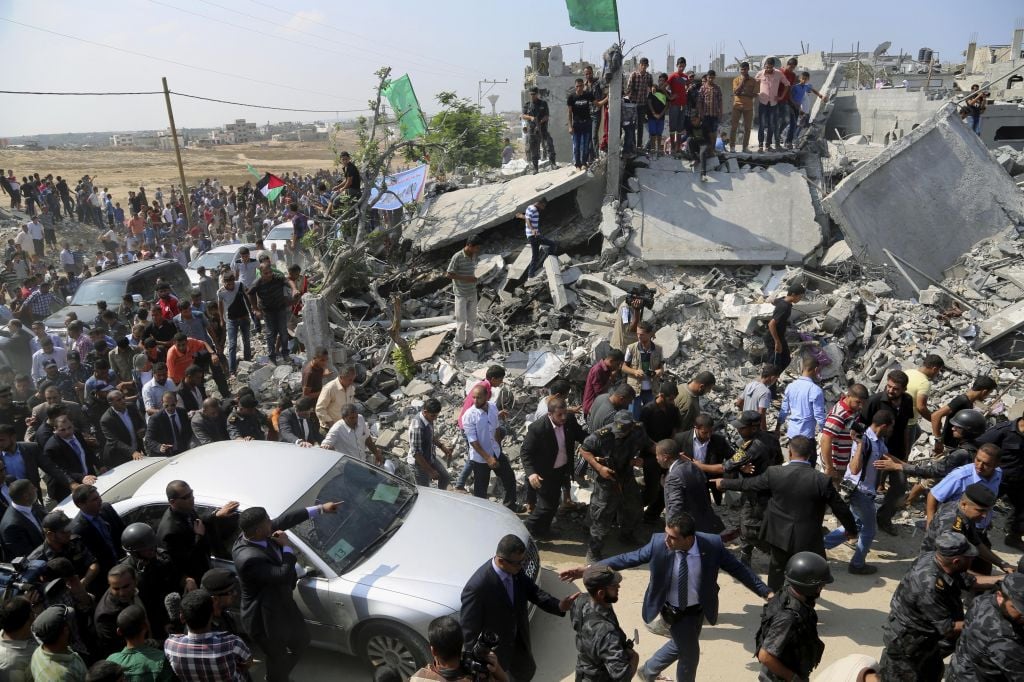
The $5.4 billion pledged for the reconstruction of the Hamas-run Gaza Strip following this summer’s 50-day conflict could take many decades to reach the Palestinian people living in the blockaded enclave, according to international charity organization Oxfam.
“The bulk of [the] money pledged at the global donor conference to rebuild Gaza will languish in bank accounts for decades before it reaches people,” the organization said in a press release Monday.
“It could take more than 50 years to build the 89,000 new homes, 226 new schools and the health facilities, factories and water and sanitation infrastructure that people in Gaza need” if Israel’s — and Egypt’s — restrictions on the Palestinian enclave are not lifted. Both countries imposed the blockade following Hamas’s violent takeover of the Strip in 2007 from the Palestinian Authority, in large part to prevent weapons smuggling.
“Unless donors step up pressure to end the blockade [of Gaza], many children made homeless by the recent conflict will be grandparents by the time their homes and schools are rebuilt,” said Oxfam Regional Director Catherine Essoyan.
“Aid agencies are providing desperately needed emergency assistance, but long-term reconstruction and development requires more than money,” she noted, adding that “these will be empty pledges unless donors also ensure that this aid can actually be delivered.”
The latest conflict in Gaza was the most ruinous of three recent wars, killing more than 2,000 Palestinians — mostly civilians, the UN says. Another 11,000 were wounded, and some 100,000 people remain homeless. Israel says some 1,000 of the fatalities were Hamas and other gunmen, and blames Hamas for all civilian casualties, arguing that it attacked Israel from within residential areas. Hamas and other terror groups fired over 4,500 rockets and other projectiles at Israel, and staged several attacks through cross-border tunnels. Seventy-two Israelis were killed.
On Sunday, donors at the international conference in Cairo promised $2.7 billion to rebuild the war-ravaged Gaza Strip, but all of the key participants said their efforts would be futile without a permanent peace between Israel and the Palestinians.
US-mediated talks broke down this summer before the 50-day war between Hamas and Israel began — the third since 2008 — and it remains unclear how peace can come about.
Norwegian Foreign Minister Borge Brende, who co-chaired the one-day meeting in Egypt, said pledges of $5.4 billion have been made, but that only half of that money would be “dedicated” to the reconstruction of the coastal strip.
Brende did not say what the other half of the funds would be spent on. Other delegates have spoken of budgetary support, boosting economic activity, emergency relief and other projects.
Meanwhile, Israeli officials acknowledged Sunday that Israel failed to link international assistance for the rehabilitation of Gaza after the summer’s war to its central demand that Hamas disarm, as delegates representing some 50 nations and 20 regional and international organizations pledged billions to rebuild the Palestinian enclave.
An Israeli official was quoted by Channel 2 admitted that Prime Minister Benjamin Netanyahu’s demand that Hamas give up its arms — endorsed in principle by the US, EU and others at the end of the 50-day conflict — had not prevailed as a condition for overseas funding to rehabilitate Gaza. The funding for reconstruction, the official said, would flow so long as the ceasefire was maintained. Further development of Gaza after such reconstruction, the official said, would be contingent on the demilitarization of the Strip.
Israeli officials noted that a mechanism had been agreed, with UN involvement, to ensure that international funding not be diverted to finance the rebuilding of Hamas’s military capabilities. But sources quoted by Channel 10 expressed concern that such a mechanism would not hold firm, and the same TV report quoted sources in Gaza as saying there was no practical way to control how such money would be spent. The head of the Israeli Air Force’s Air Defense Command told The Times of Israel last week that Hamas has resumed rocket manufacturing in Gaza.
Foreign Minister Avigdor Liberman said earlier Sunday that Gaza reconstruction efforts would need the consent of Israel, which was not invited to the international conference in Cairo. “Gaza cannot be rebuilt without the cooperation and participation of Israel,” he said.
US Secretary of State John Kerry said Gazans “need our help desperately — not tomorrow, not next week, but they need it now.” He said the new US money, which nearly doubles American aid to the Palestinians this year, would go to security, economic development, food and medicine, shelter and water and sanitation projects.
Abdel Fattah El-Sissi, the Egyptian president, whose government negotiated the ceasefire that ended the war, said the reconstruction effort hinged on a “permanent calm” between Hamas and Israel, and required the exercise of “full authority” by the Palestinian Authority led by President Mahmoud Abbas.





The Times of Israel Community.