

Are we there yet? Are we there yet?
The Israeli press awaits the announcement of a government like the crowds outside St. Peter’s waited for the new pope
 Add ToI as a Preferred Source on Google
Ilan Ben Zion is an AFP reporter and a former news editor at The Times of Israel.
Like antsy children on a road trip, Israel’s papers are hopping up and down in the back of their parents’ station wagon shouting “Are we there yet?” Israel’s destination is a coalition deal between Yesh Atid leader Yair Lapid and Prime Minister Benjamin Netanyahu which has been in the works for even longer than it takes to drive from Rhode Island to the Grand Canyon, so you can imagine how impatient they are (sort of like this dog).
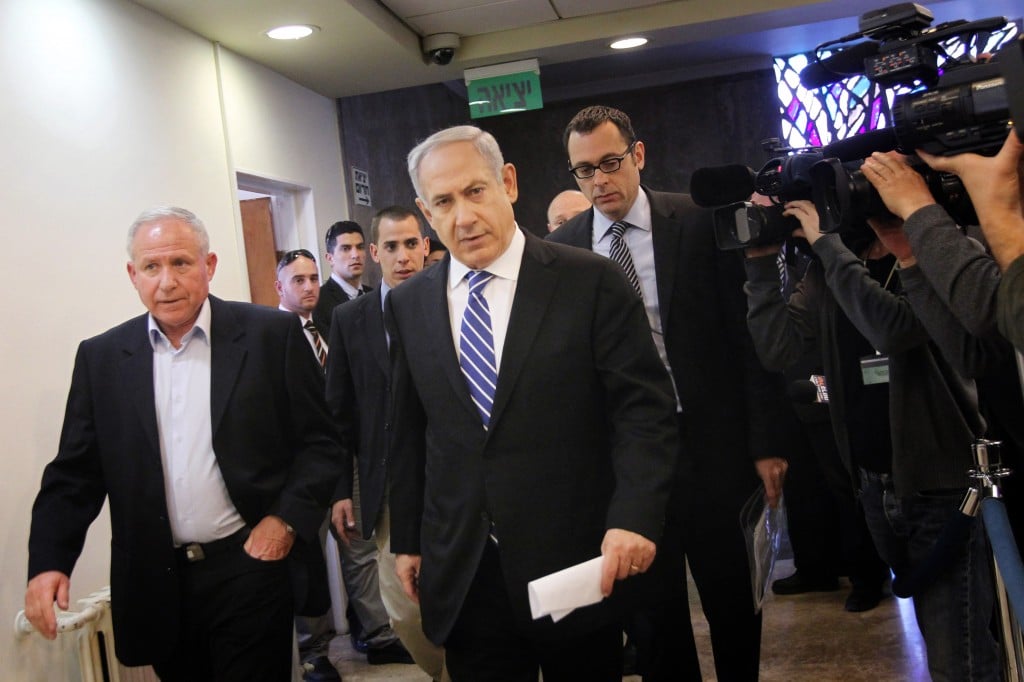
Road signs finally heralded the approaching Arizona state line on Wednesday as the sides indicated a major breakthrough in negotiations. Maariv reports that Netanyahu feared being forced to turn the car around and head all the way back to elections, and therefore sent out a text message warning that if there was no deal with Lapid, there’d be one with the ultra-Orthodox. Lapid and Jewish Home leader Naftali Bennett (the entity referred to by Shas leader Eli Yishai as BennLapid) met Netanyahu face-to-face shortly thereafter and hammered out a final deal in which Yesh Atid took the Education Ministry from Likud.
“Netanyahu fought for [outgoing Education Minister Gideon] Sa’ar until the last bullet,” Maariv writes. “[Wednesday] evening the outgoing education minister complained that he didn’t know anything about the deal formed behind his back. Perhaps. Sa’ar was essentially dismissed from the Education Ministry and he is paying the price for the failure of the Likud Elections Committee, which he headed, and for additional provocations of Netanyahu during the campaign, which wakened the anger of the prime minister’s spouse as well.”
Yedioth Ahronoth must be the middle child, because it uses the expected play on words for the sake of attention. Since the coalition breakthrough came at the same time that the Catholic Church picked its new pope, the front page reads “White smoke.” The paper reports that despite Netanyahu’s guarantees that he’d hold onto the education portfolio, Sa’ar “understood that he has no other choice but to give up the ministry.”
Lapid, in exchange, gave up his dibs on the Interior Ministry and the powerful Knesset Finance Committee, which Yedioth reports will be given to Bennett.
Keeping with the papal theme, Nahum Barnea writes that while it took the cardinals one day to pick a pope, it took Israel six weeks to form a government.
Barnea argues that Netanyahu wanted neither Bennett nor Lapid in his government in the first place. “He regarded each of them, and moreover the two of them together, as a Trojan horse which would destroy the government from within. The coalition negotiations didn’t ease the concern.” He adds that Sa’ar wasn’t the big loser in the Education Ministry arrangement, it was Netanyahu and the ultra-Orthodox.
Israel Hayom reports that after 39 days on the road, “the signing of the coalition deals is closer than ever,” channeling the child that’s just excited to get out of the car already. The paper rejoiced at what it painted as a Netanyahu victory over Lapid, noting that Netanyahu gave up the Education Ministry, but Likud gave up both the Interior Ministry and the demand that the government not exceed 20 ministers.
After sketching out the possible arrangement of cabinet portfolios, the paper quotes sources close to Netanyahu saying “despite the concession on education, the foreign and defense [portfolios] are in our hands, and so is the Interior Ministry. It’s not the coalition that Netanyahu wanted in the first place, but despite the concessions made along the way, the achievement is that Likud kept a majority in the government, something essential for its stability.”
Haaretz is the child who moped in the back seat the whole ride and didn’t want to come on this trip in the first place. Yossi Verter also uses the (now hackneyed) reference to white smoke about the expected coalition deal, which he calls “the strangest final accord of a coalition negotiation — if not the most bizarre — in memory.”
Sami Peretz, editor of Haaretz’s business paper The Marker, writes that Lapid and Bennett have their work cut out with them; negotiating with Netanyahu is the easy part, the hardest tasks lie ahead “when budget cuts or cutting back on social services will be demanded.”
“Then the real powerhouses in the economy will emerge: the defense establishment, the major unions, the Histadrut labor federation, the government monopolies, Israeli bureaucracy,” he writes.
He says it will be interesting to see when that time comes whether Lapid and Bennett’s muscle-flexing and cooperation was a one-off demonstration or whether it will be their MO for the next four years.
“Most of the key economic posts in the new government will be filled by new and inexperienced people. That is not bad when the goal is to generate change, but it could be a very costly tutorial,” he says.
“There is one portfolio that gets no grace period. The finance minister must immediately roll up his sleeves and present a budget that is slashed and responsible, yet inspiring,” and that man is Lapid.
And now for something completely different: Yedioth Ahronoth reports that US President Barack Obama, who is set to arrive next week in Israel, will be bringing his presidential taster with him. The man makes sure nothing foul or poisonous enters the president’s gullet. It lists Obama’s favorite foods, too, but falafel and shwarma are not found: steak, potatoes, nuts, martinis, chocolate ice cream, tilapia, and hot dogs.







The Times of Israel Community.