

France urges tech giants to help fight terror
French minister meets with Google, Facebook, Twitter, asks them to assist in removing terrorist propaganda from web
 Add ToI as a Preferred Source on Google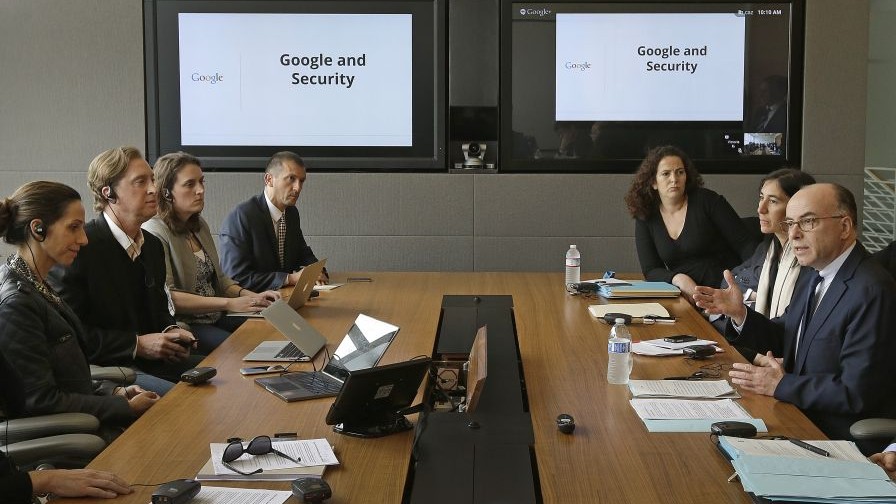
SAN FRANCISCO — The French interior minister said Friday he asked Google, Facebook and Twitter to work directly with French officials during investigations and to immediately remove terrorist propaganda when authorities alert them to it.
“We emphasized that when an investigation is underway we don’t want to go through the usual government-to-government channels, which can take so long,” said French Interior Minister Bernard Cazeneuve after a meeting with representatives from the US tech giants.
“It’s important to have full cooperation and quick reaction,” he added.
Cazeneuve’s one-day visit to San Francisco and Silicon Valley comes weeks after terrorist attacks in Paris left 17 people dead.
On January 7, two gunmen killed 12 people and injured 11 more during an attack on the satirical newspaper Charlie Hebdo in Paris. A third gunman killed a policewoman January 8 and then killed four more people a day later after taking hostages at a kosher supermarket in Paris. Police killed the three gunmen.
Twitter and Facebook spokespeople said they do everything they can to stop material that incites violence but didn’t say whether they would heed the minister’s request for direct cooperation with French authorities.
“We regularly host ministers and other governmental officials from across the world at Facebook, and were happy to welcome Mr. Cazeneuve today,” a Facebook spokesperson said. “We work aggressively to ensure that we do not have terrorists or terror groups using the site, and we also remove any content that praises or supports terrorism.”
When asked whether Twitter would work closely with French investigators, a spokesperson said their website outlines the guidelines for law enforcement to request information.
“We review all reported content against our rules, which prohibit direct, specific threats of violence against others,” the spokesperson wrote in an email.
An email to Google requesting comment was not immediately answered.
Cazeneuve said he called on the tech companies to join in the fight against terrorist propaganda disseminated on the Internet and to block terrorists’ ability to use websites and videos to recruit and indoctrinate new followers.
The pace of foreign fighters joining the Islamic State and other extremist groups has not slowed and at least 3,400 come from Western nations among 20,000 from around the world, US intelligence officials say.
While he did not call for Internet firms to take on the burden of automatically censoring photos, posts, video or other digital content uploaded to websites, Cazeneuve urged rapid cooperation when it comes to removing terrorist propaganda reported to the services.
“I told them we can figure this out together, we can come up with counter-terrorism speech and block these sites that are enticing the most vulnerable members of our society to commit terrorist acts,” Cazeneuve said.
France also is pushing to treat jihadi material on the Internet like child porn, a task that before the attacks in Paris was getting scant traction but now seems to have caught the attention of Europe’s top security officials.
Cazeneuve said the meeting Friday is a first step in building a strong relationship between the tech companies and the French government. He said he invited them to go to Paris in April to continue the conversation.
Since the recent terror attacks in Paris, Internet firms have taken to responding to reports of online terror mongering in minutes or hours as opposed to months as had previously been the case, according to the minister.
“The value of free speech in a democratic society is a core essential value to the ideals we are trying to protect in the fight against terrorism,” said Emma Llanso, director of the Free Expression Project at the US Center for Democracy and Technology, adding that “over-blocking and censorship is not the answer.”
Videos of gruesome executions have been frequently distributed online by the Islamic State group as a propaganda tool.
More generally, calls to join violent jihad or methods to carry out “lone wolf” attacks are spread on social media by militants and their supporters.










The Times of Israel Community.