

Gazans delight in local chocolate treats, long for golden ticket to exports
Despite restrictions, factories in enclave churn out ‘Natalia,’ a spread based on Nutella, and ‘Crimpos,’ similar to Israeli Crembo
 Add ToI as a Preferred Source on Google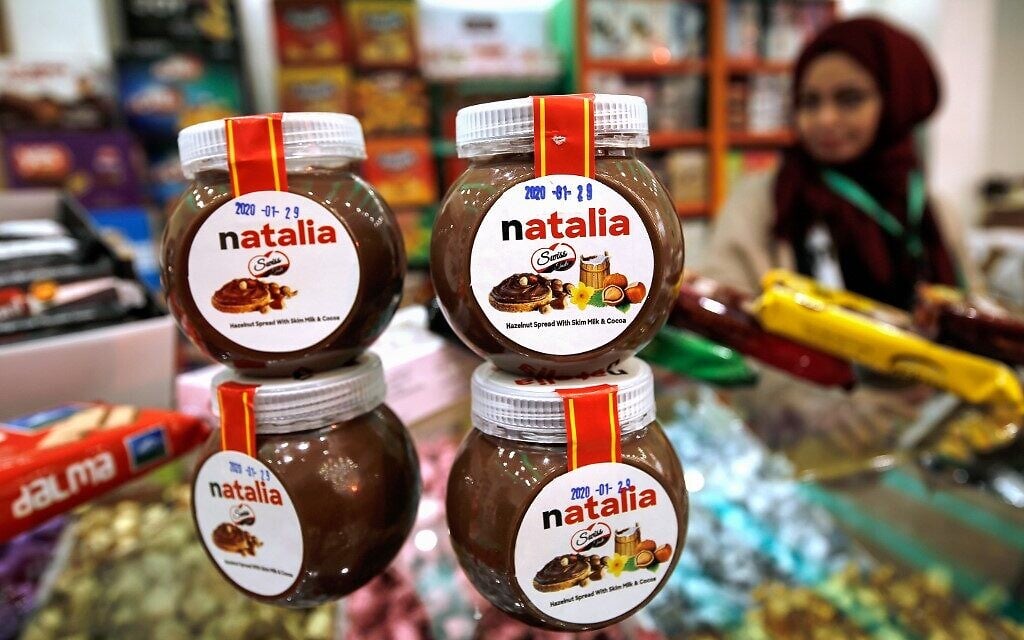
GAZA CITY — Off a bumpy dirt road in Gaza city, a group of children stood outside a half-open factory door, desperate to get their hands on what was being made inside.
“We want chocolate!” they shouted at a worker as he left the Al-Arees factory, which despite daunting obstacles churns out treats ranging from chocolate-covered biscuits to a Gazan version of a world famous spread, dubbed here “Natalia.”
Buckling in the face of candy-crazed kids, the man popped behind the door and returned with enough free chocolate to rot their growing teeth.
Al-Arees’s products are Gazan but their components are not, as few of the basic raw ingredients are produced in the impoverished Mediterranean coastal strip.
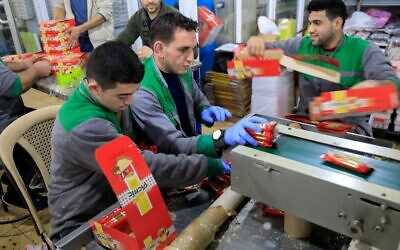
The factory relies on chocolate from as far as Argentina, sugar from African countries and dried eggs from the Netherlands, with other essentials imported from Turkey and Israel.
Egypt and Israel control all goods that enter Gaza. The two countries imposed a blockade in 2007 after the tiny enclave was seized by the Islamic terrorist group Hamas. Israel says it is necessary to prevent Hamas and other terror groups importing weaponry.
Hamas has fought three wars with the Jewish state, which frequently strikes the Strip in response to projectiles fired by terrorists at Israel. Since 2007, Hamas and Palestinian Islamic Jihad have launched thousands of rockets and mortars. More recently, Palestinians there have begun launching balloons carrying explosive and incendiary devices into Israel, causing significant damage to farmlands on the Israeli side of the border.
The exchange of fire has escalated since last month after US President Donald Trump unveiled his Middle East peace plan, angrily rejected by the Palestinians as a capitulation to Israeli objectives.
But even last week — amid rockets and mortars from Gaza and late night Israeli airstrikes — the chocolate factories kept whirring.
Gaza has no airport. Goods for the Strip are usually brought into Ashdod, an Israeli port around 35 kilometers (21 miles) north of the Strip.
Getting them into Gaza requires patience and money.
“From Ashdod we pay for workers and trucks that take these goods to the Kerem Shalom border crossing (between Gaza and Israel),” said Wael Ai, head of Al-Arees.
“Then you take them out of the truck for checks, then onto another truck from Gaza and after about 500 meters you have another checkpoint for Hamas,” he added.
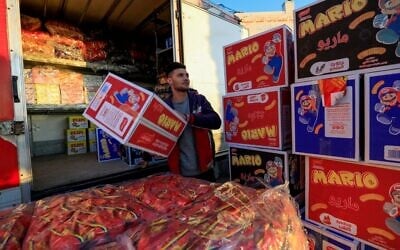
“I pay customs twice,” he told AFP, meaning once in Ashdod where Israel collects fees on behalf of the official Palestinian government based in the West Bank and then in Gaza to Hamas.
Due to Gaza’s electricity shortages, Ai has installed three fuel-guzzling generators. “If you want anything done in Gaza you have to do it yourself,” he said.
Nutella may be a global phenomena, but Gazans clamor for Natalia, their own version of a chocolate and hazelnut spread.
Local factories also make Crimpos, a large marshmallow coated in a thick layer of chocolate apparently based on the Israeli Crembo treat.
The treats are popular, but not necessarily profitable.
Four hundred grams of Natalia sells for just three or four shekels (about a dollar) while Crimpos sell for as little as five shekels per box of 20.
With Gaza’s unemployment rate at nearly 50 percent, there is little space to raise prices domestically. And exports to more lucrative markets are largely banned by Israel, which permits some vegetables and clothing to be sold abroad but not processed food.
Maher al-Tabbaa of the Gaza Chamber of Commerce insisted that factories in the Strip make attractive products that are “forbidden from leaving Gaza.”
“They are banned from being exported even to the West Bank,” he added. “In Gaza we have a limited market, so the banning of exports weakens the industry.”
Despite ongoing tensions, Israel and Hamas have reached a series of agreements over the past year that have slightly eased tensions.
That fragile accord led to an event in December which, for a Gazan producer, could fairly be described as momentous: for the first time in years Gaza exported sweet goods.
Eight tons of Crimpos were cleared for export to Bahrain, crossing through Israel and the West Bank to Jordan, and onward to the Gulf Arab state.

“What I exported was one day’s work only,” said Wael al-Wadiya, chairman of Sarayo Alwadiya company that made the Krembos.
“Right now we have 150 employees at the company. If they open the door to exports we will have people working three shifts — each one eight hours. So the number will go from 150 to between 300 and 450.”
But in recent days the situation has slipped backwards again.
After increased Gaza rocket fire following Trump’s peace proposal, Israel again tightened the export rules and canceled 500 permits for Gazans to work in Israel.
But Wadiya remains optimistic.
“If you can succeed in Gaza, you can succeed anywhere.”






The Times of Israel Community.