

Judge rules US can’t deny citizenship to child of US-Israeli gay married couple
Court rejects State Department position that girl, born to a surrogate in Canada, was born out of wedlock because one of her married parents is not her biological parent
 Add ToI as a Preferred Source on Google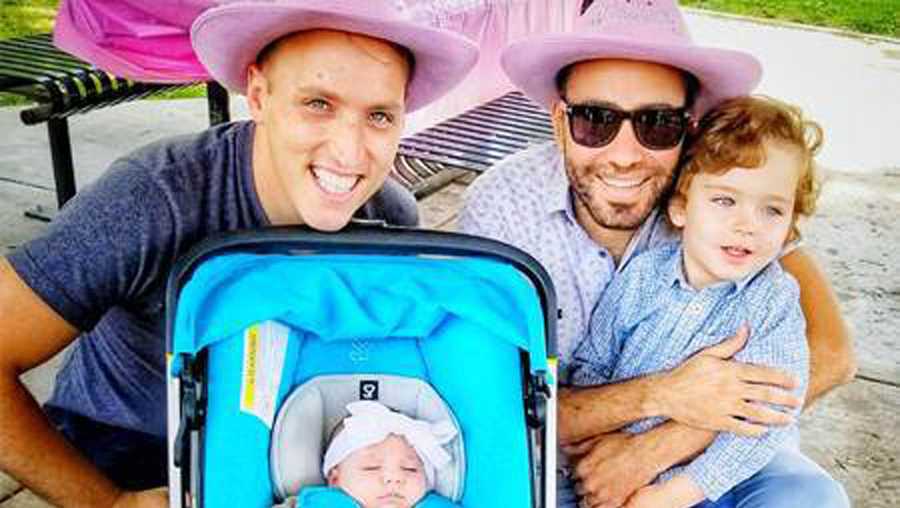
SILVER SPRING, Maryland (AP) — A federal judge ruled Wednesday that the State Department must recognize that the daughter of a gay couple in Maryland has been a US citizen since her birth in Canada via a surrogate last year.
US District Judge Theodore Chuang rejected the State Department’s position that the child was born out of wedlock because one of her married parents is not her biological parent.
The girl’s parents, Roee Kiviti and Adiel Kiviti, sued after the State Department denied her application for a US passport. The couple argued that their equal protection rights were violated by a State Department policy requiring that both parents be biologically related to a child in order to consider that the child was born in wedlock.
The judge ruled the child was a US citizen at birth, born of married parents who were both US citizens who had resided in the United States before her birth.
An attorney for the Kivitis said their suit is one of at least five cases to challenge how the State Department has applied its policy to same-sex parents.
Immigration Equality executive director Aaron Morris, whose legal advocacy group represents the Kivitis, said other federal courts already have chastised the State Department’s “completely absurd interpretation of the law that disproportionately affects same-sex couples.” Litigating the cases has caused “a lot of pain for these families,” Morris said.
#BREAKING: Victory! We won our case w/@IEquality on behalf of the Kiviti family!
The Trump administration has refused to recognize Baby Kessem as a U.S. citizen since birth, even though her (married) fathers are U.S. citizens.
Opinion here: https://t.co/P82ByxgwGg pic.twitter.com/LBBzpYq2dj
— Lambda Legal (@LambdaLegal) June 17, 2020
“It’s just really frustrating and cruel that they won’t change this policy, especially when they’ve never articulated a single governmental interest that is served by the policy,” he added.
In February 2019, a federal judge in California ruled that a son of a gay married couple has been a US citizen since his birth. US District Judge John Walter concluded that the Immigration and Nationality Act doesn’t require a child born during their parents’ marriage to demonstrate a biological relationship with both of their married parents.
The State Department is appealing Walter’s decision. The 9th U.S. Circuit Court of Appeals hasn’t ruled yet.
The State Department didn’t immediately comment on Wednesday’s ruling by Chuang.
In the California case, government lawyers argued that citizenship for foreign-born children is not a “constitutionally enshrined right” for either the US citizen or the child seeking to acquire citizenship. Rather, they said, it is a right granted by Congress.
“Further, the Supreme Court has underscored the importance of a biological connection between the child seeking to acquire citizenship and the US citizen seeking to confer citizenship,” government lawyers wrote in a January 2019 court filing.

Lambda Legal Defense and Education Fund Inc. also represents the couple in their lawsuit, which named Secretary of State Mike Pompeo as the lone defendant.
“We are tremendously relieved that the court recognized what we always knew: that our daughter was a US citizen by birth,” Roee and Adiel Kiviti said in a statement released by Lambda Legal.
The Kivitis are naturalized US citizens who were born in Israel. Their daughter, Kessem, was born via gestational surrogacy in Canada in February 2019 using Adiel’s sperm and a donated egg.
The State Department determined that Kessem Kiviti isn’t a US citizen because Adiel, the only parent with a biological connection to her, hadn’t lived in the U.S. long enough to meet a five-year residency requirement under a provision of the Immigration and Nationality Act, according to the couple’s lawsuit. But the five-year requirement is not meant to be applied to the children of married US citizens, the couple’s lawyers maintained.
Adiel moved to the US in May 2015 and became a US citizen in January 2019. Roee has lived in the US since 1982 and became a US citizen in 2001.








The Times of Israel Community.