

Jewish National Fund-USA brotherhood mission shows solidarity with Israel during wartime
A volunteer mission becomes a powerful show of unity as American participants remain in Israel during wartime, supporting communities, soldiers and recovery efforts.
In late February, as dozens of American men gathered in Israel for what was meant to be a weeklong service trip, few could have predicted how quickly their mission would be transformed. What began as the third annual Jewish National Fund-USA Brotherhood Mission to Israel became, within days, an experience shaped by war, resilience and an even deeper sense of purpose.
Co-chaired by Dr. Steve Katz of Delray Beach, Florida, and Michael Segal of Naples, Florida, the mission brought together 35 participants from across the United States—many of them returning participants of prior Brotherhood Missions, others joining for the first time. They came from places as varied as Texas, Maryland, New York and Utah, united not by profession or geography, but by a shared commitment to supporting the land and people of Israel.
“We arrived on Wednesday morning,” Katz recalled. “The war broke out Saturday at around 8 a.m. That’s when the first air raid siren hit.”
The group was at their hotel, gathered for breakfast on Shabbat, when the sirens sounded. Within moments, they were ushered into a bomb shelter—a jarring initiation into a reality Israelis have endured for years. Yet for Katz and Segal, the experience only deepened their resolve.
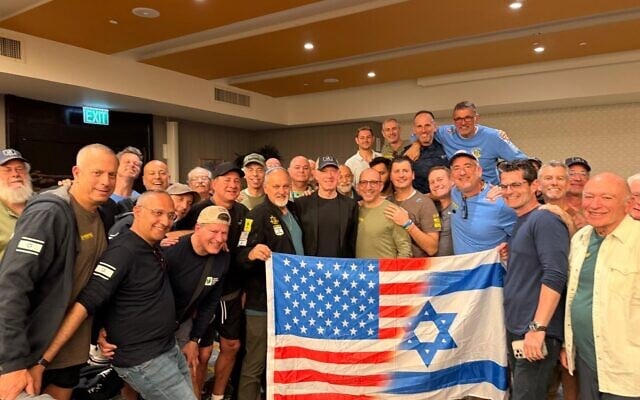
“We weren’t stuck,” Katz said. “We were with our brothers.”
A mission redefined
Originally planned as a weeklong volunteer and solidarity mission to bestow acts of lovingkindness on Israelis who were impacted by the Israel-Hamas war, as well as to support Jewish National Fund-USA’s resilience, therapy, and rebuilding initiatives in Israel’s North and South, the trip stretched into nearly two weeks for some participants as travel disruptions complicated departures. Some participants, like Segal, exited through neighboring Jordan after Jewish National Fund-USA arranged for a van to take several of the guys to the Israel-Jordan border. They spent the night at a hotel in Amman, Jordan’s capital, before flying out to New York City.
Katz, who had planned on extending his trip for five days and was delayed returning home another three days because of the war, eventually caught an El Al flight to Miami.
But even as logistics became more complex, the mission itself intensified.
From the outset, the group immersed itself in hands-on volunteer work. On their first day, they partnered with Israel’s Home Front Command, working alongside Jewish National Fund-USA affiliate Special in Uniform, which integrates young adults with disabilities into the Israel Defense Forces (IDF), helping them develop social skills, everyday life skills, and practical job skills. The experience, Katz said, was both humbling and inspiring.
“The Israeli army has really done a tremendous job of building these individuals up and not having them be excluded,” he said. “A lot of them have tremendous skills in organizing and processing supplies.”
That same day, mission participants attended a program convened by Next October, an initiative connecting high-tech entrepreneurs with families of victims from the Oct. 7 attacks. Hosted at Kibbutz Shefayim, which has absorbed displaced residents from devastated communities near Gaza, the event left a profound emotional impact.
“That was a very meaningful event,” Katz said. “We met with lots of families of fallen soldiers and victims, and it was just very heart-wrenching, because they would come up to us and tell us how much it meant to them and how much it honored the legacy of their fallen soldier or their fallen Nova victim.”
Segal praised the mission of Next October, which proposes the establishment of more than 1,750 new startup companies for each fallen soldier and civilian victim of the Oct. 2023 Hamas War.
“Israel has more startups per capita than any other country in the world, and some of these will hit big, and your hope is that some of these technologies that they invent will be named after a fallen hero and the name will forever be synonymous with something beautiful,” Segal said.
Healing a wounded nation
If there was a unifying theme to the Brotherhood Mission’s work, it was healing.
“The majority of the missions that we do gravitate to healing, helping the country heal, whether it be through PTSD farms, therapy, therapy clinics, hospitals,” Segal said. “More than half of the projects that we’re involved with all deal with mental health or physical well-being and trying to patch the country back together.”
On this recent mission, participants—about half of whom were American doctors, though people of all professions were welcome—visited therapeutic farms, rehabilitation centers and community programs, including Jewish National Fund-USA affiliate LOTEM, which uses the healing powers of nature to make society accessible for people with disabilities. Additionally, certain programs offered are designed to help Israelis cope with trauma. At one such site in southern Israel, they met soldiers grappling with severe psychological distress.
“They call it TSD—trauma stress disorder,” Segal noted. “It’s not ‘post’ yet. A lot of them are dealing with trauma right now and they said, ‘We’ll get to the ‘post’ later.’ That’s their Israeli humor, trying to make light of it.”
Katz recalled meeting soldiers who had been suicidal in the aftermath of their experiences but were beginning to recover through structured therapy programs
supported by Jewish National Fund-USA, including the Rimon Therapeutic and Rehabilitative Farms in the Negev.
“These places,” he said, “are saving lives.”
The group also met Tal Shoham, a former hostage held for more than 500 days in Gaza after being abducted on Oct. 7 from his home at Kibbutz Be’eri. Despite enduring unimaginable hardship, Shoham has dedicated himself to helping others heal.
“He’s taken his grief and turned it into something constructive,” Katz said. “That’s a pattern we saw everywhere—people channeling tragedy into service.”
Brotherhood under fire
Even amid the stress of wartime conditions, the camaraderie among participants stood out.
“These are all successful, type-A individuals,” Katz said. “But there were no egos on that bus. No arguments, no divisiveness. Everyone just helped each other. The amazing part of this trip is all these boundaries just fall by the wayside.”
That spirit extended beyond the group itself. In bomb shelters during late-night sirens, participants found themselves singing with Israeli families, helping parents carry strollers downstairs, and offering comfort in moments of fear.
“The Israelis couldn’t believe we were there,” Katz said. “They kept asking, ‘Why would you come now?’ And the answer is simple: because we’re family.”
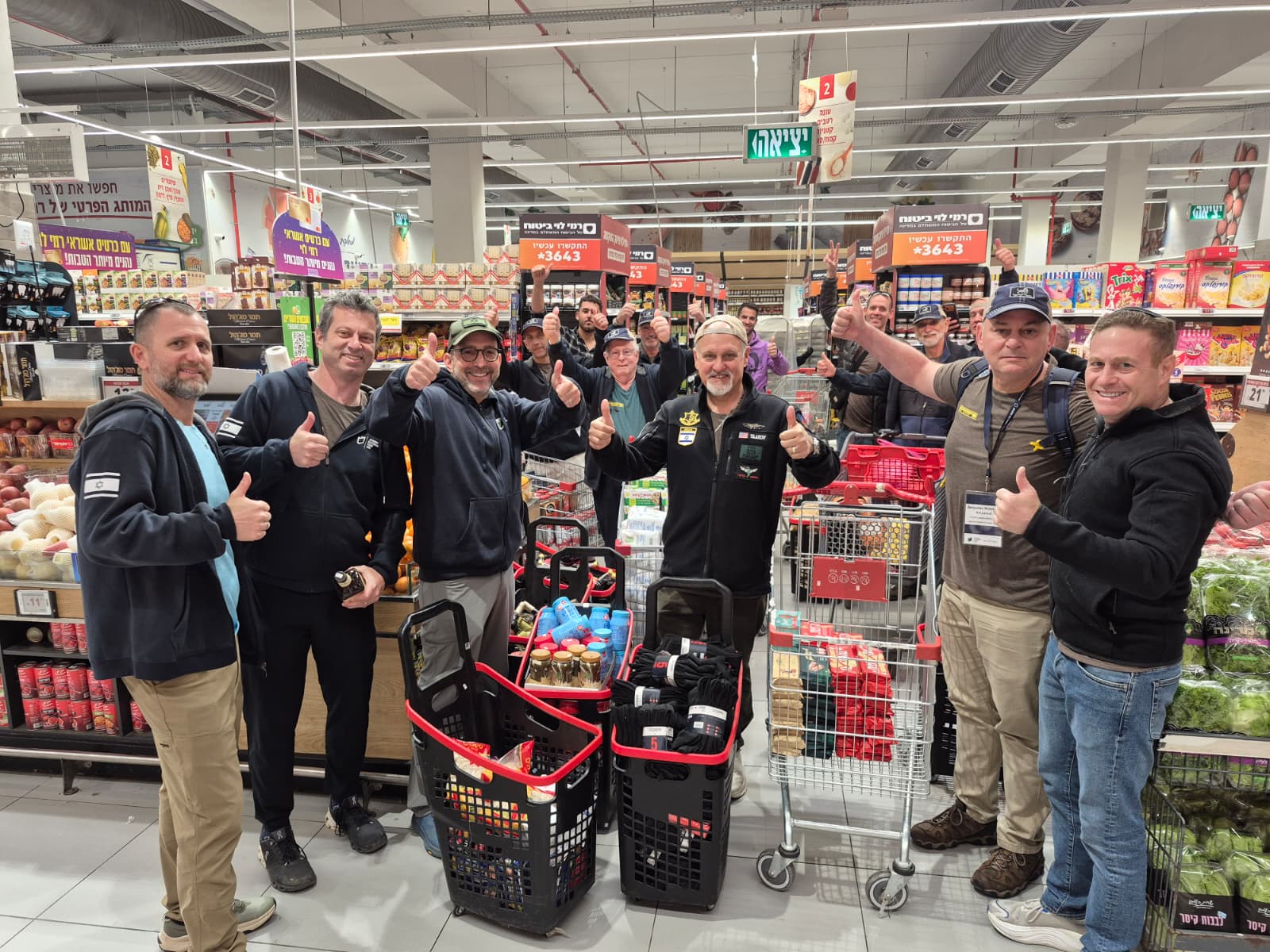
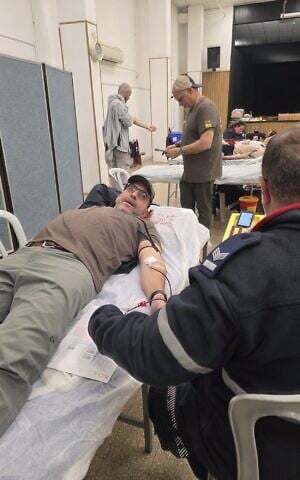
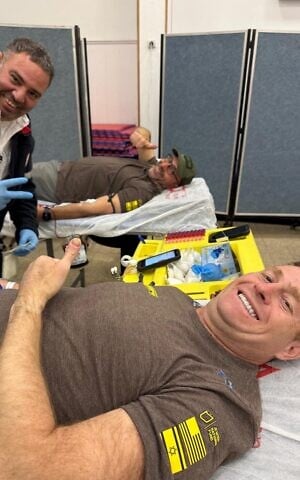
Despite restrictions that limited travel to Israel’s South, the group adapted by bringing good deeds and acts of service to them. They organized a blood drive near their hotel, went grocery shopping for supplies, packed food packages for Air Force pilots, and assembled Purim food baskets—mishloach manot—for families in need.
“We were busy, even with the war,” Katz said.
They also found unexpected moments of joy. When a planned Purim celebration in Be’er Sheva was canceled due to security concerns, the group hosted its own celebration in Caesarea, inviting soldiers from Unit 9221, a reserve combat unit from the West Bank. A local Chabad rabbi and his son turned out to lead a megillah reading.
“We were singing with these soldiers, and they were so happy, and you could see the joy on their faces that we were there with them celebrating before they went out and did missions that night,” Katz said.
On the front lines of solidarity
Throughout the trip, the participants made a point of showing up—whether by visiting soldiers stationed along the Israel-Syrian border in the Golan Heights or by building a children’s play area, which required hauling bricks in cold, muddy conditions.
In one memorable moment, they hosted a barbecue for a tank crew stationed in an isolated outpost near the Golan.
“It was like minus-30-degrees—it was freezing,” Segal said. “And we showed up with food, music, just trying to lift their spirits. They were incredibly appreciative.”
The group also received an unexpected visit from a senior Israeli official, who provided insights into the country’s strategic situation and its relationship with the United States. While the details of the conversation were off the record, Katz described it as “a huge highlight…he was basically saying that the Israel and the United States have never been more aligned.”
A growing movement
Since its inception, the Jewish National Fund-USA Brotherhood Missions to Israel have collectively raised more than $5 million for the land and people of Israel, with each participant of the latest mission committing to a minimum fundraising goal of $18,000 on top of covering their own travel expenses.
Katz said that 80 percent of the funds raised benefit Jewish National Fund-USA projects. “The trip is self-funded, so every penny we raise goes to the projects that we’ve allocated to.”
But the mission’s impact extends beyond fundraising totals. Katz believes its greatest success lies in activating individuals who were previously less engaged in Jewish communal life.
“People come on this trip, and something changes,” he said. “They go home and start hosting events, raising money, getting involved. They become advocates.”
Looking ahead, the organizers plan to expand the initiative. A fourth weeklong mission is already scheduled for Feb. 24, 2027, with hopes of doubling participation and even including non-Jewish allies.
“We want anyone who supports Israel to be part of this,” Segal said. “We’ve seen that solidarity firsthand—from Jewish communities, from the Druze, from others. It matters.”
A lasting impact
For Katz, the experience has been life-altering. He is preparing to make aliyah, relocating permanently to Israel in the coming months.
“I want to contribute to the State and the people,” he said. “I want to be all-in.”
That sense of belonging—of shared destiny—resonated throughout the mission. Whether in moments of fear or celebration, participants found themselves connected not only to each other, but to the broader story of the Jewish people.
“You can’t just embrace Israel when it’s easy and good and it’s beaches and shawarma,” Katz said. “You also have to be there when times are rough, and the people of Israel, which are our family, have suffered since Oct. 7, 2023, non-stop.”
For those wishing for more information or to join the next Jewish National Fund-USA Brotherhood Mission to Israel, they can email travel@jnf.org or visit jnf.org/BrotherhoodMission.