

US authorities locate 400 pages of Hitler confidant’s lost diary
Holocaust Memorial Museum says discovery of Alfred Rosenberg’s journal, missing since 1946, ‘sheds new light’ on historical events
 Add ToI as a Preferred Source on Google
Lazar Berman is The Times of Israel's diplomatic reporter
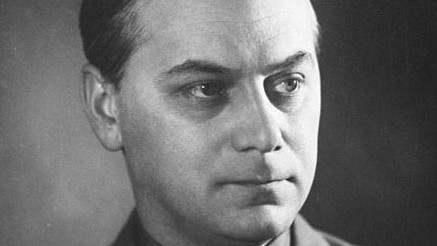
Nearly 400 missing pages of the diary of prominent Nazi Alfred Rosenberg have been found by US federal agents, according to the United States Holocaust Memorial Museum.
Details of the discovery were revealed at a press conference Wednesday in Wilmington, Delaware.
Museum experts have yet to fully review the diary, which had been missing since 1946, but it “does give details that one would never know about the politics within the top leadership of Nazi party and the state,” said Henry Mayer, senior adviser on archives the museum.
Specifically, it is expected to shed new light on meetings Rosenberg held with Adolf Hitler, Hermann Goering, and Heinrich Himmler. It also includes new information on internal disputes within the Nazi high command, especially tensions in the wake of deputy fuhrer Rudolf Hess’s 1941 solo flight to Scotland in a quixotic attempt to broker peace with the United Kingdom.
Details of German plans to exterminate Jews and other peoples in Eastern Europe are also contained in the journal.
The diary contains Rosenberg’s handwritten entries from spring 1936 to winter 1944. According to the museum’s report, some of the recollections are written on the back of official Nazi stationery.
Rosenberg was a close associate of Hitler’s, and played a prominent role in planning the Holocaust. In addition to heading the Nazi party’s foreign affairs department and editing the party newspaper, Rosenberg served as reich minister for the occupied eastern territories, giving him responsibility for the extermination of Jews in the Soviet Union. He also established the Einsatzstab Rosenberg, a body dedicated to looting cultural treasures from across the Continent to bring to Germany. Much of the art came from Jewish collectors.
“The documentation is of considerable importance for the study of the Nazi era, including the history of the Holocaust,” the Holocaust Memorial Museum said in a statement. “A cursory content analysis indicates that the material sheds new light on a number of important issues relating to the Third Reich’s policy. The diary will be an important source of information to historians that complements, and in part contradicts, already known documentation.”
After standing trial before the International Military Tribunal at Nuremberg in 1945 for crimes against humanity, Rosenberg was hanged on October 16, 1946, along with other senior Nazis. His diary was used as evidence by the prosecution, but mysteriously disappeared after the trial.
American officials suspected that Robert Kempner, assistant US chief counsel at Nuremberg, himself a concentration camp survivor, smuggled the diary back to the United States. As prosecutor, Kempner had access to thousands of original documents, and was a master at locating key pieces of evidence, identifying most notably the Wannsee Protocol in which senior Nazis discuss the Final Solution.
After receiving permission to “review and retain” certain unclassified documents for “research, writing, lecturing, and study”, Kempner left Germany with a large number of documents that he kept guarded in his private collection.
Over the ensuing years, excerpts from the diary occasionally surfaced. Entries from 1939 and 1940 were published by a German historian, and Kempner himself cited the journal in his memoir. Still, the book was not found.
After Kempner’s death in 1993, a fight over his papers broke out between his family, his secretary, and the Holocaust Memorial Museum. Kempner’s children finally agreed to release the papers to the museum.
More than 150,000 documents were recovered, a significant portion of which were found in the hands of Kempner’s former secretary, who was living with an academic named Herbert Richardson in New York. But the diary was not among the found documents.
Its scholars first reviewed the collection in 1997, but when they returned two years later to reassess the documents, they found that thousands of papers had gone missing.
The FBI opened an investigation into the case, but filed no charges.
Some of the collection was recovered in 2001 and 2003.
In early 2013, federal agents working with the Holocaust Museum located the diary at a company in upstate New York, and handed it over the Department of Homeland Security office in Delaware.









The Times of Israel Community.