

Hagel forced out as US defense secretary
Sources cite differences over Syria, tackling Islamic State; Israel praises ‘true friend’; Michele Flournoy possible successor
 Add ToI as a Preferred Source on Google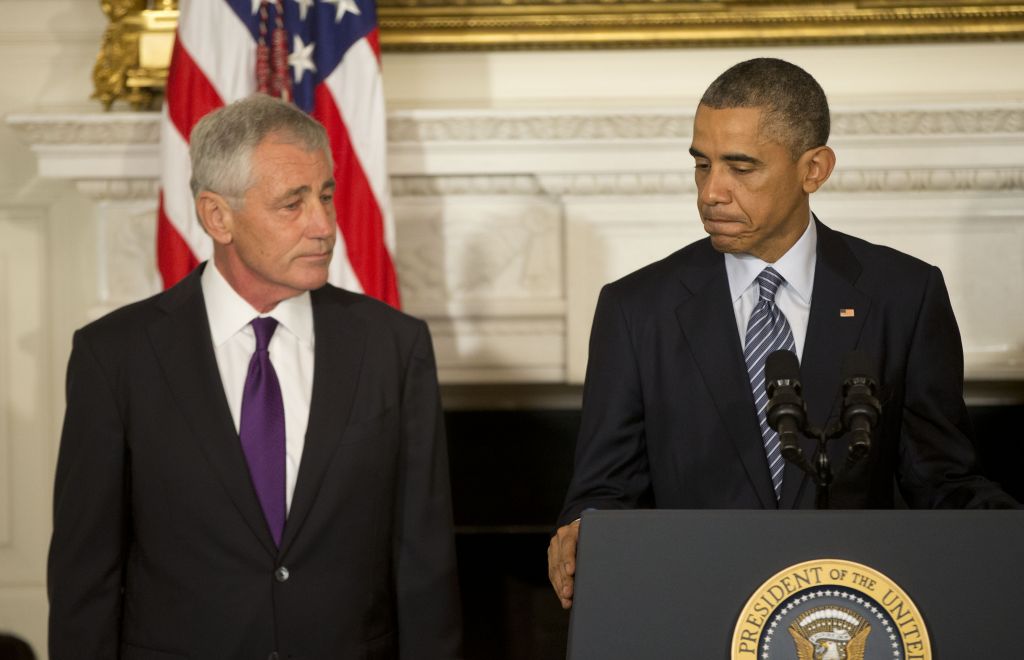
US Defense Secretary Chuck Hagel announced Monday he is stepping down, leaving under pressure following a rocky tenure in which he has struggled to break through the White House’s insular team of national security advisers.
During a White House ceremony, Obama said he and Hagel had determined it was an “appropriate time for him to complete his service.”
Hagel is the first senior Obama adviser to leave the administration following the sweeping losses for the president’s party in the Nov. 4 elections. It also comes as the president’s national security team has been battered by crises including the rise of Islamic State militants in Iraq and Syria and Russia’s provocations in Ukraine.
The president praised Hagel, a Republican who grew close to Obama while they both served in the Senate, as an “exemplary defense secretary” who forged a strong bond with troops stationed around the world. Hagel, who served in the Vietnam War, is the first enlisted combat veteran to serve as defense secretary.
“Chuck Hagel has devoted himself to our national security and our men and women in uniform across six decades,” Obama said.
Among the leading contenders to replace Hagel is Michele Flournoy, who served as the Pentagon’s policy chief for the first three years of Obama’s presidency. Flournoy, who would be the first woman to head the Pentagon, is now chief executive officer of the Center for a New American Security, a think tank that she co-founded.
Others mentioned as possible replacements include Ash Carter, the former deputy defense secretary, and Robert Work, who currently holds that post.
While Obama has sought to consolidate foreign policy decision-making within the White House, advisers have privately worried about Hagel’s ability to communicate the administration’s positions. There have also been concerns that Hagel wasn’t proactive or engaged in Cabinet meetings and other national security discussions.
In what appeared to be an effort to refute that criticism, Obama said Monday that Hagel had always “given it to me straight” during their private conversations in the Oval Office.
Hagel has had his own frustrations with the White House. In recent weeks, he sent a letter to national security adviser Susan Rice in which he said Obama needed to articulate a clearer view of the administration’s approach to dealing with Syrian President Bashar Assad. The letter is said to have angered White House officials.
Sen. John McCain, the Republican who is poised to become chairman of Armed Services Committee, said Hagel has been “frustrated with aspects of the administration’s national security policy and decision-making process.”
“His predecessors have spoken about the excessive micromanagement they faced from the White House and how that made it more difficult to do their jobs successfully,” said McCain, referring to public criticism from Robert Gates and Leon Panetta. “Chuck’s situation was no different.”
Hagel submitted his resignation letter to Obama on Monday morning. The 68-year-old said he had agreed to remain in office until a successor is confirmed by the Senate.
Hagel’s aides assert that he is leaving at an appropriate juncture, after having brought to fruition this year several major initiatives on nuclear weapons management and as well as reforms to the military justice system and to the military health system. But his departure also coincides with a period of great uncertainty over the course of the administration’s campaign to defeat the Islamic State group, as well as worry over Russia’s actions in Ukraine.
The timing of Hagel’s departure sets up a potential confirmation fight in the Senate. Republicans, who will take control of the body next month, have been deeply critical of the president’s foreign policy.
Hagel served as senator from Nebraska and became a critic of U.S. involvement in Iraq. After Obama nominated him to succeed Leon Panetta as defense secretary in his second term, Hagel struggled through a confirmation hearing that raised early concerns about him within the White House.
Recent questions about Hagel’s future at the Pentagon were prompted in part by his decision to postpone a long-planned trip this month to Vietnam. At the time, officials said he needed to remain in Washington for congressional consultations, but that did not stop speculation that the White House might be looking for a replacement for the final two years of Obama’s term.
Senior administration officials who spoke with The New York Times said the decision to replace Hagel stemmed from the belief that he lacked the necessary skills to manage the fight against the Islamic State in Iraq and Syria.
“The next couple of years will demand a different kind of focus,” an official told The New York Times.
Speaking at the White House after submitting his resignation letter Monday, Hagel said he was “immensely proud” of what was accomplished during his tenure.
Hagel said the US had prepared itself, its allies and Afghanistan’s military for a successful transition. He said the US had strengthened alliances and partnerships overseas while responding successfully to global crisis, and that the Pentagon had launched important reforms that will prepare the military for future challenges.
Reacting to the news, Israel’s Defense Minister Moshe Ya’alon released a statement calling Hagel “a true friend of Israel” who contributed greatly to Israel’s security and its ties with the United States.
A critic of Israel
Before he assumed office in the Pentagon, Hagel was known as a critic of Israel and of American policy toward the Jewish state. He criticized the Bush administration in 2002 for refusing to meet with late Palestinian leader Yasser Arafat, and rebuked Israel for not engaging in negotiations with an Arafat-led Palestinian Authority.
“Israel must take steps to show its commitment to peace,” he wrote in the Washington Post at the time. “This does not mean giving up or limiting its right to self-defense against terrorism. But Palestinian reformers cannot promote a democratic agenda for change while both the Israeli military occupation and settlement activity continue.”
During the 2006 Second Lebanon War, Hagel broke party ranks by calling for an immediate unilateral ceasefire by both Israel and Hezbollah.
“The sickening slaughter on both sides must end and it must end now,” the then-senator from Nebraska said. “President Bush must call for an immediate cease-fire. This madness must stop.”
Hagel, a Vietnam veteran, was also an outspoken critic of the Bush administration’s foreign policy vis-à-vis Iraq, and rebuked his party’s approval for deploying more troops later in the war.
“There will be no victory or defeat for the United States in Iraq. These terms do not reflect the reality of what is going to happen there,” he wrote in the Washington Post in 2006. “The time for more US troops in Iraq has passed. We do not have more troops to send and, even if we did, they would not bring a resolution to Iraq.”
Once he became defense secretary, however, Hagel’s tone changed on Israel.
Israel is “a model for the world, and the relationship between our two countries… is as strong as it’s ever been,” Hagel said during his first trip to Israel while in office. “This is a difficult and dangerous time. This is a time when friends and allies must remain close, closer than ever. I’m committed to continue to strengthen this relationship.
Ilan Ben Zion contributed to this report.






The Times of Israel Community.