

Jerusalem said to make blacklist of Arab residents
Municipality reportedly targets families of protesters in last summer’s riots in East Jerusalem for special investigation
 Add ToI as a Preferred Source on Google
Judah Ari Gross is The Times of Israel's religions and Diaspora affairs correspondent.
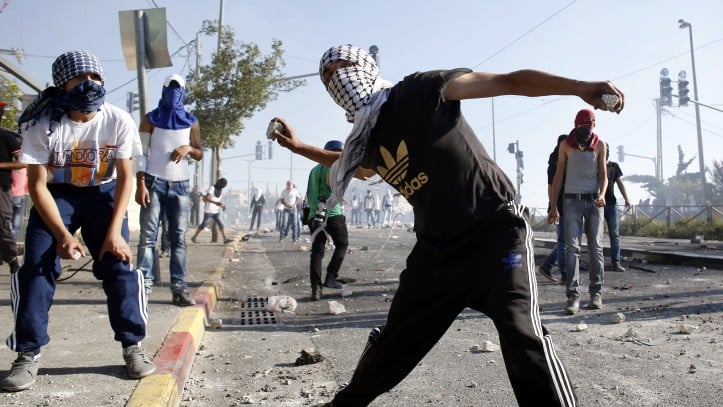
The Jerusalem municipality has reportedly been targeting protesters from this summer’s riots in East Jerusalem and their families for additional, hyper-critical scrutiny by city services.
City workers have been told to check names and ID numbers they come across to see if they appear on a blacklist, Haaretz reported Tuesday. The semi-official register catalogs residents of East Jerusalem known by police to have taken part in last year’s violent protests in response to the murder of Muhammed Abu Khdeir and Operation Protective Edge.
For those whose names appear on the list, officials are reportedly instructed to review tax records, building permits, business licenses and more to see if they contain any irregularities that the municipality can use against them.
The municipality has also enlisted other governmental and bureaucratic bodies to this end, the report said. The National Insurance Institute and the Interior Ministry also use these lists to target rioters.
Some of those who appear on the list, of which Haaretz received a copy, are minors, some as young as 11, who in some way took part in the riots. In addition to the protesters, the list also contains the names of local Arab community leaders.
Jerusalem Mayor Nir Barkat has said in the past that he planned on using a firmer hand with East Jerusalem residents and as such his administration defended this new tactic.
“In general it should be noted that it is the city’s duty to demand the compliance of building code violators, invaders of the public space, those who have unpaid municipal taxes or water bills and the like,” the municipality said in a statement. “Our actions are carried out only with regards to our legal authority, according to the law and with the full support of the city’s legal counsel, and in areas that require additional security for city workers — in coordination with the police.”
“Many residents of East Jerusalem turn to the municipality because of a lack of city enforcement that only encourages criminals to take over the private and public areas and devastate the lives of neighborhood residents, and our enforcement activities have even been met with praise by the public,” the statement continued.
“It’s not clear what charge is being raised against the municipality,” a city official was quoted as saying in responce to the report.
But some question the legality of the inequitable enforcement of city ordinances.
“If someone commits a traffic violation, you take him to traffic court. You can’t punish him in some other place,” Sami Arshid, an attorney who often represents Jerusalem Arabs, said. “That is the use of administrative law for extraneous considerations. It is collective punishment that is against the spirit of justice.”
Michael Sfard, who most recently unsuccessfully defended the PLO in New York, also questioned the practice.
“A system of enforcement is supposed to prioritize based off objective criteria that serve the rule of law, not based off security interests,” he said. “Beyond that, it is plain and simple the persecution of people and a bad use of governmental power. It is a style of power that we’ve only seen in undemocratic regimes. If it indeed exists in Israel, it represents the worst kind of corruption.”










The Times of Israel Community.