

NYT’s Friedman: Israel should’ve worked with US for better Iran deal
Veteran columnist says nuclear agreement is ‘giant bet’; argues Netanyahu should have ‘hugged Obama’ so that Israel was ‘the P6’
 Add ToI as a Preferred Source on Google
Stuart Winer is a breaking news editor at The Times of Israel.
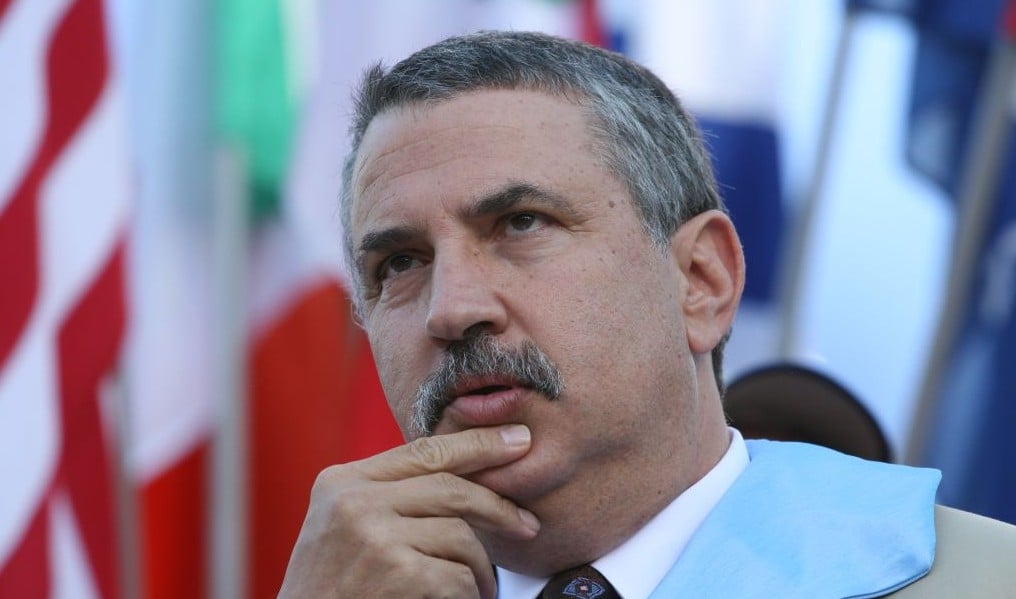
New York Times columnist Thomas Friedman said Thursday that the nuclear deal with Iran is “a giant bet,” and suggested that by working tightly with the Obama administration during negotiations, Israel and the US would have come away with a better deal.
In an interview with Army Radio, Friedman discussed his Wednesday opinion piece in The New York Times in which he tried to view the nuclear deal through the eyes of three Israelis: a grocer, an IDF general, and the Israeli prime minister.
“We have to admit that America’s interests and Israel’s interests are not the same here,” Friedman noted. “Israel understandably wants a non-nuclear Iran and given the current regime, a weak Iran. America really just wants a non-nuclear Iran. We can live with a healthy Iran if we see the prospect of it changing its behavior.”
Friedman criticized Prime Minister Benjamin Netanyahu’s approach of trying to block the deal by pushing against US President Barack Obama’s policies, and said that the Israeli leader should instead have “hugged Obama” in order gain more access to the negotiations between Iran and the so-called P5+1 world powers of US, Britain, France, Russia, China, and Germany.
Closer work with the US would have meant that “we didn’t just have a P5 but that Israel was the P6, so that Israel was effectively in the room through the US because of such a tight relationship.”
“I think we would have had a better deal and Israel would have had a better deal,” Friedman said. The current agreement is, he said, “a giant bet.”
“It’s a bet by the leader of Iran that the deal with be just transactional — ‘we’ll [the Iranians] do the deal, we’ll get our money’ — but that it won’t change the region. And it is a bet by Barack Obama that the deal with not be transactional, but transformational.”
“I am frightened for Israel,” he said. “It really is a bet and what I am trying to argue for is to increase the insurance on the bet by increasing our deterrence.”
In the opinion piece, titled “If I Were an Israeli Looking at the Iran Deal,” Friedman speculated that as the grocer viewing the nuclear deal, “I’d hate it for enshrining Iran’s right to enrich uranium, since Iran regularly cheated its way to expanding that capability.”
Seeing things as an IDF general, while sharing “my grocer’s skepticism,” Friedman said he would rely on the doctrine that “no enemy will ever out-crazy us into leaving this region,” a view he explained to Army Radio.
“Israel has leaned to survive in the Middle East by playing by the local rules,” he said. “And the local rules are ‘you will not out-crazy us.'”
“The Israeli army tries to avoid civilian casualties, but if you launch your rockets from the homes and backyards of civilian areas, Israel will respond accordingly, and if that results in a lot of civilian casualties, so be it,” Friedman, said referring to the Hamas and Hezbollah tactic of firing rockets from civilian areas.
The nuclear deal, which was signed on July 14 and is now awaiting approval or disapproval from Congress, has developed into a bitter partisan debate with heated arguments among US lawmakers for and against the terms of the agreement. In addition to reducing Iran’s uranium enrichment capabilities, it also stipulates monitoring of nuclear sites by international inspectors.
“Inspectors are good, but what I want is for the Iranians to understand that if they cheat there will be vast military consequences from the United States of America,” Friedman said. “You can say what you want but on the whole this Iranian regime has not been suicidal — it has been quite homicidal — but not suicidal as compared to Saddam Hussein’s regime.”
Saddam he recalled, had “bet his whole regime” three times — in 1980 by attacking Iran, in 1990 by invading Kuwait and in 2003 by thinking that US president George Bush wouldn’t invade.
“Israel generals make the same point, these people [the Iranians] are very good at calculating the balance of power,” he said. “I want to make sure the balance of power and the level of deterrence from the US and from Israel and from its allies is indisputable.”
In his opinion piece, Friedman speculated that as Israeli prime minister he would recognize that campaigning via pro-Israel lobbyists to defeat the deal in Congress would result in a worse situation than one in which there was no agreement at all.
“It is an imperfect deal, as are all arms control agreements,” Friedman said. “We are dealing with a really complex foe in Iran, one that we don’t have a lot of transparency on and one that both the United States and Israel have had bad experience on.”
While noting that he has “total respect” for Netanyahu’s position, he added that “I don’t see the credible alternative right now.”
Friedman tried to offer an insight into why Obama is so emotionally invested in the Iran nuclear deal.
“He really believes that this deal can work, and if it works it will buy Israel 15 years of much more security,” he said, noting that he himself has interviewed the US president about Iran. “And because he thinks it opens up the possibility for transformation of the Iranian political scenes.”
“Obama believes that Iran was a great civilization and can be again,” he said. “He believes that the Arab world right now is very, very messed up and in turmoil. I think that what he believes is that this 36-year alienation between American and Iran has not served American interests. That there is a real civilization there that can emerge under the right conditions [to] be a contributor … at a moment when the Arab world is disintegrating. America needs some partner in certain places to help us manage the disintegration of the Arab world, whether it is counterbalancing ISIS [Islamic State] or counterbalancing the Taliban.”
Despite the sharp differences between Netanyahu and Obama on Iran, Friedman predicated that the US and Israel would remain staunch allies.
“I still believe there are so many common interests, and more so as the whole region disintegrates, we are doomed to be friends,” he said.










The Times of Israel Community.