

US says Iran nuclear talks to continue until Friday
US official says sides to remain in Vienna to ‘allow additional negotiations,’ but EU foreign policy chief insists deadline not extended
 Add ToI as a Preferred Source on Google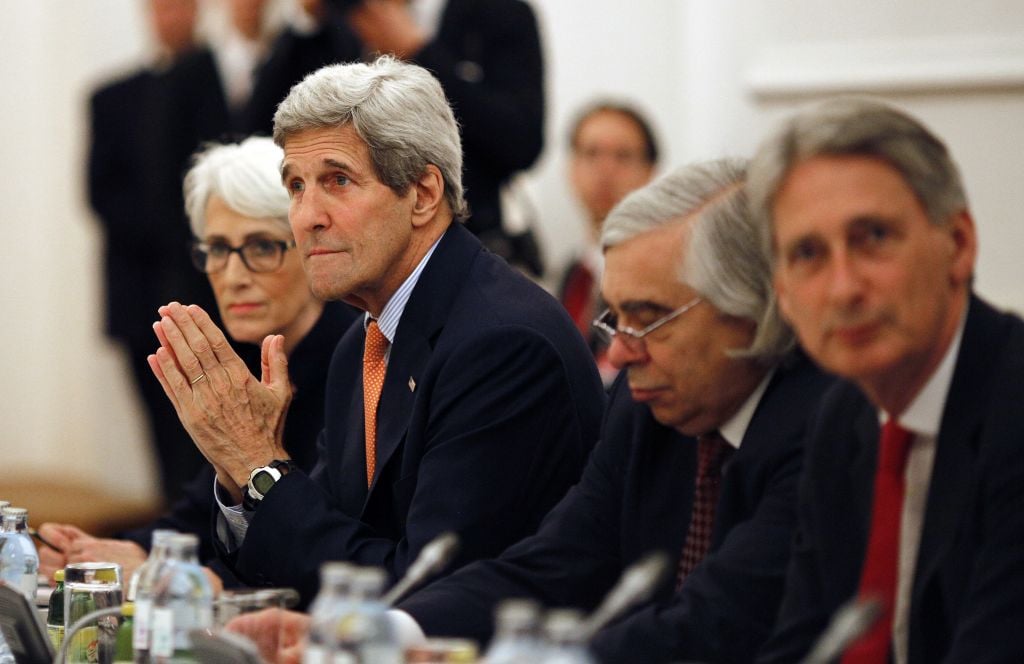
The terms of the 2013 interim nuclear deal between Iran and major powers have been extended until Friday, the US said Tuesday, meaning this is the new effective deadline for talks on a final deal.
“To allow for the additional time to negotiate, we are taking the necessary technical steps for the measures of the Joint Point of Action (the 2013 agreement) to remain in place through July 10,” State Department spokeswoman Marie Harf said.
“We are continuing to negotiate for the next couple of days,” EU foreign policy chief Federica Mogherini told reporters during a break from the negotiations in Vienna.
“This does not mean we are extending our deadline. I told you one week ago more or less. We are interpreting in a flexible way our deadline, which means that we are taking the time, the days we still need, to finalize the agreement,” she said.
She added that a deal is “something which is still possible even if we are now getting into the difficult time. I am here to stay, to continue together with all the teams. All the six teams are here.”
She said that foreign ministers may leave the talks but “are ready to come back in the coming hours and days.”
An Iranian spokesman told AFP meanwhile that for his delegation, “we have no deadline.”
Diplomats extended their discussions by a week when they missed their goal of a pact by June 30, after passing previous deadlines in July 2014 and last November. For Kerry and his team, pressure is increasing from skeptical US allies and members of Congress. If the accord isn’t sent over to American lawmakers by Thursday, their month-long review period would be doubled to 60 days, hampering the ability of the Obama administration to offer speedy economic benefits to Iran for nuclear concessions.
In Tehran Tuesday, Iran’s Atomic Energy Organization declared it had reached a “general understanding” in parallel talks with the UN nuclear agency on “joint cooperation.” The Iranians have made similar claims previously, and it was unclear if any process was established for the International Atomic Energy Agency’s long-stymied investigation of past nuclear weapons work by the Islamic Republic — a demand of Washington and its partners in negotiations in Austria’s capital.
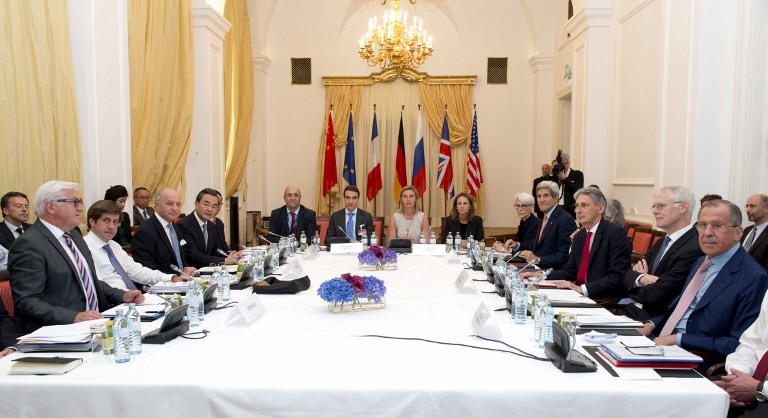
There, in a baroque, 19th-century palace, Kerry gathered early Tuesday with the foreign ministers of Britain, China, France, Germany and Russia. The larger group was to meet with Zarif at some point later in the day, with the clock ticking. Russia’s Sergey Lavrov and China’s Wang Yi were expected for a gathering of emerging economies in the Russian city of Ufa on Wednesday, and White House spokesman Josh Earnest said another prolongation of talks was “certainly possible.”
The US is in a tough spot. President Barack Obama has expended significant political capital on finalizing an agreement that has prompted suspicion from Iran’s regional rival, Saudi Arabia, outright hostility from America’s closest Mideast ally, Israel, and deep ambivalence even among Obama’s Democratic allies in Congress. They’re concerned that the accord would leave Iran’s nuclear infrastructure largely intact and compel the West to provide the leading US-designated state sponsor of terrorism with potentially hundreds of billions of dollars’ worth of economic relief from international sanctions.
To ease their concerns, Obama and Kerry have vowed to hold out for a “good deal” that verifiably keeps Iran at least a year away from a nuclear weapons capability for at least a decade. Current intelligence estimates put the Iranians only two to three months away from amassing enough material for a nuclear warhead, if they pursued such a course. As part of the guarantee, the administration has repeatedly threatened to abandon negotiations if they prove fruitless or appear as an Iranian stall for time.
On-and-off talks with Tehran have been going on for more than a decade, though this incarnation has come closest to any resolution. The latest effort began in secret a couple of years ago and gained speed after the election of moderate-leaning Iranian President Hassan Rouhani in 2013. By November that year, Iran and the six world powers clinched an interim nuclear agreement and began the process for a comprehensive accord.
Over the weekend, a cautious Kerry told reporters that talks on the final package “could go either way.”
“If we don’t have a deal, if there’s absolute intransigence, if there’s an unwillingness to move on the things that are important, President Obama has always said we’ll be prepared to walk away,” Kerry said. “It’s not what anybody wants. We want to get an agreement. But I’ve said from the moment I became involved in this we want a good agreement, only a good agreement, and we’re not going to shave anywhere at the margins in order just to get an agreement.”
Republicans hostile to compromise with Iran have been urging the US to pull back from the talks. Their refrain for several months has been that Obama and Kerry want a deal more than the Iranians do, and have let red lines erode on Iranian enrichment capacity, inspections and providing limited sanctions relief. The president and his top advisers vehemently reject such claims.
Iran has its own red lines, defiantly outlined in recent weeks by Ayatollah Ali Khamenei, the nation’s supreme leader. They include a quick easing of sanctions, and rejection of any inspections of military sites or interviews with Iranian nuclear scientists.








The Times of Israel Community.