

At Ethiopian-Israeli rally, blood and smoke and scant hope for the future
Melees between protesters and cops leave 50 injured, as Tel Aviv protest against racism and police brutality devolves into chaos
 Add ToI as a Preferred Source on Google
Judah Ari Gross is The Times of Israel's religions and Diaspora affairs correspondent.
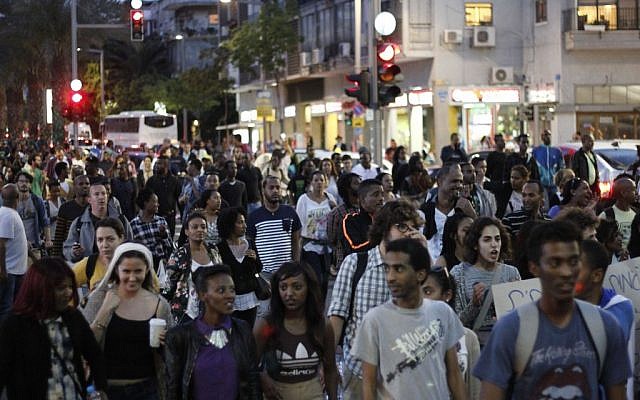
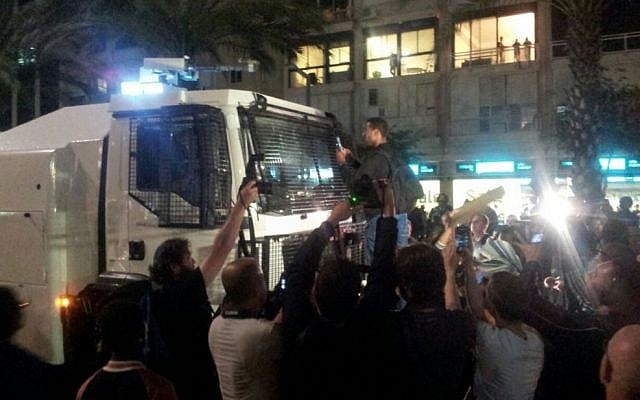
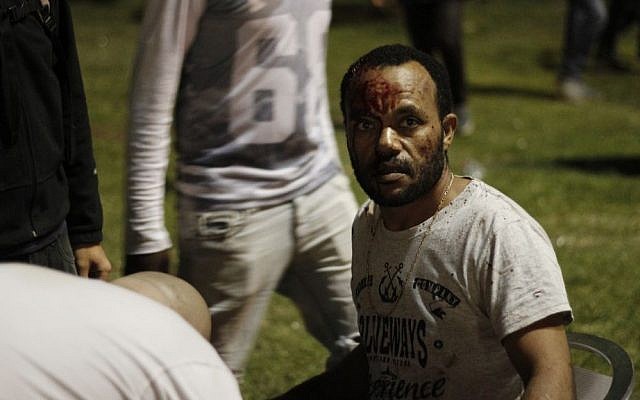
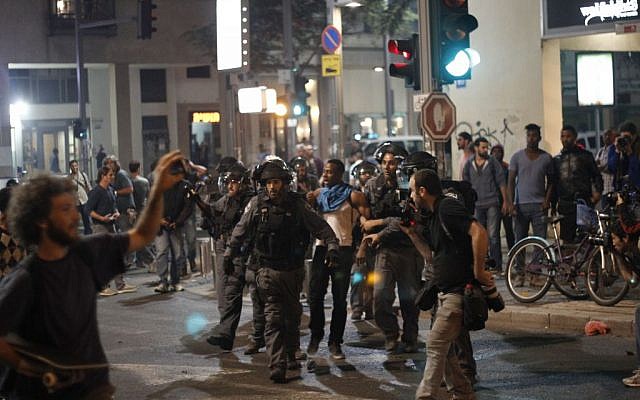
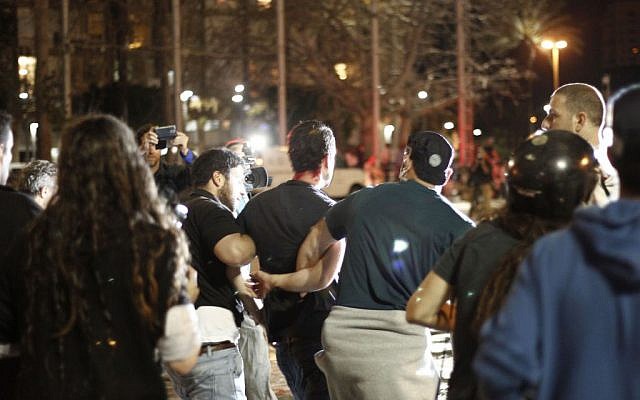
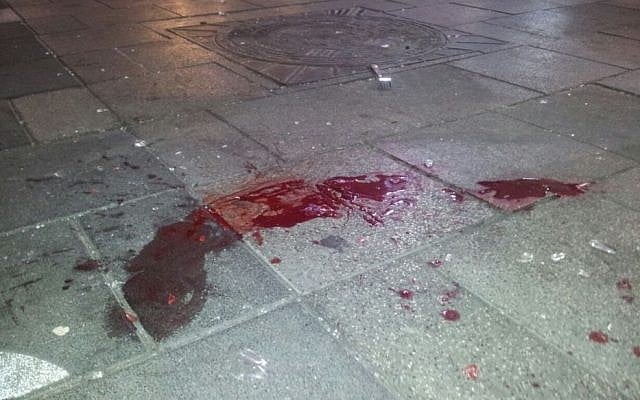
What began as a peaceful protest turned into bedlam in the heart of Tel Aviv Sunday, as demonstrators gathered to protest police brutality and alleged institutional racism against Israel’s Ethiopian population.
A video released last week showed a policeman and a police volunteer assaulting an Ethiopian-Israeli soldier in Holon. That footage sparked a demonstration in Jerusalem Thursday, and again in Tel Aviv Sunday night.
At Sunday’s demonstration, protesters threw rocks and glass bottles at police, who responded with stun grenades and fired water cannons at protesters.
As of midnight Sunday, almost 50 people were injured. According to Israel Police spokesman Micky Rosenfeld, 23 of them were police officers.
By the end of the night, 26 protesters were arrested, he said.
Police arrest 26 protesters this evening in Tel Aviv after disturbances. Extra police units in area to prevent any further incidents.
— Micky Rosenfeld (@MickyRosenfeld) May 3, 2015
Prime Minister Benjamin Netanyahu met with Public Security Minister Yitzhak Aharonovitch during the tempestuous protest, and afterward called for order.
“There’s room for the clarification of all claims, but there’s no room for violence and breaking the law,” he said. Netanyahu was set to meet leaders of the Ethiopian community Monday, including the soldier who was beaten by police last week.
Sunday’s protest began mildly. A few dozen Ethiopian-Israelis and sympathizers gathered at the intersection of Menachem Begin and Eliezer Kaplan streets. The group blocked traffic on Tel Aviv’s Ayalon Highway and other roadways, but the protest was non-violent.
Tenat, a nurse at Petach Tikva’s Schneider Children’s Hospital, sat down in the middle of the intersection. She had just worked a double shift at the hospital and was tired, but felt it was important to come to the demonstration. So she did what she could: block the intersection.
“This is my country, too,” she said. “Tomorrow it could be my brothers or my cousins [who are subject to police brutality].”
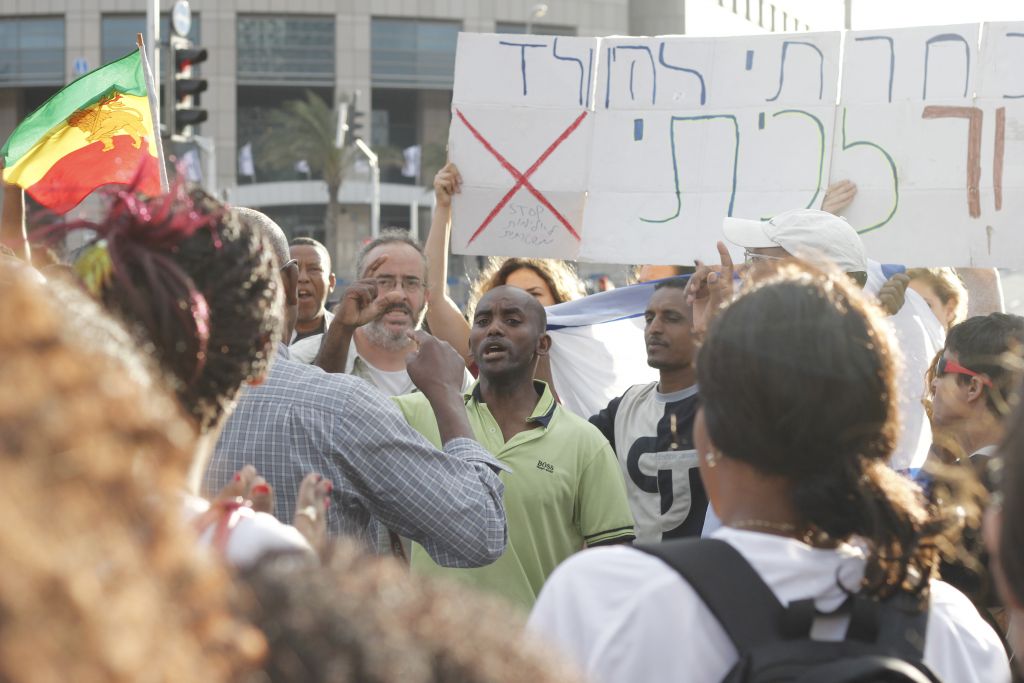
But as more people arrived at the normally busy intersection, the intensity grew. Police formed a human chain, locking arms to prevent protesters from crossing Menachem Begin eastward to Givat Hatachmoshet Street. Restless demonstrators took that as a challenge.
The two sides pushed up against each other for dominance. Protesters shouted at Israel Police, and then at the Border Police officers who arrived as reinforcements. A female protester broke the tension at 5:45 p.m. when she grabbed a policewoman’s hair and pulled. She was swarmed by other officers, handcuffed and escorted away.
After more aimless struggling with police on Givat Hatachmoshet, the protesters eventually made their way west down Kaplan toward Rabin Square, where the rally was planned to continue.
With no leadership or organizing committee, the protest lacked focus as the demonstrators arrived at the square in central Tel Aviv.
People chanted in Hebrew, “Violent police officers should be locked up!” and “For blacks and for whites, racism is the devil.”
Sometimes it was simpler. “Police state” and “no to racism,” some shouted.
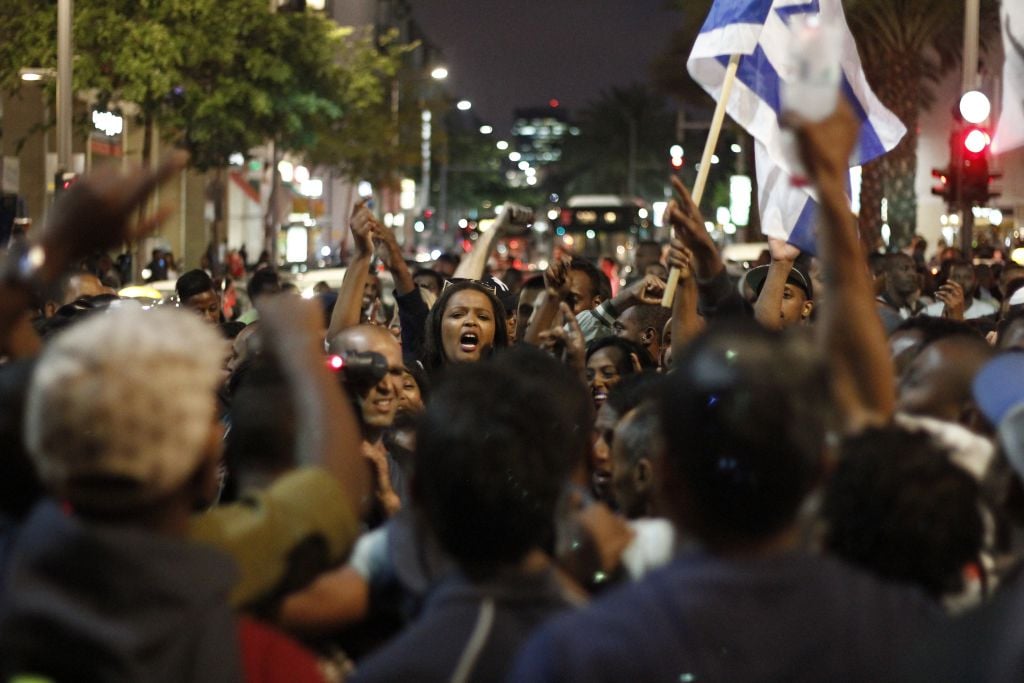
An Ethiopian man in his mid-20s who identified only as V., stood in the crowd draped in the flag of the Golani Brigade’s 13th Battallion. He was a veteran of the 2008’s Operation Cast Lead in Gaza.
“We say no to racism,” he said. “We say no to violence. We’ve had it up to here.
“I almost lost my life for the country, and this is how they treat me?”
But while many protesters came with good intentions, there were no speeches planned, no fixed goal. And so with nothing to do, protesters pushed their way onto the platform overlooking the square. Police quickly and forcefully pushed them back.
In response, protesters threw plastic water bottles at them. Eventually that unrest yielded small scuffles in the parking lot beneath the platform. The mounted police unit arrived on the scene shortly after 8:00 p.m., causing a stir amongst the demonstrators.
Police regrouped on the platform above the square, forming another human chain of officers in full riot gear. Protesters pushed and shoved, someone brought a hose from a nearby building and sprayed the police.
At a little after 9:00 p.m. the first stun grenades were thrown by police. That set off the first of many rounds of escalation, followed by full-blown conflict.
Over and over, police and protesters clashed on the east side of Rabin Square. The two sides would push and shove until someone — from either side — would push too hard. Police would respond by throwing stun grenades. Protesters would respond by throwing bottles and rocks.
According to Rosenfeld, “Police did not use force until… protesters threw stones at officers and there was no option but to make arrests.”
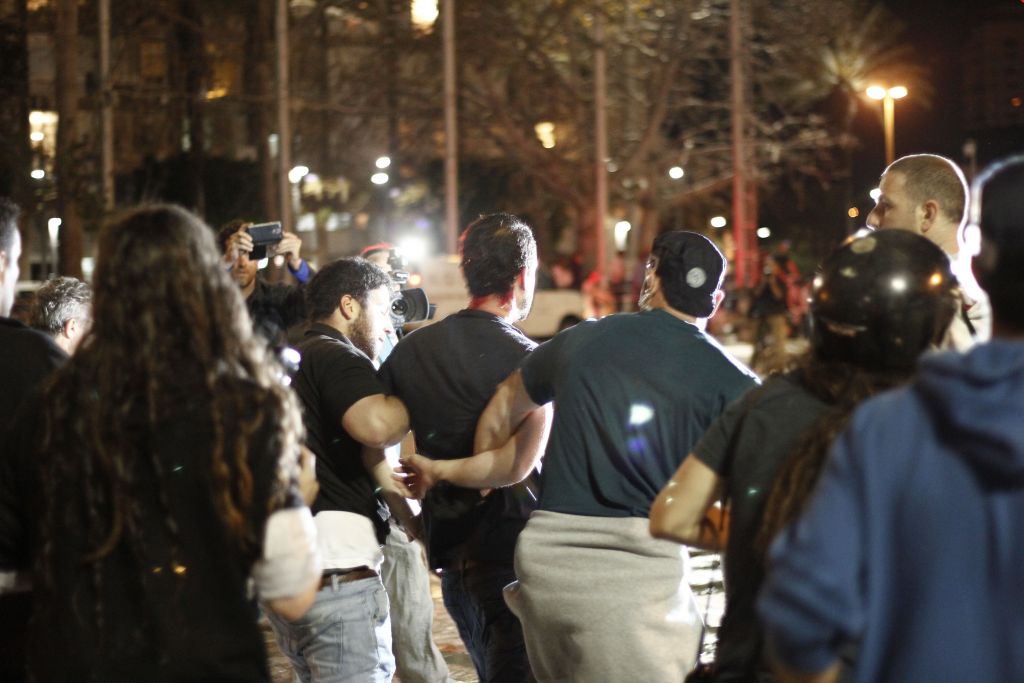
At 10:55 p.m. police brought water cannon trucks into the square, dousing protesters with a sudsy blue spray. Several protesters were knocked down by the water cannon. Medics from Magen David Adom, who treated demonstrators and police alike, had to themselves brave the water cannons to get to and treat injured protesters.
But there were glimmers of hope in the chaos. A middle-aged Ethiopian man, Gidon, gathered a group of younger people around him. “Violence,” he told the group, “we’ve gotten it. The hardest hits, we’ve experienced them.” That’s why now, he told the surrounding protesters, don’t pick up a rock. “Say no to that violence.”
Black and white Israelis struck up dialogue on the outskirts of the square. The Ethiopians tried to explain what they’ve been through, the white Israelis asked if this — the violence — was really the best way to solve the problem.
There were also low points. A volunteer medic — not a member of Magen David Adom — was helping a wounded protester, whose head and arm were bleeding. As the medic and others gathered to clean the man’s wounds and apply bandages, a stun grenade landed in the middle of the group. The volunteer medic fell to the ground.
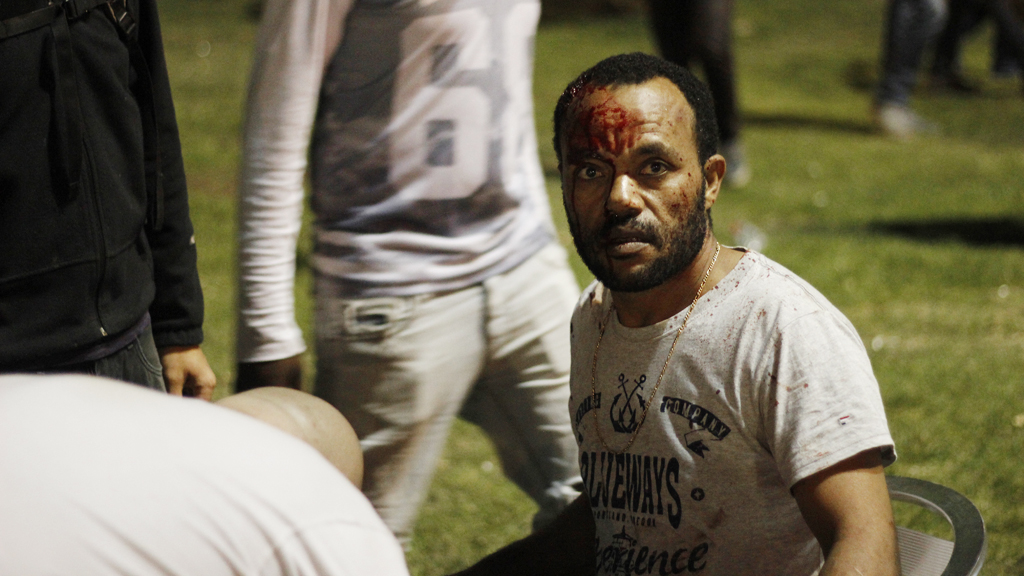
Two stretchers then had to be brought to take away both men.
A protester later shouted at police: “You see that? That’s your brother you’re doing that to. That’s your brother you’re putting in jail.”
The police were given orders not to respond. “Is it difficult?” an officer asked, “Sure it’s difficult. Any more than that I can’t say.”
Standing over a puddle of blood and broken glass on Malchei Yisrael Street, an Ethiopian man said to the surrounding protesters with a wry laugh, “See, our blood is just like yours.”
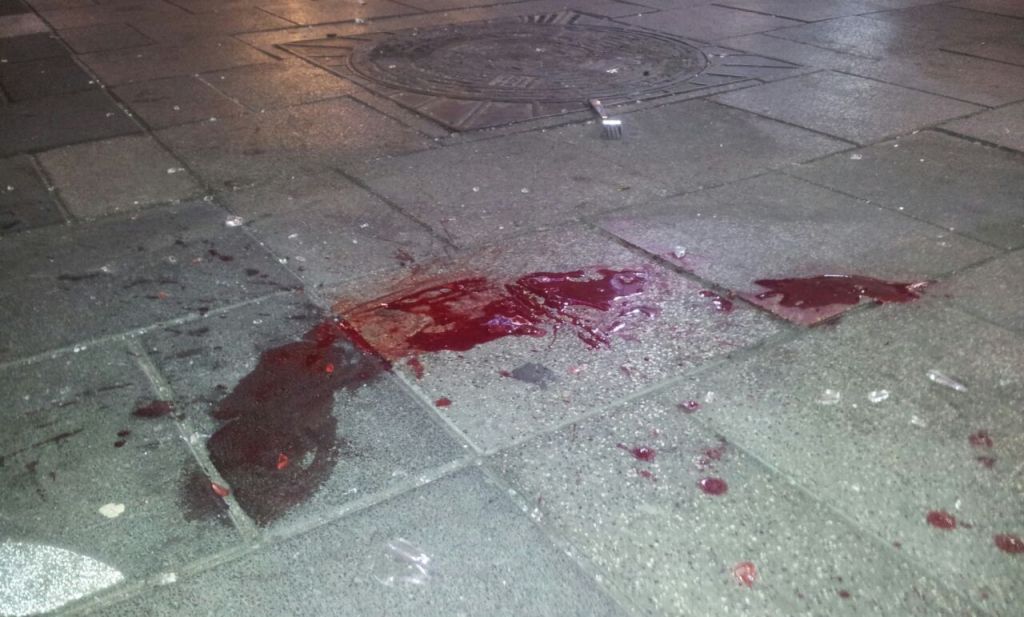
Yitzhak, a religious Ethiopian man with side-curls and a large white yarmulke, commented, “I feel like we’re strangers, like we’re not Jews.”
“We fight all these wars,” he said, “but this is the real war.”
While Yitzhak believed that he, as a father, had to come to the demonstration for the sake of his children, he was unconvinced that there would be any discernible effect.
“This protest — there will be more and more of it,” said Yitzhak, who like the rest of the protesters refused to provide his last name for fear of legal consequences.
“But in a few days it will blow over. Then where will we be?” he asked.
By midnight, the protest began to wind down, leaving Rabin Square — named for an assassinated prime minister and symbolizing, perhaps, deep schisms in Israeli society — full of broken glass, shards of stun grenades, rocks and burned garbage.





The Times of Israel Community.