

‘I live alone and I can’t run’: Elderly from the north become social welfare hot potato
The Tzalir Fund has evacuated and is looking after 1,200 frontline residents, most of them 75 and over, in five hotels. Its funding will end on April 15. Will the ceasefire outlast their respite?
 Add ToI as a Preferred Source on Google
Sue Surkes is The Times of Israel's environment reporter

Everything sparkled at the Leonardo Plaza Hotel in the northern city of Haifa on Wednesday evening as a group of elderly men and women donned traditional North African kaftans, or their “Sabbath best,” to sing, clap, and shimmy at a Mimouna celebration.
There were brightly colored cakes and queues for mufleta — the iconic pancake associated with the Maghrebian Jewish festival marked nationwide at the end of Passover.
A crooner dressed in a black jacket threaded with gold sang at an eardrum-busting volume against the backdrop of a golden throne.
But the festivities were laced with anxiety. These were not the large, multigenerational families traditionally present for Mimouna, but elderly people aged 75 and over from bomb-scarred communities near the Lebanon border who cannot get to a protected space within the 15 seconds needed during a rocket attack.
They were evacuated from mid-March onwards by a charity, the Tzalir Fund (link in Hebrew) and its “Banu” platform of volunteers. The NGO reached people interested in evacuation via the northern authorities and an advertising campaign.
The fund, established by Zilit and Meir Jakobsohn after October 7, 2023, has guaranteed the evacuees’ stay until April 15. It hopes the state will step in thereafter.

Some 1,200 people from cities like Kiryat Shmona, Shlomi, and Nahariya, and other smaller communities, mostly moshavim, are being put up in five hotels, three in Haifa — itself a frequent target of rocket attacks — and two in Tiberias. All have large protected spaces.
The evacuated participants’ fear is well-founded: On March 18, an elderly couple, identified as Yaron and Ilana Moshe, were killed in Ramat Gan while attempting to reach their shelter. Police said they were headed to the bomb shelter, but the missile hit before they could get there.
“We haven’t come to replace the government,” Zilit Jakobsohn was careful to point out, describing the fund as a body that reacts quickly to emergencies while the state prepares. “There’s a whole belt of Israel where our grandmothers and grandfathers live with only 15 seconds to reach a shelter. We couldn’t wait. This is social solidarity in its purest sense.”
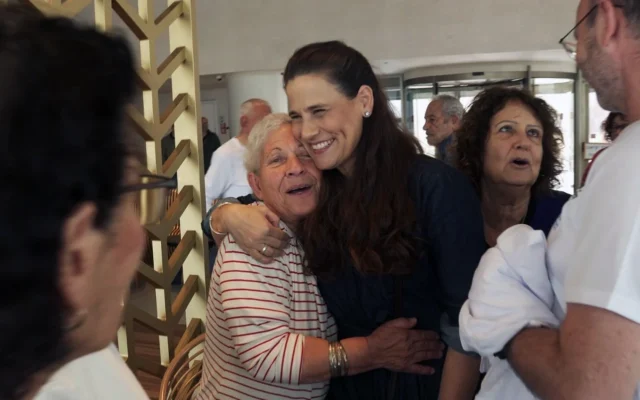
For elderly people such as Ruhama Cohen, a sprightly 84 from Kiryat Shemona, the future is cloudy.
On Tuesday, US President Trump announced a two-week ceasefire with Tehran, but as this article was being written, Israel and Hezbollah were continuing to fire at one another.
Cohen immigrated from the Moroccan city of Fez aged 14, married at 17, and bore seven children — three of whom she has sadly outlived. After Hezbollah joined the war in 2023, the city evacuated her to Jerusalem, then she moved to live with a son in Netanya, only returning home in July 2025.
“I was so sure everything was finished and that we were returning to normal,” she said.

But Kiryat Shemona, a key target of cross-border hostilities for over 50 years, has seldom been “normal.”
Cohen is one of around 8,600 out of 24,000 city residents whose homes lack a protected room (mamad).
“I live alone, my apartment doesn’t have a mamad, and I can’t run to a neighborhood shelter,” she explained. “The people from Banu fell from Heaven. My granddaughter saw an advert; they sent a car for me.”

Both Cohen and her friend Simha Shimoni, 80, said they felt abandoned by the state.
Shimoni, who immigrated from Tunis aged eight, used an anachronistic term for the Left when discussing her political disillusionment, saying that with the passing of her Likud-supporting husband, she would be voting for the “Maarach” (Alignment).
Cohen said the central government “invests nothing in Kiryat Shmona. It’s such a beautiful place, with such warm people. But there’s no work for the youngsters, and no entertainment.”
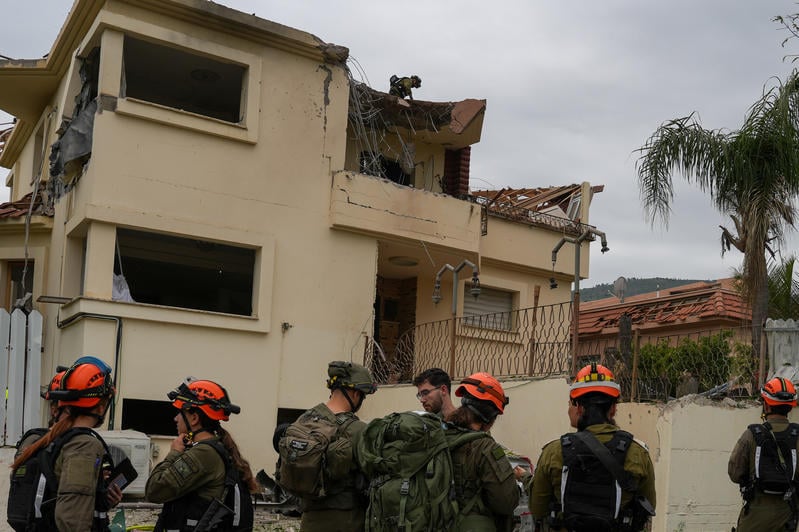
Founded in 1949 and largely populated by immigrants from Muslim lands, Kiryat Shmona sits in the Galilee panhandle, some 200 kilometers (124 miles) from the Knesset in Jerusalem. Even with modern roads and transportation, it still feels remote.
While traditionally right-wing, it elected an independent, Avihey Shtern, in 2018 and again in 2025. Shtern, an outspoken critic of the government, has been alternately harangued and boycotted by the Likud Party.
On March 30, the government passed the 2026 budget, allocating billions to Haredi educational institutions and coalition priorities while slashing ministry budgets — except for the Defense Ministry’s — by an across-the-board three percent to help fund the IDF. This translated into a NIS 150 million ($48.6 million) budget cut for the Gaza and northern borders, including a NIS 60 million ($19.4 million) cut for the north. It prompted a public outcry.

In the run-up to Passover, the government found NIS 110 million ($35.6 million) to help northern frontline communities cope with the Iran and Hezbollah wars. Of this, NIS 50 million ($16.2 million) was for physical repairs, and NIS 60 million ($19.5 million) was to strengthen resilience, for example, by funding respite periods for residents.
Shtern, whose municipality received NIS 6 million (just under $2 million) for the latter purpose, for the 16,000 residents still in the city, accused the government on Facebook of subjecting the north to an “exercise in survival,” making authorities “fight over crumbs among ourselves instead of demanding justice and evacuation for everyone.”
Instead, philanthropy has been picking up the bill. It was the KKL-JNF that gave Kiryat Shmona resident Tiki Sa’adia, 71, and her husband Adi, 74, five days of respite in a Tel Aviv hotel three weeks ago. Adi suffers from arthritis and finds it hard to run down a flight of stairs at home to a shelter 300 meters (985 feet) away. They eventually arrived at the Leonardo in Haifa via the Banu program.
“I feel like my respect has been trampled,” Tiki said. “I had to beg to be evacuated. But thank goodness for the philanthropists.”
On Thursday, she contacted this reporter with a headline suggestion: “There was a past, but there’s no future.”
As the April 15 deadline approaches, the KKL-JNF Jewish National Fund said it would not contribute to the project.
The Finance Ministry referred the Times of Israel to the NIS 60 million it had already budgeted to strengthen social resilience.







The Times of Israel Community.