

Jewish pioneers of TV history on display in new show
Given the rampant anti-Semitism in other fields, ‘creative-types’ flocked to the upstart medium which soon took over the world
 Add ToI as a Preferred Source on Google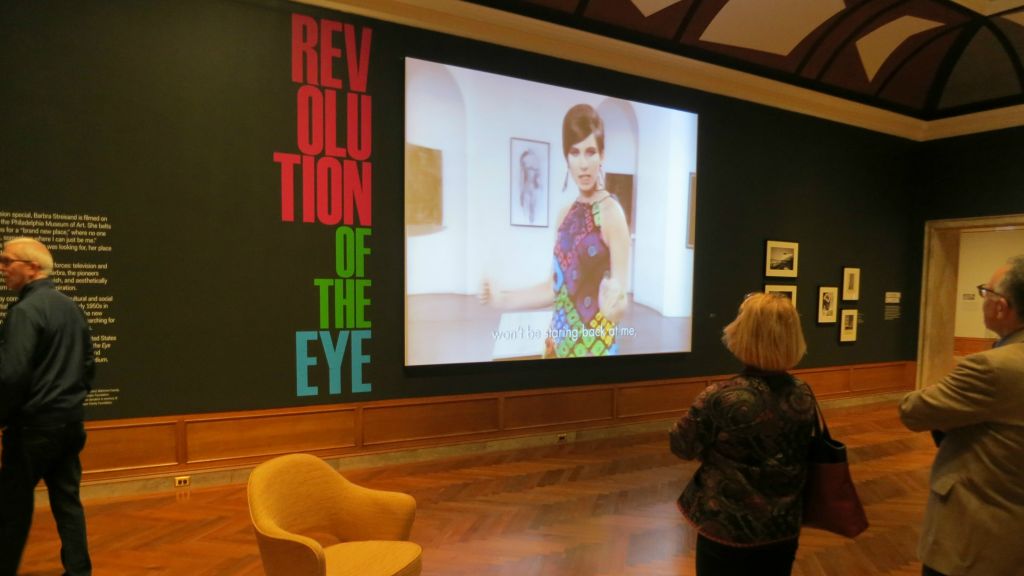
BOSTON — Half a century after a young Barbra Streisand wowed American television viewers in “Color Me Barbra,” her velvety rich, powerful voice and bold production still pack a dazzling aural and visual double-punch.
In the one-hour broadcast that kicked off CBS television’s 1966 first full-color season, Streisand belted out song after song, dancing around the Philadelphia Museum of Art in different eye-catching costumes that mirrored the art. In the modern art gallery, in a colorful pop-art dress, she delivered “Gotta Move,” a Peter Matz number that sang of a yearning “for a brand new place… someplace where I can just be me.”
A clip of the rousing program greets visitors as they enter “Revolution of the Eye: Modern Art and the Birth of American Television,” an exhibit that explores the early days of a new medium.
Television’s pioneers — many of whom were Jewish — drew on modernism and avant-garde artists and designers as a source of inspiration.
Curated by Maurice Berger, the show originated last year at the Jewish Museum in New York and is on view through July 31 at the Addison Gallery of American Art in Andover, Massachusetts. Over the next year, the show will travel to the Center for Art, Design, and Visual Culture at the University of Maryland, where Berger is a professor and chief curator, and the Smart Museum of Art at the University of Chicago.
The early years of television were especially hospitable to Jewish cultural innovators, according to Berger.
“Given the rampant anti-Semitism of a number of cultural milieus, from advertising to publishing, the novelty and newness of television — in an entertainment industry with many Jewish professionals and in a new industry with then low stakes — also made it more fertile ground for Jewish performers, executives, writers, directors, and designers,” he wrote in an email.
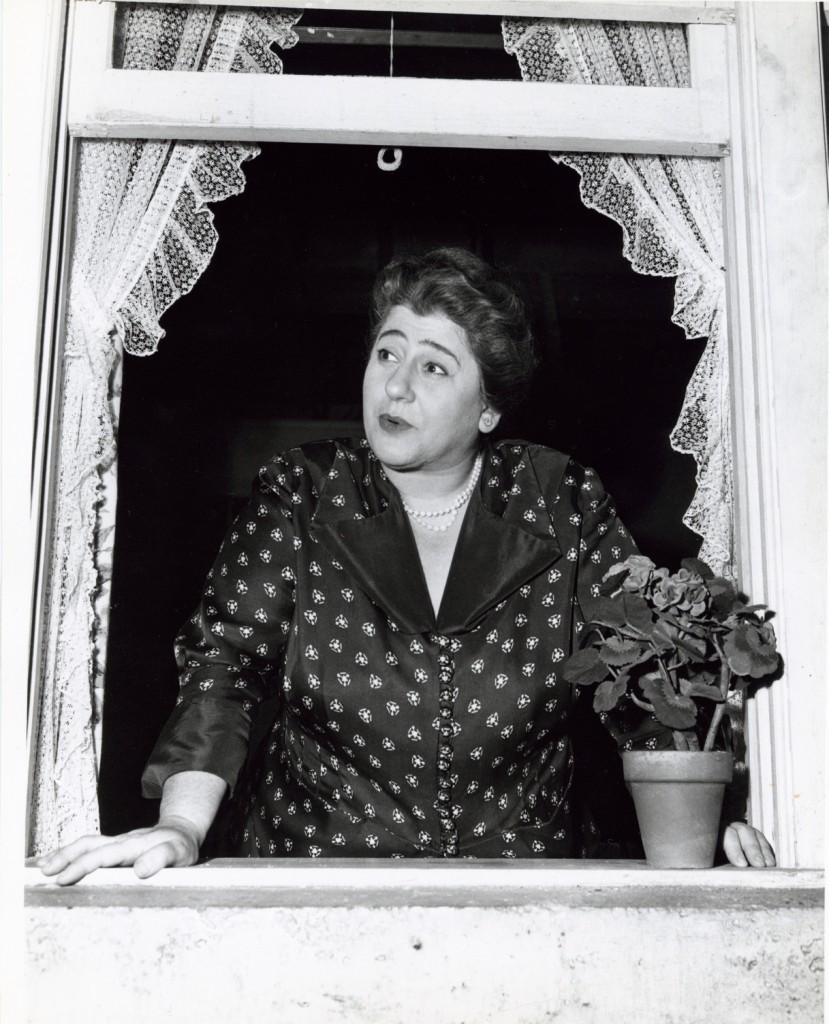
Berger doubted that Gertrude Berg, for example, would have achieved her tremendous success with Molly Goldberg, the character she created and portrayed on the 1949 CBS television series “The Goldbergs,” without television.
Her Jewishness made her a relatively tough sell in the mainstream culture of the time, he added.
The rapid rise of television sales — from just over 170,000 in 1948 to more than 45 million by 1960 — is one signal of its tremendous impact on American life, as noted in Berger’s fascinating cultural timeline in his companion book to the exhibit.
Beyond Barbra, exhibit visitors are treated to an array of far-ranging works of art and photographs by groundbreaking modern artists who influenced the creative experiment of early television and whose work now fills museums — from Salvador Dali, Sol Lewitt, and Roy Lichtenstein to Ben Shahn and Georgia O’Keeffe.
The last gallery space is devoted to work by Andy Warhol including excerpts from his 1968 commercial for Braniff Airways and his print of the Marx Brothers, from Ten Portraits of Jews of the Twentieth Century.
Clips of television episodes include Rod Serling’s “The Twilight Zone,” surrealist scenes of sardines dancing out of their cans from “The Ernie Kovacs Show,” pop art-inspired scenes in “Batman,” and psychedelic and other avant-garde art sets on “The Ed Sullivan Show.”

One surprising display features clips of a 1950s kids television program, “Winky Dink and You” — a forerunner of today’s interactive media.
The revelatory exhibit lives up to its name. There is admittedly a lot to take in — over 260 pieces of art, artifacts, and clips — but the show is tantalizing, and more than the sum of its parts. While many of the individual works are familiar, their juxtaposition sheds light on the broader historical, social and cultural landscape that shaped television’s extraordinary impact on popular culture and public opinion.
The exhibit makes connections that were not obvious before, according to Allison Kemmerer, the Addison Gallery’s curator of post-1950s art.
“We’re seeing art in a new way and looking at TV in a new way,” Kemmerer told The Times of Israel.
One example is the clip of the singing group The Temptations dancing on a platform on “The Ed Sullivan Show,” paired in the exhibit with a 1965 sculpture by Robert Morris.
“When I see it side by side, it’s eye opening,” Kemmerer said.
Despite the exhibit’s affinity for pushing the limits of creativity and politics, women and minorities were not well represented. Two exceptions were Georg Olden and Aline Bernstein Saarinen.
Olden was a CBS executive, a champion of modern art, and one of the first African-Americans to work in television.
Saarinen emerged from the art world to become the first on-air art critic for NBC’s Sunday and Today shows.
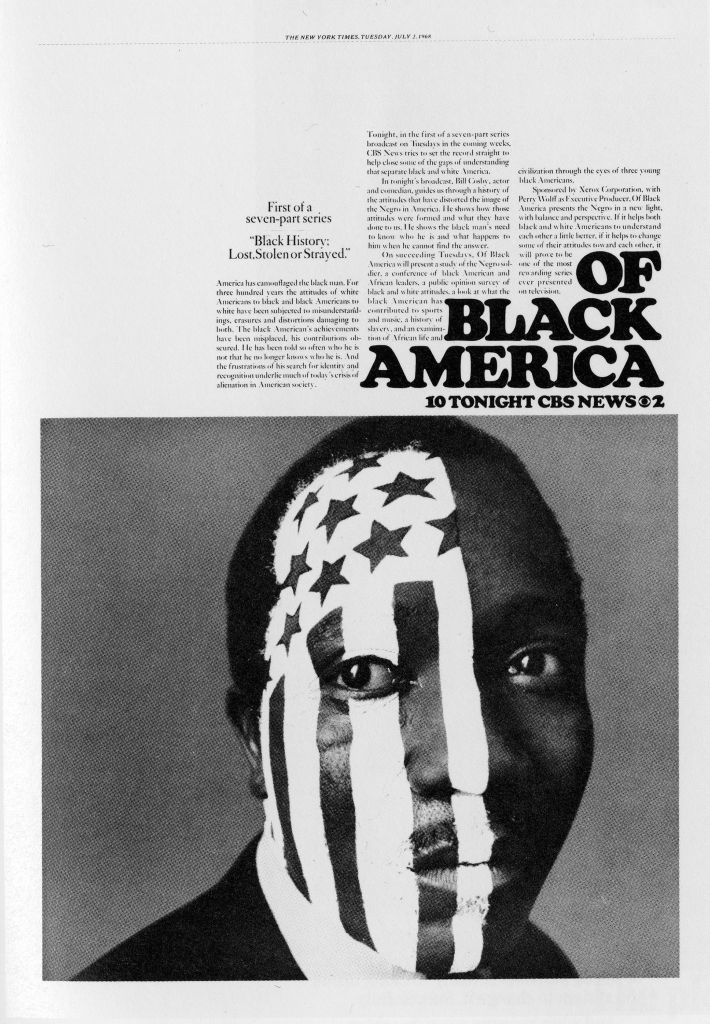
The stirring images of the print campaign for the ten-part CBS series “Of Black America” and other images from television’s coverage of the civil rights movement still resonate today, and it’s remarkable to see clips of Saarinen — now little known — with a voice both erudite and accessible, exposing mass audiences to the art and artists of her time.
In addition to its programming, the exhibit sheds light on how television also emerged as a platform for the visual arts, notably the overarching influence of the design team at CBS, headed first by William Golden, art director from 1937 through 1959. Lou Dorfsman succeeded him and is credited with cementing the network’s branding.
Among the other artists and designers were Saul Bass, Georg Olden, Ben Shahn, Paul Strand, Andy Warhol and Kurt Weihs — a Viennese-born artist who fled Nazi-occupied Austria.
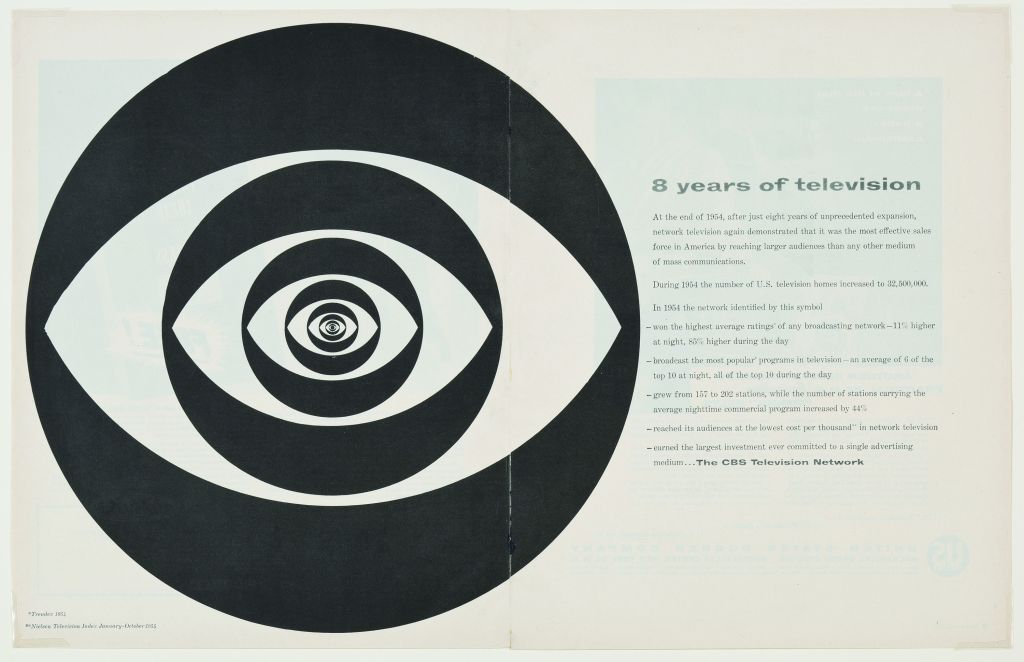
Golden brought a far-reaching vision to shape the network’s corporate identity that included its now well-known “eye” logo and the architecture of its two buildings, its New York City headquarters designed by Eero Saarinen (the husband of art critic Aline Bernstein Saarinen), which is known as “Black Rock,” and the sleek television studio in Los Angeles.
It’s fascinating to see the behind-the-scenes development of the CBS trademark as it first emerged. A symbol in surrealism, Golden acknowledged his source as the “evil eye” drawn on Shaker barns to ward-off evil. Under Dorfsman’s 40-year reign, the trademark popped up on ashtrays, cuff links, matchboxes, record labels, and on the roof of the towering NYC corporate headquarters.
A 155-page companion catalog, “Revolution of the Eye” by Maurice Berger, with an introduction by Lynn Spigel includes expanded material, and an extensive, annotated timeline (The Jewish Museum, New York; Center for Art, Design and Visual Culture, University of Maryland and Yale University Press).
The exhibit runs at Addison Gallery through July 31, then travels to the Center for Art, Design, and Visual Culture at the University of Maryland (October 20-January 8, 2017) and the Smart Museum of Art at the University of Chicago (February 16, 2017-June 11, 2017).









The Times of Israel Community.