

Kerry: ‘Too early’ to tell if Iran nuclear deal will be sealed
US secretary of state awaits Iranian foreign minister’s return to Vienna; Russian FM set to arrive Tuesday
 Add ToI as a Preferred Source on Google
VIENNA, Austria — US Secretary of State John Kerry warned Monday it was too soon to tell if a nuclear deal with Iran is possible, as he awaited the return of Iranian Foreign Minister Mohammad Javad Zarif from consultations in Tehran.
“We’re just working and it’s too early to make any judgments,” Kerry told reporters in Vienna following a weekend of intense talks with counterparts from five other major powers and Iran.
In a possible sign meanwhile of progress, Russian Foreign Minister Sergei Lavrov said that he would arrive on Tuesday, coinciding with the expected return of his Iranian counterpart.
French Foreign Minister Laurent Fabius, speaking in New York, said he would be back in Vienna this week. It was unclear when his British, German or Chinese counterparts might follow suit.
Over the weekend officials from both sides made clear that their Tuesday deadline to nail down a deal was highly unlikely to be met, although they said they would only extend by several days.
Zarif flew back to Tehran on Sunday night, as did many of the other ministers.
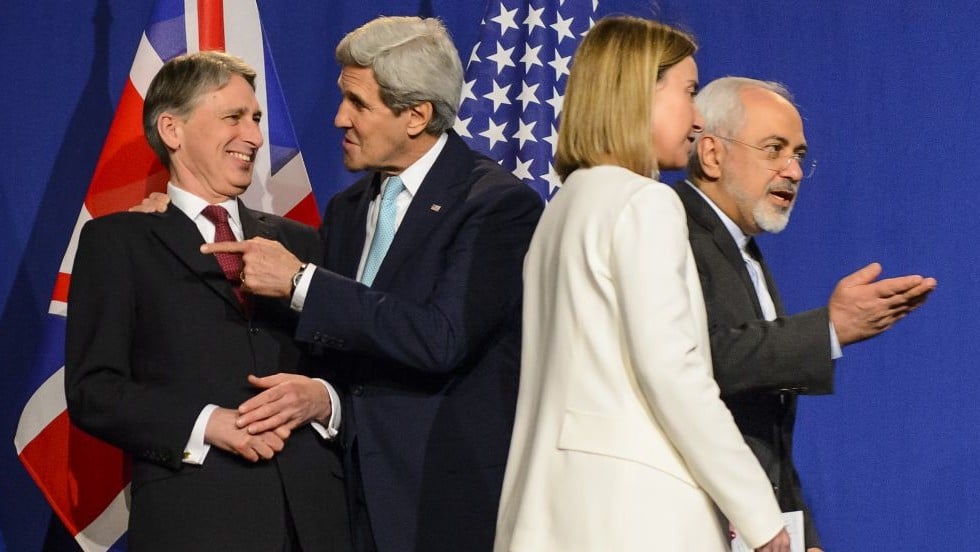
EU foreign policy chief Federica Mogherini spoke for many late Sunday when she insisted there would be no formal months-long extension, saying “postponement is not an option.”
“I would say that the political will is there. I’ve seen it from all sides,” Mogherini said, adding “we have conditions now to close the deal.”
In April Iran and the P5+1 group — the United States, China, Russia, Britain, France and Germany — agreed on the main outlines of a deal that they hope will end a 13-year standoff over Iran’s nuclear ambitions.
Under the framework, Iran will dramatically scale down its atomic activities in order to make any drive to make a weapon — an ambition it denies having — all but impossible.
This includes slashing the number of centrifuges enriching uranium, which can be used for nuclear fuel but also in a bomb, reducing its uranium stockpile and altering the Arak reactor.
In return, the powers have said they will progressively ease sanctions that have suffocated Iran’s economy, but while retaining the option to reimpose them if Iran violates the agreement.
Prime Minister Benjamin Netanyahu lashed out at the burgeoning agreement on Sunday, expressing outrage at world powers for backtracking on terms they’d set for themselves during the negotiations with Iran.
“We see before us a clear diversion from the red lines set by the world powers recently and publicly,” the prime minister said at the start of the weekly cabinet meeting in Jerusalem.
“Iran tramples on human rights, spreads terrorism, and is building a huge military infrastructure, yet the talks with [Iran], despite these reports, continue as usual.”
Nitty gritty
But turning the 505-word joint statement agreed in April in Lausanne, Switzerland into a fully-fledged, highly technical document of several dozen pages has proved hard work.
“It sounds easy, but it’s difficult,” German Foreign Minister Frank-Walter Steinmeier said Sunday.
Key sticking points are thought to include the pace and timing of sanctions relief, the mechanism for their “snapback” and Iran’s future development of newer, faster centrifuges.
Another thorny topic is role of the International Atomic Energy Agency watchdog, whose chief Yukiya Amano met Kerry on Monday and who has been spotted several times entering the luxury Viennese hotel where the talks are being held.
The UN watchdog already keeps close tabs on Iran’s nuclear activities, with between four and 10 inspectors in Iran on any given day, accounting for every ounce of nuclear material and keeping facilities under constant surveillance.
Under the mooted deal, it will be up to the IAEA to verify that Iran really does reduce its capacities, and also to make sure it does not cheat in the future.
More contentiously, it also wants to investigate claims that before 2003 and possibly since Iran carried out nuclear weapons development work — something denied by Iran — and to be able to probe any such claims in the future.
Clearing up these claims is a key condition of the six powers for a deal, and may require the IAEA visiting military bases, something that Iran’s supreme leader Ayatollah Ali Khamenei last week rejected as a “red line”.
“I think the asymmetry here is that Iran clearly needs this deal. They’re hemorrhaging hundreds of billions because of sanctions, tens of billions because of the drop in oil prices and billions trying to sustain the Assad regime (in Syria),” said Karim Sadjadpour at Carnegie Endowment.







The Times of Israel Community.