

Nobel Prize in chemistry awarded for research solving ‘mirror image’ mystery
Honor goes to French researcher Henri Kagan, whose family hid during Holocaust, and Japan’s Kenso Soai; award committee member calls work ‘coolest experiment’ in organic chemistry
 Add ToI as a Preferred Source on Google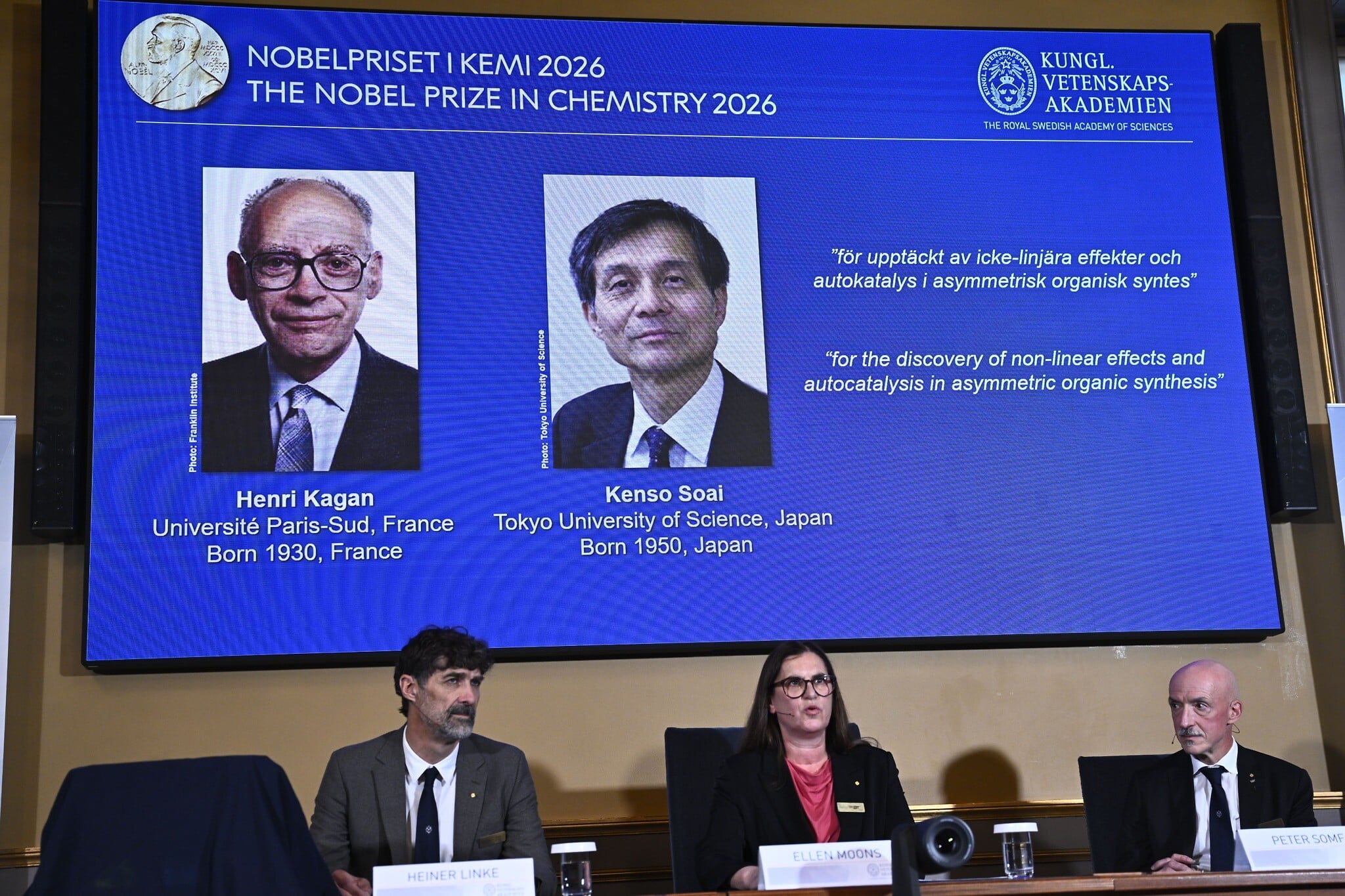
Scientists Henri Kagan and Kenso Soai won the 2026 Nobel Prize in Chemistry for solving a long-standing riddle of how to form a single molecular mirror image, a discovery hugely important for pharmaceutical manufacturing, the award-giving body said on Wednesday.
“This is the most exciting day in my life, I am very glad to share this prize with professor Henri Kagan,” Soai said, speaking by phone to the Nobel Prize press conference, adding he had been out shopping when receiving the news.
Kagan, 95 years old and born in France, is affiliated with the Université Paris-Sud in Orsay, France, and Soai, born in 1950 in Japan, is affiliated with the Tokyo University of Science.
According to online obituaries for his siblings, the Kagan family, who were Jewish, hid in a village in the south of France under assumed names during World War II.
“So this year’s prize is about foundational chemistry,” said Heiner Linke, chair of the Nobel Committee for Chemistry.
Many molecules of life come in versions that look alike but aren’t exactly identical, like right and left hands. One mirror-image of the chemical carvone smells like mint, for example, while the other has a whiff of caraway.
When designing drugs to treat diseases, scientists want to be choosy about which mirror-image they’re getting. They want the version of a molecule that’ll treat a cold, not the kind that’ll make the sniffles worse.
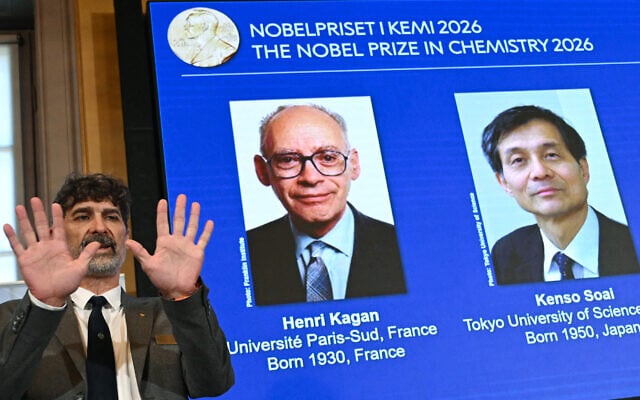
“Many of the drug molecules occur in two variants that are each other’s non-identical mirror image: one has the therapeutic effect, while the other can cause unnecessary and sometimes harmful side effects,” the Nobel Foundation said.
Kagan and Soai found ways to make chemistry pick a side, designing and manipulating reactions to produce the desired mirror-image.
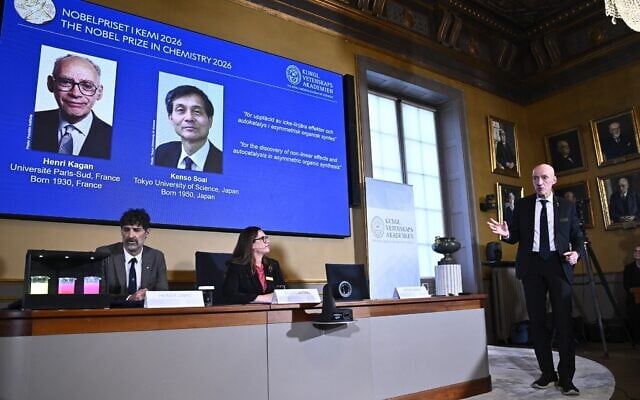
“This is probably the coolest experiment in organic chemistry,” said Peter Somfai, a member of the Nobel Committee for Chemistry. “Taken together, the groundbreaking discoveries by Henri Kagan and Kenso Soai have reshaped our understanding of molecular chirality — how it is created, amplified and transmitted.”
“Chirality” comes from the Greek word for “hand.”
Soai, in 2003, successfully created the first-ever chemical reaction that produced only one of a molecule’s mirror-images. The so-called “Soai reaction” is named for the scientist’s experiment.
“Other than life itself, no one had previously achieved this feat,” the committee said in a news release.
“It might be difficult to say that this drug, or that drug, was developed using this,” Somfai said. “I would say all of them, because we use this as a tool, we use this as an understanding, how to develop catalysts, how they function.”
“The medicines we have today would not be possible without this chemistry,” said Rigoberto Hernandez, president of the American Chemical Society.
The French Academy of Sciences, of which Kagan is a member, did not immediately respond to an AP request for comment, nor did the Université Paris-Sud.
The Tokyo University of Science did not immediately respond either.
Kagan’s research dates back to the 1980s, when he found a new way to manipulate chemical reactions.
“I’m very excited to receive the very nice news,” Soai told the committee and journalists by phone. “Of course this is one of the most exciting days in my life.”
He said he was shopping near his home when he was reached by the Nobel committee.
The Royal Swedish Academy of Sciences announced the winner in Stockholm.
Established in the will of Swedish inventor and businessman Alfred Nobel, the prizes for achievements in science, literature and peace have been awarded since 1901, with a few interruptions mostly due to the world wars.
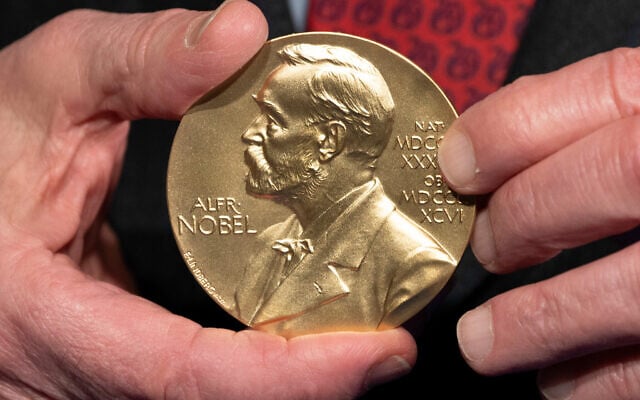
Nobel, a chemist by trade, amassed huge wealth in the 19th century from inventions primarily tied to warfare, most notably dynamite. The economics prize is a later addition funded by the Swedish central bank.
Sometimes overshadowed by more famous laureates in the fields of physics, literature and peace, the chemistry awards have still recognized many influential discoveries such as nuclear fission and genetic sequencing techniques.
This year’s prizes began with the Nobel for medicine, awarded Monday to three scientists whose work led to a tool that uses light to help unravel how the brain works. The physics award Tuesday recognized a scientist’s efforts to demystify a rare group of neutrinos.
The literature prize is set to be awarded Thursday. After Friday’s peace prize is awarded, the Nobel Memorial Prize in Economic Sciences will be announced Monday.
The prize money this year is 12 million Swedish kronor (about $1.2 million), whether for an individual, a small group of laureates or an organization.







The Times of Israel Community.