

Who is Dafni Gafni and why is she the most viral Israeli on Facebook?
The lovable troll has pranked everyone from Roger Waters to Turkey’s Erdogan to Israel’s right-wing Lehava organization
 Add ToI as a Preferred Source on Google
Simona Weinglass is an investigative reporter at The Times of Israel.

One of the most popular comic sensations in Israel these days is a Facebook troll by the name of Dafni Gafni.
“Hi saints, I would like to establish a fur processing factory in suburban Quito, Ecuador,” she wrote on the Facebook page of environmental NGO Greenpeace. “To do that, we’d need to flat down 20 square km of forest. I’d like to know the fastest and cheapest way to get rid of those big bushes.”
“You should be processing your own empty brain as fur!!” one person responded.
“WHAAAAATT?!??!!!!?” another posted.
In a post on the Israel Railways Facebook page she wrote, “My grandmother had a pacemaker implanted that works on WiFi but crowding on the trains made the signal weak which causes my grandmother to be sleepy and miss her station. Is it possible to increase the bandwidth? P.S. When the train goes through a tunnel the signal disappears and she loses consciousness.”
In response, Israel railways wrote, “Hi Dafni, we’re sorry for the inconvenience, your request is being processed, we’ll be in touch soon.”
“Her grandmother is losing consciousness and you’re calling it an ‘inconvenience’?” a responder commented.
Dafni replied, “‘We tried tying her to the ceiling by her hips but then she looks like a pendulum, ha ha ha!”
“You should be ashamed of yourself!” wrote another user, “she’s your grandmother, you scum!”
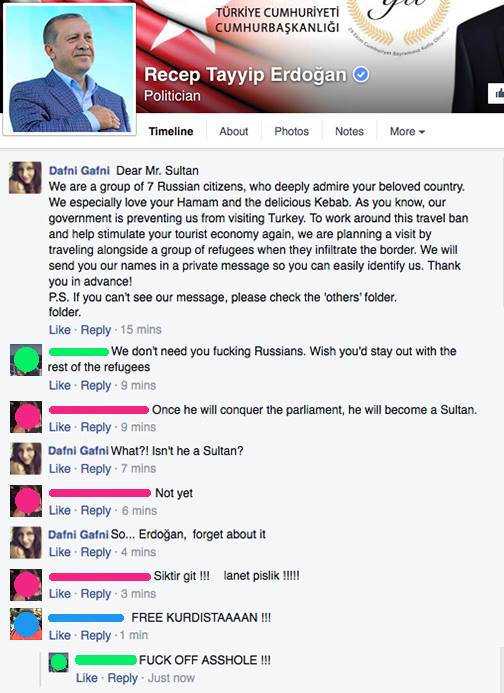
Since, September, Dafni Gafni (not her real name, nor does anyone know for a fact that she’s a woman) has posted over 80 mock-naive questions to Facebook groups, including a Hebrew holistic sexology group, mothers in Herzliya who want to get back in shape, and a group for Jews returning to Orthodoxy.
“I’m at a loss. I go to classes to become more religious and on Friday night I saw my teacher online and on WhatsApp, what should I do?”
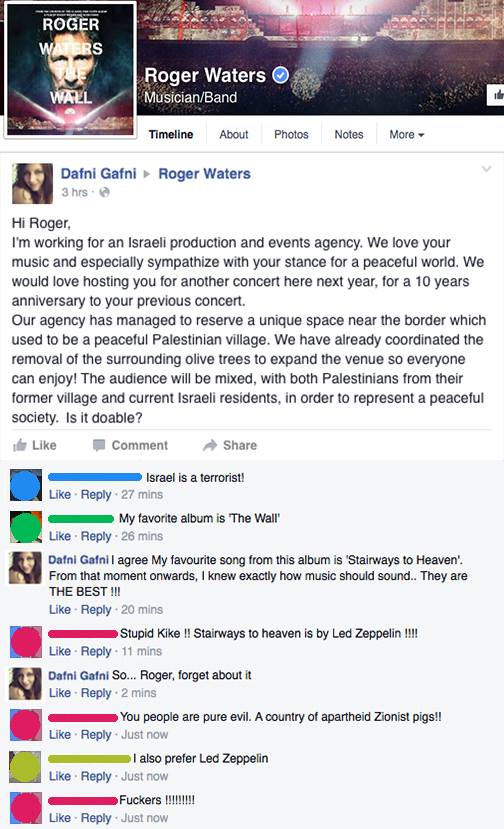
Some of her posts go more viral than others. Her most famous troll was when she punked singer-songwriter Roger Waters, who is known for his outspoken calls for boycotting Israel, inviting him to Israel for a concert on the site of a former Palestinian village. The post touched a nerve, because Facebook removed her page for a week afterward.
But another troll, of Santa Claus, was not as effective. “I don’t think they really understood what I meant and the forum is not very active,” Gafni said in an interview with The Times of Israel. “I didn’t get more reactions than these. But I put up the question because it made me laugh.”
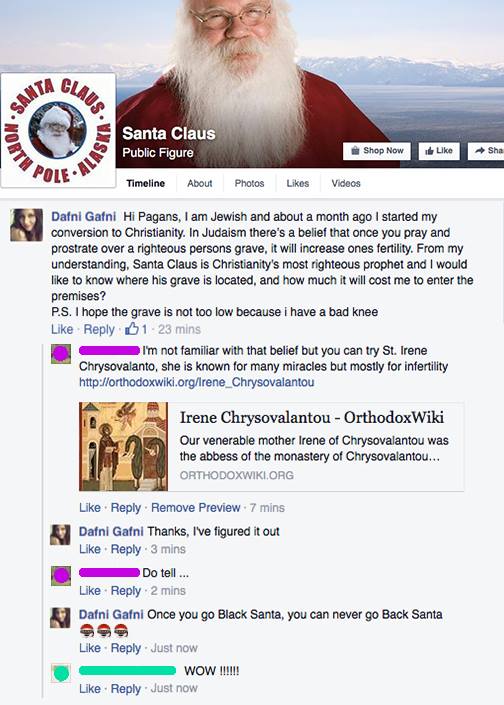
Gafni’s trolling posts have been collected on a Hebrew Facebook page called Dafni Gafni Asks with over 72,000 likes, but she has also created an English-language page, called Dafni’s Wonders, where she has been posting English-language pranks, including translations of her best Hebrew ones.
In an interview via text with The Times of Israel, Gafni is coy about revealing her true identity. She lives in Tel Aviv and has a 9-5 job that has nothing to do with comedy “even though I am a comedian in my soul,” she writes with a smiley emoticon. Most evenings she gets home at around 6 p.m. and spends about six hours in front of her computer, surfing social media and trying to come up with ideas for questions. Sometimes the questions come to her suddenly, and sometimes it takes a few hours to come up with an idea.
“Basically, I have no life,” she says.
Gafni says that now that she’s gained more public exposure, it’s getting harder to write questions that people will fall for.
In the academic literature, a troll is defined as someone who interacts with other people online in a way that is a game to them, in the hope of provoking a strong reaction and thereby obtaining lulz, or laughs at others’ expense. A troll has two target audiences — one that doesn’t realize it’s a prank and reacts accordingly, and another that is in on the joke.
“The worst thing for a troll is to become famous,” Gafni says, “and more than that, a lot of people are starting to ask questions in my style and so every question that gets asked is scrutinized a lot more carefully to see if it’s real.”
She says the trick is to come up with the right question that will lure the first dupe, and from there it snowballs. “There are a lot of people who get mad, and that’s understandable, it’s part of posting the question. I don’t show all the responses because sometimes there are a lot. I get private hate mail but it’s part of the game, so it’s okay.”
Asked where she would like to take her trolling, she says she would like to do television, and hopes that one day a fan who works in television will contact her.
The question she is most proud of is one she posted on the page of the far-right Lehava organization. In Hebrew, the initials for Lehava are similar to the initials for LGBT.
“Hi,” she wrote, “I just stopped being religious a few months ago and people have always told me I am an undeclared lesbian. Where can I declare it and what forms do I need to fill out?”
“In the ministry of stupidity,” wrote one person.
“Get out of here, you vermin!” wrote another.
“Do you even know what Lehava is?” asked another
“Lesbians, gays, bisexuals and homo erectus,” she writes.
“God help us,” the person replied.
Gafni says that only her family and a few close friends know her true identity. “My mother doesn’t even know what Facebook is, but she sees the interviews with me and laughs.”
And yes, it can be lonely and frustrating to keep a secret for so long.
“I do feel like revealing my identity already but then the page will lose some of its popularity because part of its success is due to the mystery of not knowing who I am.”
“I see how much love the page gets and I get messages from people who say they are in a tough period in their life and the page made them laugh and helped keep them going, so I continue.”









The Times of Israel Community.