

Lapid presents budget of ‘hope and promise’ for 2015
Finance minister publicizes final draft of annual expenditures, which ups defense spending without cutting education, health
 Add ToI as a Preferred Source on Google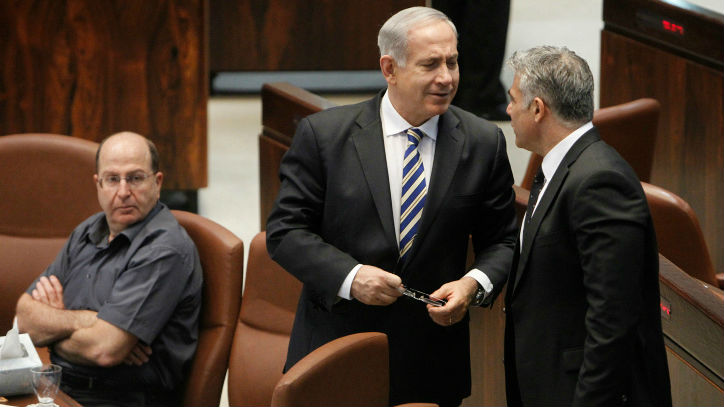
Finance Minister Yair Lapid presented the newly agreed-upon 2015 budget at a press conference Sunday, calling it a budget of “hope and promise.”
“This is a budget in line with society, that pumps resources into improving education, health, welfare and everything that touches the lives of Israel’s citizens,” he said. “If the previous budget was a budget of crisis, the current budget is one of hope and promise.”
After a long political struggle Prime Minister Benjamin Netanyahu, Defense Minister Moshe Ya’alon, and Finance Minister Yair Lapid consented to a plan Wednesday to increase the defense budget without raising taxes.
According to the budget, NIS 7-8 billion ($1.9 – 2.2 billion) will be added to the defense budget this year and another NIS 6 billion ($1.6 billion) next year. The added funds will cover the costs of this summer’s 50-day Operation Protective Edge in Gaza, as well as training and personnel.
Rather than raising taxes to cover the costs, Netanyahu and Lapid agreed to raise the deficit to 3.4 percent, slightly higher than the 3% target Netanyahu hoped to achieve.
To keep the deficit down, Netanyahu wanted to raise taxes, but Lapid vehemently opposed the measure and eventually prevailed, arguing that average citizens shouldn’t have to bear the cost of the war in Gaza and that a tax increase would further slow growth. Lapid even went as far as threatening to bolt the coalition in the event of a tax hike.
“The Israeli economy is strong and built on healthy fundamentals, and despite the slowdown in recent months, is still projected to be higher than European countries,” he said. “The last thing the economy needs is a tax increase.
“It’s no secret that they pressured us to raise taxes, but we decided not to accept them,” he said. “The last thing the economy needs is a tax increase. Our job is to get the economy to jump forward. Instead of raising taxes we will take money from other sources, like the JNF. We’ll take more from natural resources, improve tax collection and continue the war against money laundering.”
The meeting between the three senior politicians took six hours on Wednesday, the eve of the Rosh Hashanah holiday.
Even with the increase, defense officials were not pleased. A senior official said that the NIS 6 billion increase for 2015 will mean that training and equipment purchase will be sharply curtailed, Israel Radio reported. He said that the implications of the budget will be presented to Netanyahu, the cabinet, and the relevant Knesset committee.
The prime minister had been pushing for an additional NIS 20 billion ($5.5 billion) to be allocated to the defense establishment — NIS 9 billion to cover the costs of Operation Protective Edge in Gaza and NIS 11 billion for expanded operational and personnel spending.
Lapid and Netanyahu have been engaged in a semi-public political tug-of-war over the 2015 state budget for weeks, and Ya’alon in recent days has been outspoken in his push for a larger allocation to the IDF.
Two weeks ago at a Tel Aviv security conference, Ya’alon said that Israel’s defense needed “billions,” which it would be “irresponsible” to withhold. He stressed that the defense budget had been cut in recent years “for political reasons,” so the requested increases were not extras, “but rather about correcting this distortion to cover the cost of Operation Protective Edge.”
Addressing the gap between the Defense Ministry’s request and the actual increase, Lapid clarified that he was never against allocating money to the IDF.
“I know that the tradition is that the finance minister wants to cut the defense budget, but that is not the case here,” he said. “We clarified that we recognize that there is a unique situation here. We must allocate special funding for responding to the [attack] tunnels and mortars [from Gaza] and investing in cyber-defense.”
He added that there will also be special resources dedicated to making sure that “we won’t have more letters from hungry soldiers.”
“IDF soldiers will not go hungry on our watch,” he declared, referring to a letter written by dozens of conscripted combat soldiers detailing their struggles to cover basic expenses.
In addition to fighting against taxes during the talks, Lapid insisted that the government must take steps to improve the lot of Israel’s middle class.
“We will not rest for a moment from the effort to lower housing prices and the cost of living,” Lapid said. “Despite the delays, the housing minister and I stand by our original forecast that in ’15 apartment prices will begin to fall.”
He also criticized those who would delay the his 0% VAT plan for first-time home-buyers and promised it would take effect soon.
“It’s just a shame that some interested parties have caused a delay in the plan for political reasons, even though they know the plan will change the housing marketplace and lower prices.” he said.
Lazar Berman contributed to this report.








The Times of Israel Community.