

$10 ride gimmick gives GetTaxi edge in NY ‘cab wars’
Use of Israeli start-up’s app has shot up by 3000% because of the offer; company believes passengers will stick with it
 Add ToI as a Preferred Source on Google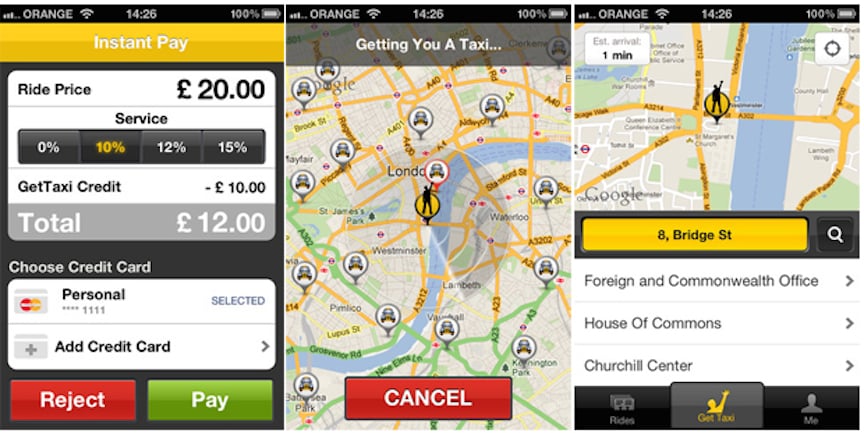
The taxi wars in New York just got a little fiercer. Gett, the brand name used by Israel-based taxi tech company GetTaxi, is offering a new deal — ride anywhere in Manhattan for just 10 bucks by using the app. The offer is good till the end of the year. “This is guaranteed to get us the attention we deserve,” said Iris Hermon, VP of marketing at GetTaxi.
They key is making the taxi business run better. In a city where it costs about $30 to get from downtown to midtown – never mind the Upper East or West side, which is even further away — $10 for a taxi ride anywhere in Manhattan is a guaranteed to raise eyebrows, and the campaign is having the desired effect, said Hermon. Since it began, the number of people ordering rides using the app has grown about 3000%, and about two thirds of them are new passengers giving the app a try. “There’s a real ‘wow factor’ involved,” she said, so it’s worth it for the company to subsidize the cheap rides from its marketing budget.
Until about four years ago, the only way to hail a cab was to actually stand on the street and try to flag one down, hoping for the happy coincidence of seeing an empty on-duty cab whose driver would deign to stop. During rush hour or inclement weather, it could take a long time for that coincidence to develop. At the same time, though, there could be fleets of empty taxis just an avenue or two away – but there was no way for a passenger to hail those cabs, because they were out of the line of sight.
The whole thing was very inefficient, and it struck two developers in San Francisco — Garrett Camp and Travis Kalanick – that technology now common on smartphones could be used to make the taxi business more efficient. In 2010, they inaugurated the Uber taxi app in San Francisco, alerting drivers to the locations of waiting passengers via GPS. Instead of standing outside in a fruitless search for a cab to hail, passengers could “e-hail” a taxi by activating the Uber app and punching in their destination. Today, Uber’s taxi service is available in 200 cities, including Tel Aviv, which was added last month.
GetTaxi was developed by Israelis Shahar Waiser and Roi More – without any inspiration by Uber. The Tel Aviv and San Francisco teams both hit upon the idea independently during 2009. Uber got to market first, premiering in June 2010, while GetTaxi was released in Tel Aviv, its first market, in mid-2010. Currently, GetTaxi is available in New York, London, Moscow, and most cities in Israel.
While the two apps use the same technology, GetTaxi offers numerous advantages over Uber, including the capability of tracking a car in real time, providing users with the option of scheduling rides in advance (hours, days, or weeks, said Hermon), as well as advantages for drivers, such as displaying those scheduled future rides for drivers so they can coordinate their personal schedules with potential fares. “For example, if a driver has to be in Haifa for personal business on a certain day, they can check the schedule and see if there is a fare going there. It’s another way for us to make things more efficient for drivers and passengers,” said Hermon.
One of the biggest differences between Uber and GetTaxi – one that could potentially push the Israeli-developed app way ahead of its California rival – is the model each uses to determine a passenger’s fare. GetTaxi, said Hermon, charges passengers only what shows up on the taxi’s meter – or, for out-of-town trips, whatever the driver and passenger agree to, or whatever appears on the standard fare tables for long-distance travel. At peak/night hours in some places, there may be a small surcharge, and there are also extra charges for stops, pickups along the way and the like, as there would be in a standard cab ride.
Uber sets prices that are the same as meter fares or their equivalent, but those prices can change radically during rush hours or periods of bad weather, thanks to “surge pricing” — an algorithm-based system that automatically raises prices for rides during times of high demand. In the past, that surge has jacked up hundreds of percent, opening the company up to charges of price gouging by authorities in several US and European cities. In July, Uber announced it was limiting the extent of surge pricing, setting a ceiling on how high fares could rise, depending on circumstances.
Uber uses surge pricing as a method to decide rationally who gets a taxi during periods of high demand — the taxi goes to the passenger willing to pay the most. GetTaxi’s philosophy is somewhat different, said Hermon. “We don’t use surge pricing. Our model is first-come, first-serve.” With that, she said, the GetTaxi system is very efficient at putting together drivers and passengers. “During peak demand periods passengers may have to wait five or 10 minutes more, but we can usually get them a ride during that period,” by expanding the geographic area in which the passenger can search for a taxi. “The more drivers we have, the more coverage we can provide during peak periods, so we’re always looking to add to our fleet.” In Israel, 3,500 drivers are in the GetTaxi network, and they are free to pick up fares independent of the app as well. Last year, a million orders for rides passed through the GetTaxi app.
Hermon stressed that the $10 ride promotion in New York was not connected to Uber in any way. “I know they are now competing with us in Tel Aviv, but we began developing our New York promotions months before their announcement,” said Hermon. Predictably, there has been bad blood between the two. In January, GetTaxi accused Uber employees of canceling dozens of GetTaxi’s New York customer rides, part of an attempt to woo drivers from GetTaxi to Uber. In a statement, Uber acknowledged the mischief, saying that “our local teams can be pretty determined when spreading the word about Uber and how our platform opens up new economic opportunities for drivers. In this instance, the New York City team was a bit too ambitious, and we’ll make sure they tone down their sales tactics.”
Dirty tricks notwithstanding, GetTaxi is determined to get ahead and win the war, said Hermon. Without mentioning names, Hermon said that “we put a lot more effort into ensuring that our app has the features users need than others working in this space. We have over 80 people working at our Tel Aviv R&D center making sure the user experience is everything passengers expect.” All that development costs money, but GetTaxi has the funds. In August, the company raised $150 million in a second funding round, $25 million of it from Swedish VC firm Vostok Nafta.
It’s an investment that can’t lose, Vostok Nafta believes. “Although competition is ripe everywhere,” the Swedish company said in a statement, “GetTaxi is already the leading player in Russia and Israel, while seeing huge growth in the U.K. and US which in our view yields a potential valuation scenario north of $2 billion a couple of years down the road.”










The Times of Israel Community.