

Knesset approves first reading of bill banning use of ‘Skunk’ spray on protesters
Rights groups, medical experts and lawmakers pan firing of putrid liquid from water cannons on demonstrators; ex-police superintendent calls for tighter oversight but opposes ban
 Add ToI as a Preferred Source on Google
Sam Sokol is a former political correspondent at The Times of Israel. He was previously a reporter for the Jerusalem Post, Jewish Telegraphic Agency and Haaretz. He is the author of "Putin’s Hybrid War and the Jews"
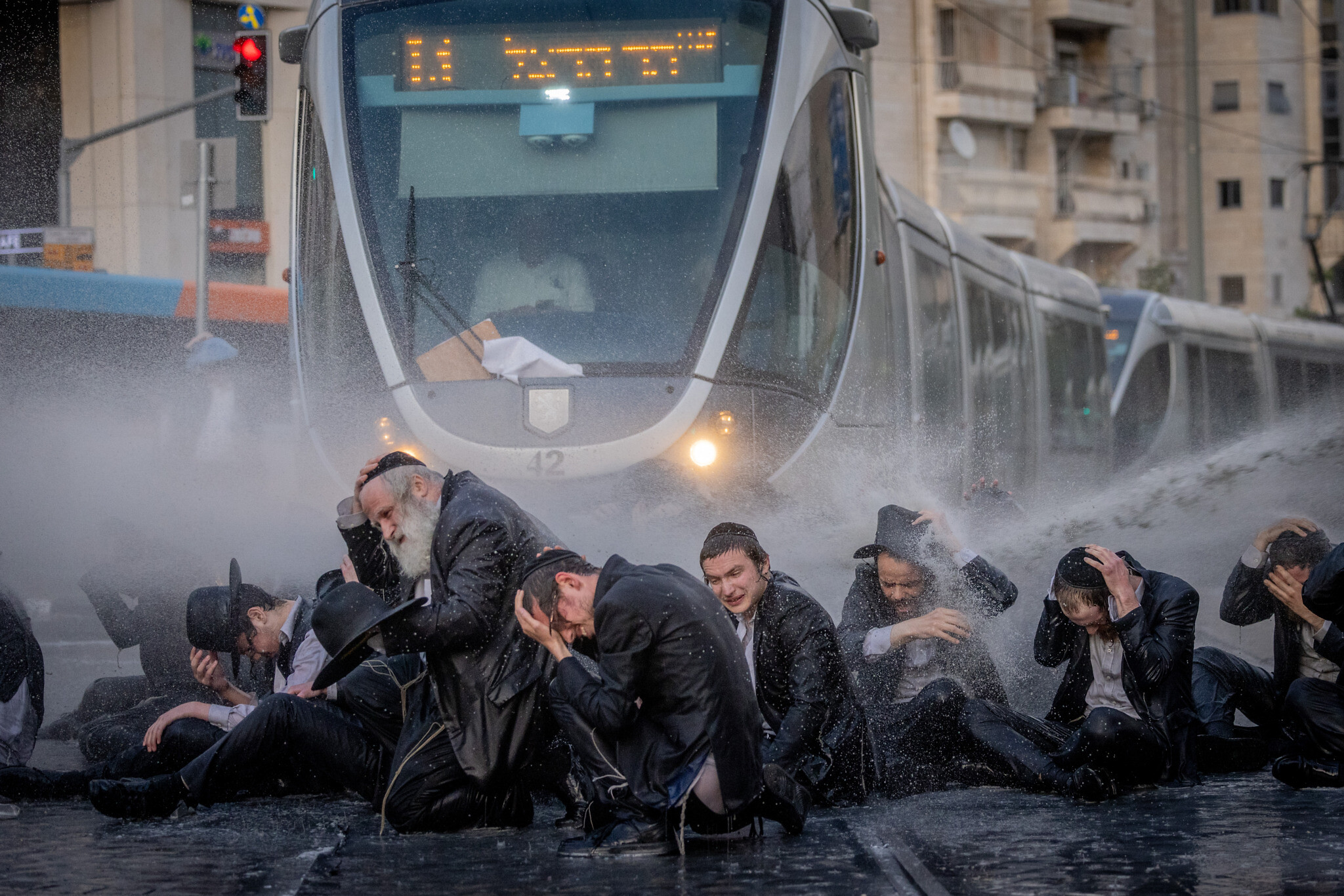
Lawmakers voted 14-0 on Wednesday evening to approve the first reading of a bill barring police use of “Skunk,” a foul-smelling liquid, on protesters.
The legislation, sponsored by United Torah Judaism MKs Moshe Gafni and Yaakov Asher, is intended to ensure that police water cannons used to disperse demonstrations will only fire clean water without the addition of any substance, including color and odor.
Sprayed out of a high-pressure water cannon truck, the putrid liquid is often used on Haredi anti-draft demonstrators and Palestinians in the West Bank, but has also been rolled out against anti-government protesters in recent years.
The makeup of the substance is shrouded in mystery and relevant authorities have declined to disclose its exact ingredients. Some of those who have been sprayed with the substance reported skin irritation, shortness of breath and headaches.
The bill, which is also supported by opposition lawmakers, stipulates that police take video of the use of such cannons and save it for three years, providing it upon request to anyone who claims to have been injured — although law enforcement would be allowed to request a court order to withhold such documentation if its release would harm an ongoing investigation or public safety.
“Although police procedures regulate the use of water cannons in order to prevent unnecessary harm to people, over the years protesters and passersby have been harmed due to the use of water cannons in their surroundings,” the bill’s explanatory notes say.
ההפגנה סמוך למעון רה"מ נמשכת: המשטרה נעזרת במכת"זית כדי לפזר את המפגינים pic.twitter.com/fGu5yl1LWe
— כאן חדשות (@kann_news) July 14, 2020
Water cannon regulations stipulate that the jets should not be fired directly at protesters and must not be fired toward the head, where they can cause significant injury.
However, the Haaretz daily reported in 2023 that the truck-mounted cannons were being used in violation of official guidelines, injuring anti-government protesters.
The Association for Civil Rights in Israel (ACRI) has also accused police of using them in “complete violation” of protocol against members of the ultra-Orthodox community, citing what it said were “incidents of using water cannons and Skunk water in quiet and empty streets free of disorderly conduct; spraying directly into closed structures; toward private windows and balconies; and at businesses and vehicles – all while intentionally targeting individuals unengaged in disorderly conduct, including children and infants.”
In 2018, several Haredim petitioned the High Court of Justice to stop the police use of Skunk spray. Two of them complained that their shops suffered thousands of shekels’ worth of damage when the spray was used against nearby demonstrators. A third complained of police shooting the spray onto his balcony as he watched a protest. He said the spray entered his home, causing damage and injuring one of his grandchildren.
מכת"זית מעיפה ילד – שפוגע בגלגלי רכב: תיעוד מההפגנות בירושלים נגד נתיחת גופות התינוקות שמתו באסון בגן הילדים@HGoldich pic.twitter.com/iU93Pjylwb
— כאן חדשות (@kann_news) January 19, 2026
“It was proven that the use of this weapon caused health damage to the public, including innocent bystanders and even policeman themselves,” Prof. Hagai Levine, the chairman of the Israeli Association of Public Health Physicians, told The Times of Israel on Thursday.
“It’s not enough to tackle this specific problem. The police do not consider enough dangers to public health, and do not follow their own guidelines when different weapons are used.”
In 2023, National Security Minister Itamar Ben Gvir reportedly barred the use of water cannons completely against Haredi protesters, although they have continued to be used, most recently this week when Haredi extremists rioted in multiple cities to protest authorities’ plans to perform autopsies on the bodies of two babies who died in an overcrowded, unlicensed daycare center in the capital.
Video posted to social media showed police using a water cannon against protesters in Jerusalem on Monday, with one person — apparently a minor — seen knocked over by the jet and then swept along the road into the wheels of a moving car.

Speaking with The Times of Israel on Thursday morning, former senior Israel Police superintendent Amnon Alkalai objected to efforts to completely prohibit the use of Skunk spray, although he did call for greater oversight of its use against demonstrators.
Doing so would remove an important tool in the police riot control arsenal and could lead to officers resorting to more lethal methods.
“You don’t want officers to immediately take a baton and use it, because that’s much more violent and much more dangerous to the human body,” he said. “You want to build a graduated scale for yourself, a scale that reflects the level of severity or the level of disorder, and give the police tools to deal with it.”
However, efforts have to be made to ensure that it is used in accordance with police guidelines, he insisted, declaring that “you have to use it wisely and not eliminate its use.”
Charlie Summers, JTA and Times of Israel staff contributed to this report.









The Times of Israel Community.