

The old and the new, in one stringed instrument
Taiseer Elias brings his brand of ancient Arab music to Jerusalem’s annual oud festival
 Add ToI as a Preferred Source on Google
Jessica Steinberg, The Times of Israel's culture and lifestyles editor, covers the Sabra scene from south to north and back to the center
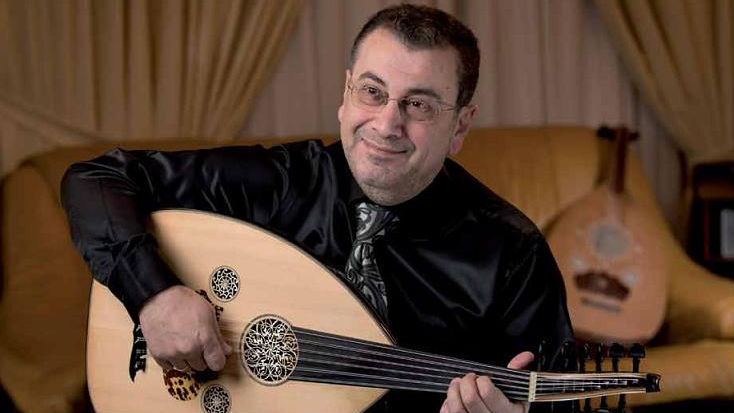
When Taiseer Elias plays the oud, he strums intently, his face creased in concentration as he creates a dialogue of notes and sounds.
Elias is a violinist and composer as well as a PhD in musicology, but he’ll be bringing his instrument of choice on Thursday night at the Oud Festival with “The Greats of the Nile: Um Kalthoum, Abd al-Wahab, Farid al-Atrash, Layla Mourad, Asmahan and Abd al-Halim Hafez,” a musical tribute to the major Egyptian musicians of the 20th century, with an ensemble of local soloists, players and choirs.
Elias calls it pure classical Arab music from the 20th century, featuring the most important singers in Egypt, but with some twists. That’s typical for this musician, who has dedicated his career to studying the sounds that can emerge from this pear-shaped instrument.
“Even when we’re playing traditional music, we try to renew it,” he said. “I don’t disconnect myself from my roots; it’s important to stay true to my roots and find something new in the tradition.”
Each year, the annual Oud Festival offers one of the best opportunities for Elias to do just that.
“The festival is somehow the only opportunity to play my music and expose it,” he said. “I know that the vast majority will be Jews in the audience but it’s the nicest thing that can happen, that you can expose your tradition, Um Kalthoum, to a Jewish audience. There’s nothing better than this.”
It felt like a weighty pronouncement to make during these times. Elias, who lives in the northern Arab city of Shfaram, talks about his desire to make good music, and its place in the annals of coexistence, or “shared existence,” as he calls it.
He is one of the co-founders of the Oud Festival, now in its 15th year and still the only one of its kind. He’s grateful for its existence, and for its home in Jerusalem’s Confederation House.
“There’s nothing like this anywhere else,” he said. “When I play, I don’t relate to or look at who’s in the audience. They are only human beings and I respect them very deeply and that’s why I devote my music to them.”
Elias was introduced to the oud by his two older brothers, and he taught himself how to play it. He went on to study classical western violin at the Jerusalem Academy of Music, and then earned his masters in Arabic music theory and his PhD in musicology, becoming, he said, “a performer and scholar and researcher.”
Call him the renaissance man of the oud.
But it wasn’t until his later years at the academy — he founded and heads its Eastern Music Department and also teaches at Bar-Ilan University — that his late teacher, Dalia Cohen, told him to develop his own music with the oud.
The oud was one of the most important instruments for Arab music theory in the Middle Ages, explained Elias. In practice, however, it was restricted to folk music and considered a modest, simple instrument used for musical interludes or preludes or to accompany singers, but without a sense of its own musical presence.
He wanted the oud to exceed expectations, to expose it to the Western world as an independent instrument that could stand on its own.
Elias worked on fusing its sound with other instruments, preserving its traditional sound while broadening its use in other musical compositions. He developed techniques for playing the oud that enabled him to dialogue with the piano and cello, working with composers who created concertos and orchestras featuring the oud.
He has since widened the oud’s reach, playing Vivaldi, Bach and Pagnini across its wide, stringed expanse, and performing with musical masters as diverse as Paco De Lucia, Isaac Stern, Ravi Shankar, Munir Bashir, Ross Daly and Itzhak Perlman.
Those kinds of compositions and performances, said Elias, prove “that the oud isn’t limited, it’s a great instrument,” he said.
“I’m creating something new,” he added. “It’s important to stay true to your roots, and then find something new in the tradition.”
“The Greats of the Nile: Um Kalthoum, Abd al-Wahab, Farid al-Atrash, Layla Mourad, Asmahan and Abd al-Halim Hafez,” Thursday, November 13, 9 pm at Sherover Hall, Jerusalem Theater. Tickets cost NIS 90, NIS 120, NIS 150 and are available through Bimot, 6226*, 02-623-7000.








The Times of Israel Community.