

 From the Liveblog of
Friday, June 26, 2026
From the Liveblog of
Friday, June 26, 2026
‘The beginning of the beginning’: Israel, Lebanon sign deal for IDF to start partially withdrawing from Lebanon
 Add ToI as a Preferred Source on Google
Jacob Magid is The Times of Israel's US bureau chief
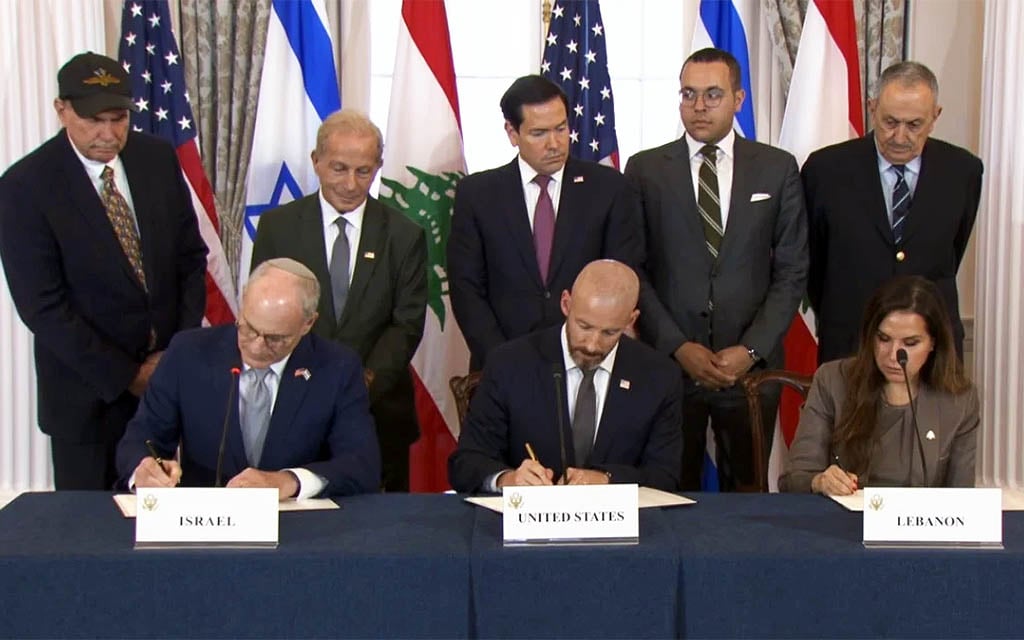
Representatives from Israel, Lebanon and the United States hold a signing ceremony at the State Department for what they are calling a trilateral agreement between their countries that will see the IDF begin to withdraw from small parts of southern Lebanon.
US Secretary of State Marco Rubio appears to acknowledge the limited scope of the agreement in his opening remarks, calling it, “The beginning of the beginning… This first step sometimes is the hardest one, but it’s an important one, and the one we’ve taken together.”
“There’s a lot of work ahead. We don’t in any way underestimate the difficulty of the task ahead, but we understand the importance of it, how vital it is, and we are honored to have played a part in bringing this together,” Rubio says before going on to tout the Israeli and Lebanese ambassadors to the US, who headed their countries respective negotiating teams in the five rounds of talks that began in April.
Rubio doesn’t get into the details of the deal, which hasn’t been publicized.
Speaking briefly after him, Lebanese Ambassador Nada Hamadeh says, “The trilateral framework we’re signing today is the first step on the road to restoring Lebanese sovereignty and territorial integrity, securing a permanent and final cessation of hostilities, enabling our people to go back to their land and allowing all Lebanese to live in peace, security and prosperity.”
“This was a long and difficult meeting. We are grateful to the host and to the two delegations for their cooperation during these talks,” she says, in an apparent nod to Israel.
“This milestone was made possible through the leadership of [Lebanese] President [Joseph] Aoun, the tenacity of Prime Minister [Nawaf] Salam, the resilience of Ambassador [Simon] Karam, and the patriotism of Lebanese Armed Forces,” Hamadeh adds.
Israeli Ambassador Yechiel Leiter gives longer remarks, but makes a point of thanking Hamadeh by name “for being a very tough negotiator.”
“You and your team set an example for patriotism to your country. You fight like a lioness, madame ambassador,” Leiter says to Hamadeh.
Leiter recalls how he began this round of talks on Tuesday by warning of an impending “train wreck,” after the US decided to include a ceasefire in Lebanon as part of the memorandum of understanding it reached last week with Iran.
The decision appeared to undercut Washington’s own efforts to prevent Iran from maintaining an influence over developments in Lebanon. The US had established the direct talks between Israel and Lebanon in April, specifically in order to ensure that Iran would not be involved in future discussions about Israel’s continued presence in Lebanon.
But either because of Iran’s significant leverage in the Strait of Hormuz or because Washington believed that Iran was needed to rein in Hezbollah, the US agreed to Tehran’s demands that the memorandum of understanding inked last week include a ceasefire in Lebanon and then agreed to allow Iran to be part of the deconfliction mechanism that was established to ensure that ceasefire — both moves infuriating Jerusalem and Beirut.
“Iran and its proxies wanted a train wreck,” Leiter says at the signing ceremony before arguing that such a result was prevented thanks to Rubio’s leadership.
Rubio has not been a part of the talks with Iran, which have been led by US Vice President JD Vance.
“We’ve put the train back on the tracks, and it’s running in the right direction. Final destination: peace between our two countries,” Leiter says. “In this performance-based, trilateral framework agreement, Iran is out, Hezbollah is out, and the road to peace between Israel and Lebanon is in.”
He goes on to maintain that today’s agreement would not have been possible without the resilience of Israel’s northern residents, the IDF and Prime Minister Benjamin Netanyahu’s government.




The Times of Israel Community.