Amit Ivri (left) with fellow swimmer Imri Ganiel (photo credit: courtesy of Israel Olympic Committee)
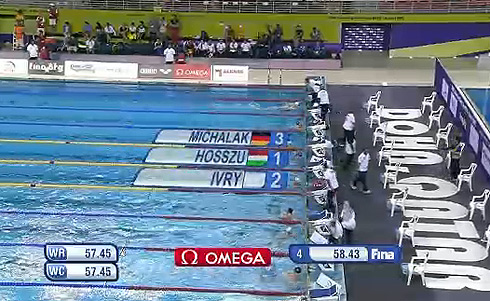
The organizers of the Swimming World Cup in Doha, Qatar, on Sunday failed to show the Israeli flag in their computer graphics displaying the races, substituting a white flag in its place, and failed to display the country name “Israel” — instead using “IRS” — in several of the cup’s races.
Some races in which Israelis featured were also not broadcast by the Qatar authorities, according to some reports.
The Israeli flag was also removed from outside the venue. A tweet was posted Sunday complaining about the flag’s presence before it was taken down from outside the Aspire Zone, according to the Doha News.
Amit Ivri, who won silver in the women’s 100-meter individual medley and broke the Israeli record in the process, said Tuesday that the experience was highly unpleasant, but she also stressed that the Israeli flag was raised when she stood on the podium to receive her silver medal.
“I’d much rather not talk about politics,” she told Army Radio.
Get The Times of Israel's Daily Editionby email and never miss our top stories
Qatar’s footage of the end of the 100-meter individual medley, in which Israel’s Amit Ivri won the silver medal. Instead of the Israeli flag, a white flag is displayed. (screen capture: YouTube)
She said that prior races, held in Dubai, took place in a warmer atmosphere for the Israelis. But Gal Nevo, who finished fifth in the men’s 200-meter individual medley in Qatar, said Israel was airbrushed out of the graphics in the early stages of the Dubai event too, although there was later “an improvement.”
Yesh Atid MK Yoel Rozbozov called the treatment of the Israeli delegation “shameful to all participants,” and vowed to file an official complaint with the International Olympic Committee and the International Swimming Federation.
JTA contributed to this report.
Advertisement
Help us report truthfully on social media
As a multimedia journalist, my job is to take the quality, fact-based journalism produced by The Times of Israel newsroom and make it accessible across every platform — from Instagram posts to podcasts to short-form videos.
This is how many, especially young people, consume news these days. But misinformation is rampant on social media. Our team at ToI produces accurate, responsible short-form reporting on Israel and the Jewish world.
If you believe in the importance of factual social media journalism, please consider joining our reader support group, The Times of Israel Community. Your financial support is essential to sustain responsible multimedia reporting.
We’re really pleased that you’ve read X Times of Israel articles in the past month.
That’s why we started the Times of Israel - to provide discerning readers like you with must-read coverage of Israel and the Jewish world.
So now we have a request. Unlike other news outlets, we haven’t put up a paywall. But as the journalism we do is costly, we invite readers for whom The Times of Israel has become important to help support our work by joining The Times of Israel Community.
For as little as $6 a month you can help support our quality journalism while enjoying The Times of Israel AD-FREE, as well as accessing exclusive content available only to Times of Israel Community members.
Thank you, David Horovitz, Founding Editor of The Times of Israel


 Add ToI as a Preferred Source on Google