

Opponents of boycott at NYC Park Slope co-op reckon with community’s vote against Israel
Cornerstone market in progessive Brooklyn neighborhood approves BDS campaign against Israeli products, forcing Jews and allies to decide whether they will remain members
 Add ToI as a Preferred Source on Google
Luke Tress is The Times of Israel's New York correspondent.
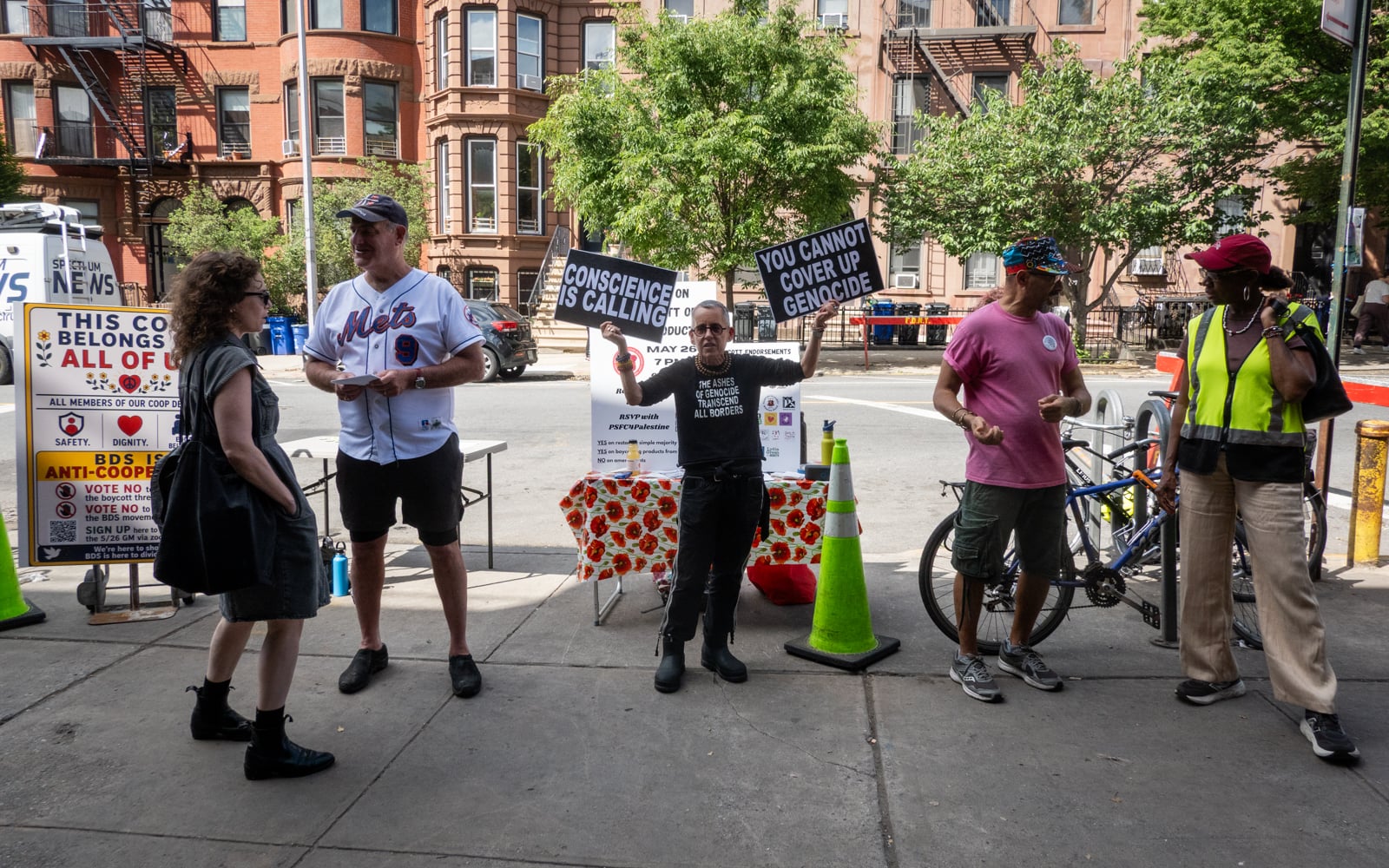
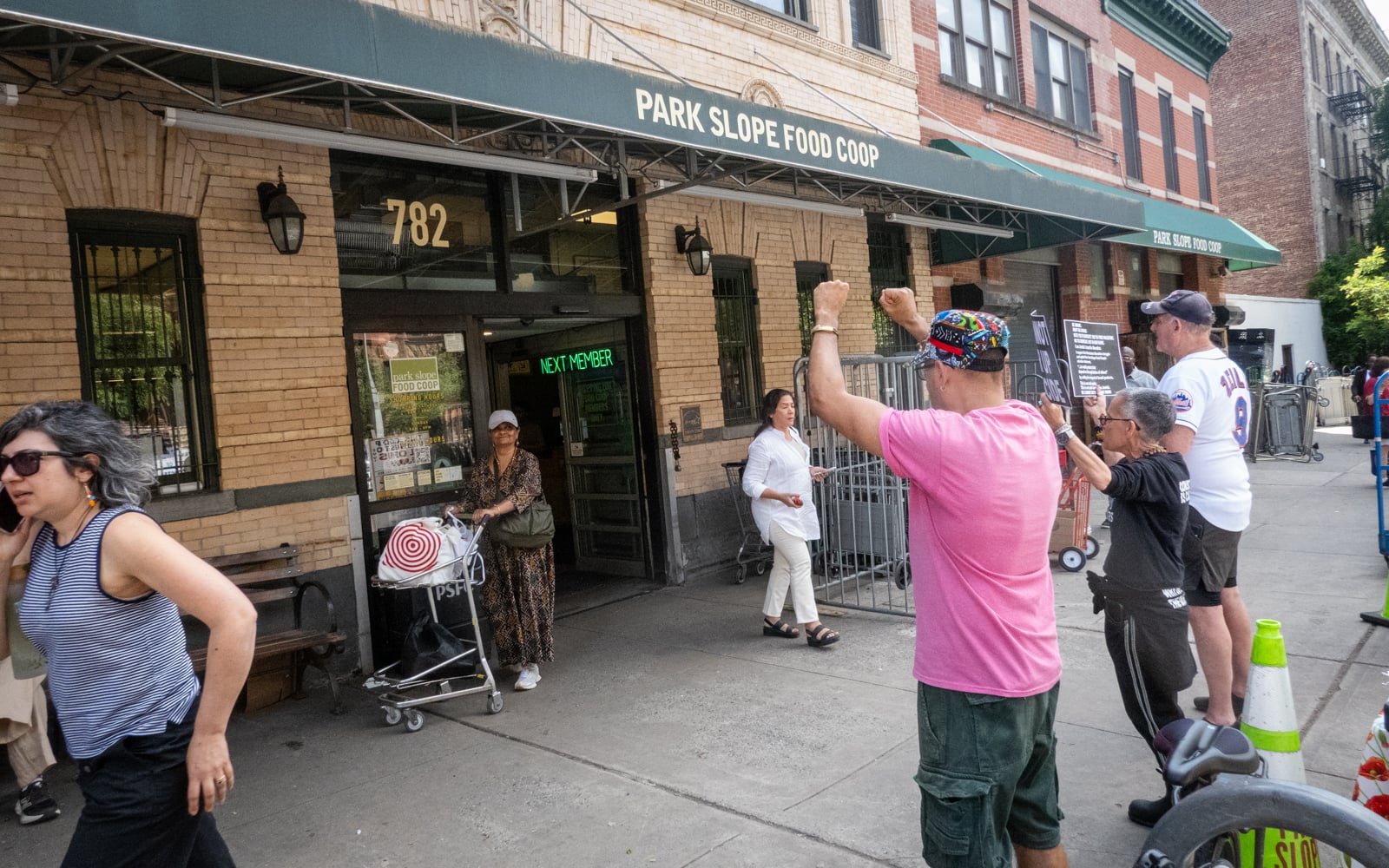
NEW YORK — Campaigners for and against a boycott of Israel campaigned outside Brooklyn’s Park Slope Food Coop on Tuesday afternoon, handing out fliers and making their pitch to shoppers, ahead of a vote that has riven the co-op community and become a major issue for Jews in the city.
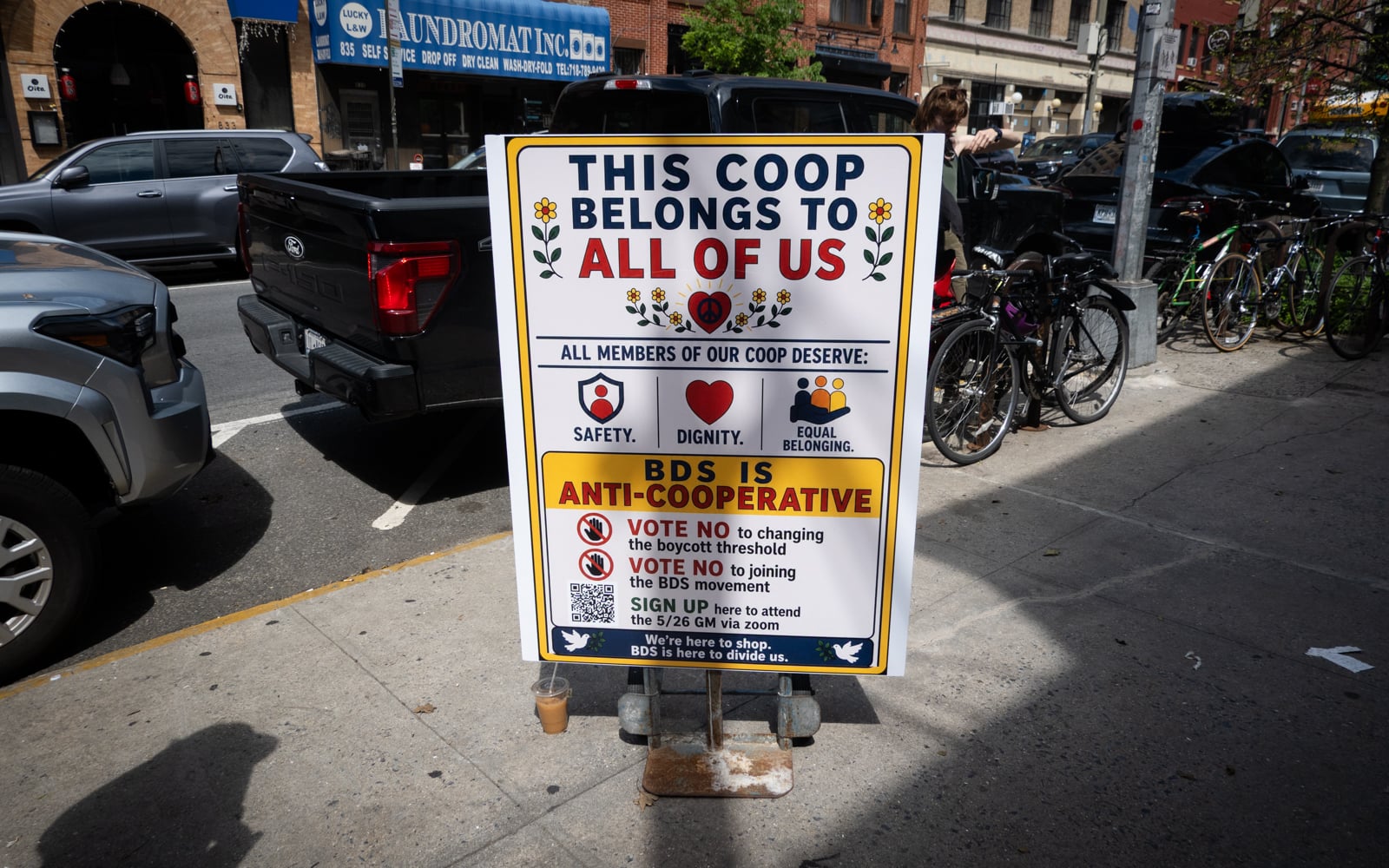
“For the health of the co-op, vote ‘No,'” an anti-boycott activist said, as shoppers filed past. “Keep the co-op free from discrimination.”
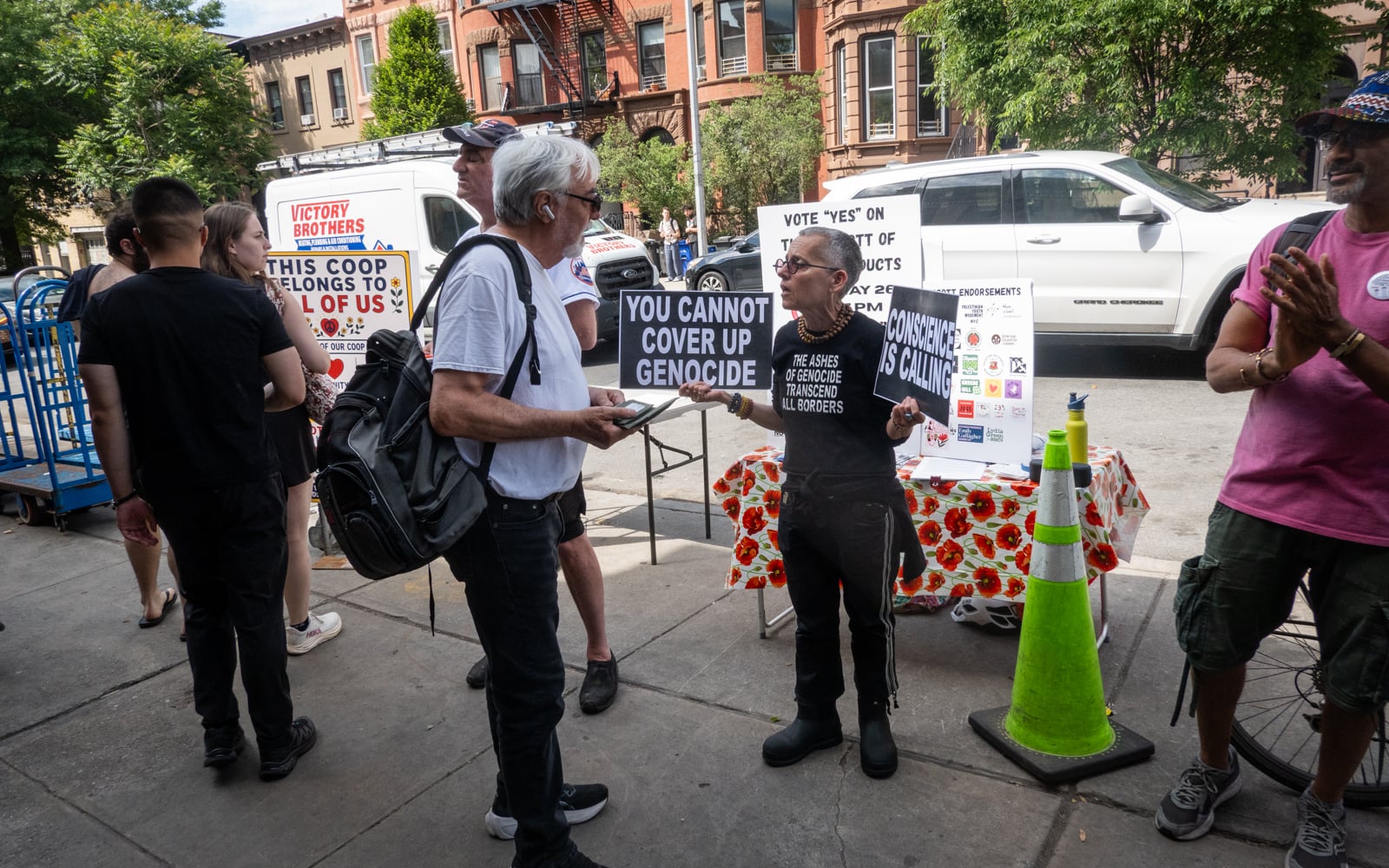
“Vote ‘Yes’ to stop genocide,” a boycott campaigner said, holding a sign that read, “You cannot cover up genocide.”
In the vote that took place hours later, the co-op passed a boycott against Israel by a wide margin, leaving the anti-boycott group reckoning with their future in the community. The dispute over the boycott highlighted how Israel issues continue to roil progressive spaces in the US, often alienating Jews, years after the start of the Gaza war.
The boycott measure passed by a vote of 67 percent in favor, 31% against, with the remaining 2% abstaining. More than 6,500 of the co-op’s 17,000 members voted.
A neighborhood cornerstone
The co-op, founded in 1972, is a longstanding cornerstone in the tony Brooklyn neighborhood known for its progressive politics and elegant brownstones. Only members are allowed to shop at the store, in exchange for working shifts in its aisles of organic products. Outside the entrance, members who request help carrying their purchases wait on benches, where “walkers” on shifts meet them to escort them home.
The Boycott, Divestment and Sanctions (BDS) vote against Israel has formed a rupture in that community.
Coordinators at the co-op told members last week that Tuesday’s general meeting on the boycott would take place via Zoom due to security concerns and the expected large turnout.
“Staff, presenters, Chair committee, and other members have all raised explicit concerns about their safety, attending the meeting in person,” the coordinators said in an email obtained by The Times of Israel.
In an internal email to members last week, the co-op’s management said that disagreements over the vote had “escalated into verbal confrontations and, in some cases, physical altercations” between members.
Threats, hostility, and security guards
The co-op has also received threats that “required coordination with the NYPD,” the email said.
Starting on Tuesday, the co-op placed security guards at the store entrance, while asking for members to “approach one another with the cooperative spirit that has sustained this community for decades.”
Some members of the co-op’s chair committee had told coordinators that, due to “concerns about hostility and reputational risk,” they were unwilling to chair meetings related to Israel.
Jewish members told the co-op’s management that they had been “systematically targeted and vilified” for years, had felt unsafe and harassed, had been labeled “genocide supporters,” and had been called “evil Zionists.”
The pro-BDS group said that “Zionists” were attempting to “shut down our boycott vote with intimidation and fear” in an email to supporters.
During one meeting with the co-op’s Dispute Resolution Committee, a BDS advocate derided an opponent for “Jewish privilege.” Other activists refused to speak with those they deemed “Zionists,” according to complaints sent to the co-op’s administration.
Last month, during a meeting, a speaker railed against “Jewish supremacy,” to some applause from other attendees.
The BDS vote is largely symbolic. The boycott campaign said it would apply to eight products, such as three tahini brands and Osem Bamba, plus “Israeli produce.”
Among the group’s demands was the “right of return” for the descendants of all Palestinians displaced in the 1948 war, which would effectively end Israel’s existence as a Jewish majority state. The founder of the BDS movement has said that the campaign rejects the existence of a Jewish state.
City leaders weigh in
Local elected officials, rabbis, leading Jewish groups, hardline anti-Zionist activist groups, members of Congress, and Congressional candidates all weighed in on the dispute.
New York City Speaker Julie Menin, ahead of the vote, said in a Tuesday statement to The Times of Israel that the co-op “has long brought together people from all walks of life around community, inclusion, and shared purpose,” but that the BDS vote “serves to further divide New Yorkers.”
On Tuesday, around 10 campaigners, from both sides, lined the sidewalk in front of the store as a security guard watched from inside the entrance. Customers stopped to chat with both groups, or announced their vote as they walked past.
The pro-BDS camp held up a printout of the co-op’s mission statement, pointing to a line that said, “We seek to avoid products that depend on the exploitation of others.”
“We’re a food justice organization, not just a grocery store,” one of them shouted.
“We started the co-op to have organic food at reasonable prices. You’d have to boycott every American product,” a woman who said she had been a member since the 1970s told them. “Where could we get anything?”
“It’s really annoying when people yell at me,” an elderly woman said.
One of the Jewish campaigners said anti-BDS members, expecting to stop buying at the store if the vote passed, were doing a “last stop shop” in the hours before the vote. He predicted that hundreds of Jewish members would quit if the vote passed.
A ‘great disappointment’
Greg Snyder, a Park Slope native whose family has been involved at the co-op for about 10 years, passed out fliers opposing the boycott that said, “Bring back cooperation. Stop polarization.”
He said that the boycott punished independent food producers who were not responsible for the actions of their government.
“Why stop at Israel? Let’s just go all the way. Let’s do it for the goods that the co-op imports from China. Let’s do it for the goods that the co-op imports from Pakistan, from Indonesia, from Russia, from the US,” he said. “Let’s do it for all of the goods that the co-op imports, and then sooner or later you’ll have no co-op.”
Snyder said he was raised in a mixed Christian and Jewish household, by a Syrian-Lebanese mother and an Ashkenazi father. A tattoo on his forearm reads, “May you be kept safe for me,” in Arabic, an expression his grandparents used. He grew closer to Judaism following Hamas’s October 2023 onslaught in Israel, leading to his involvement in the boycott campaign.
“This isn’t about any one conflict or anything. This is about being inclusive, setting up an environment of cooperation, and not setting a poor precedent of implementing exclusionary practices,” he said.
Members of the co-op have debated an Israel boycott since at least 2011, but the effort picked up steam following the war in Gaza that was sparked by the October 7, 2023, massacre. Israel rejects allegations of genocide.
Tuesday night’s virtual meeting took several hours. Ahead of the boycott vote, members voted through a measure to lower the threshold needed to implement a boycott from a 75% supermajority to a simple majority of more than 50% support. Without that rule change, which was pushed by the BDS campaigners, the boycott would not have won enough votes for approval.
“Until Israel complies with international law, including by ceasing unlawful discriminatory practices in its treatment of Palestinians, the Coop will not sell goods produced in Israel (pre-1967 borders) or in Israeli settlements in the Occupied Palestinian Territory,” the boycott resolution said.
After the boycott vote passed, members opposed to the measure held a call together, and then sent out an email to supporters.
“Tonight’s vote was not the result we wanted. It is a great disappointment. There are no other words,” said the message from the anti-boycott group, called Coop 4 Unity.
The email said that, last week, around 60% of the group had decided that, if the boycott passed, they would resign or go on leave from the co-op. Coop 4 Unity urged followers to “not make any permanent decisions yet,” and reported concerns about the voting process, saying that technical and procedural problems had prevented some attendees from voting.
Coop 4 Unity is working on a litigation strategy and organizing other responses for the weeks ahead.
“The Coop has always been larger than any one issue, and preserving that spirit remains worth fighting for,” the message said.








The Times of Israel Community.