

Secular Jewish filmmaker challenges rabbis to ‘Kabbalah Me’
Director Steven Bram’s journey to Jewish mystical enlightenment was born amid a post-9/11 mid-life existential crisis
 Add ToI as a Preferred Source on Google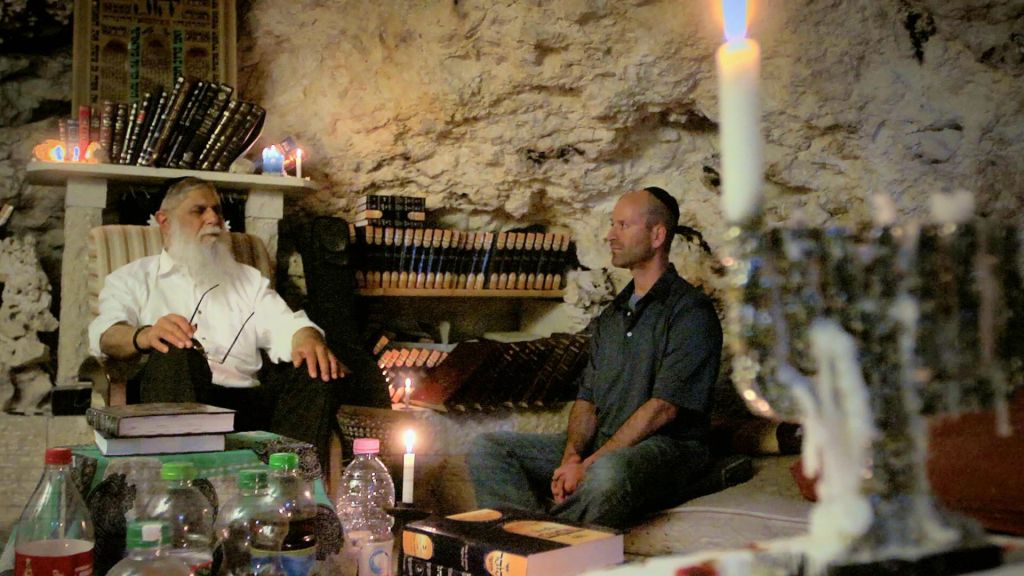
Steven Bram was a secular Jew who enjoyed Grateful Dead concerts, sky diving and Rangers games, when a midlife crisis descended on him full throttle.
With his 50th birthday looming, he began to feel his own mortality. He had watched his nest egg disappear during the financial crisis of 2009, and lost a brother-in-law in the 9/11 attacks.
“I was asking myself, ‘Why am I here? Where am I going? What have I accomplished?” A deeper connection to his faith, he thought wistfully, would have given him some answers.
Bram revealed his existential crisis to a friend, who gave him the name of a rabbi. After learning with the rabbi for a year, he became intrigued with Kabbalah, Jewish mysticism. He was determined to learn more about this ancient work that promised to reveal “the spiritual secrets of the universe.” Though his goal was knowledge and not self-transformation, his life was profoundly altered by the experience.
As a producer of sports films, Bram couldn’t quell the urge to film and share his path to enlightenment. It was a concept he picked up from Kabbalah.
“It’s this idea that you can’t just sit around: you have to act upon what you know and do something for the world,” he said. And so he created “Kabbalah Me,” which has so far been shown in LA and New York. Bram expects to bring it to Israel in the coming months.
He is hopeful his film will inspire viewers.

“People can relate to me as a modern secular person who gets involved in a spiritual pursuit. Maybe it can deepen their own spiritual journeys.” (Perhaps, but Bram’s childlike enthusiasm at times can also be disconcerting and he appears a tad too willing to accept amorphous responses from the rabbis.)
Yet following Bram around to the myriad of places he visits during his mid-life crisis tour can be entertaining whether its Manhattan’s Kabbalah Center, a gathering at MetLife Stadium to celebrate the completion of Talmudic study, Purim in Brooklyn, the Western Wall, the mystical city of Safed, or an ancient mikvah in Israel.
It’s hard not to like Bram’s onscreen persona because he comes across as genuine and passionate in his endeavor. In one scene his friends ridicule him at his own birthday party for his newfound religious fervor.
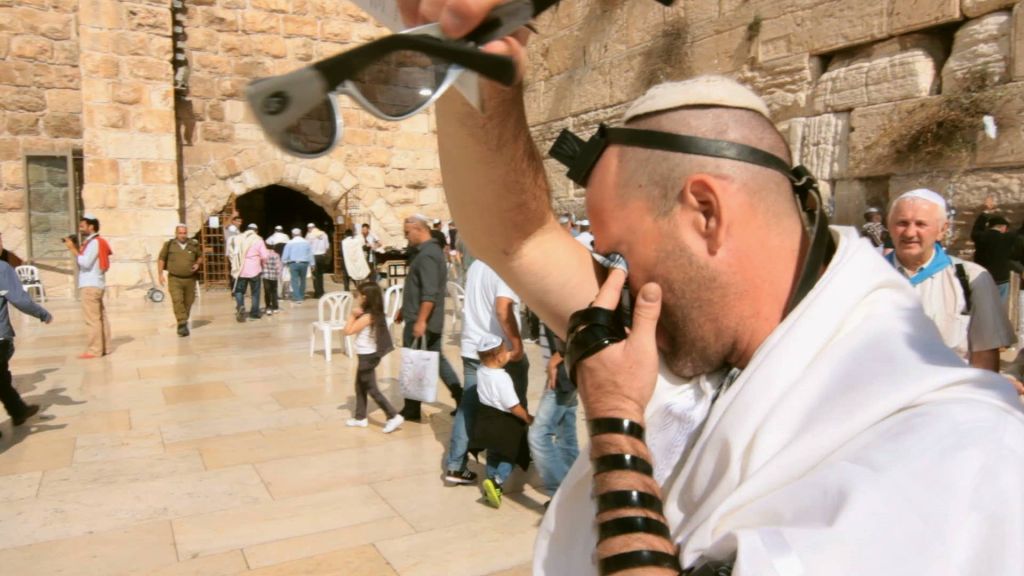
At the Western Wall, Bram has an epiphany that brings him to tears.
“This is the first time I really prayed and connected,” he said, choking up and wiping away tears with his talis. “It took me 49-and-a-half-years.”
He stops eating lobster, and begins praying regularly and observing Jewish holidays.
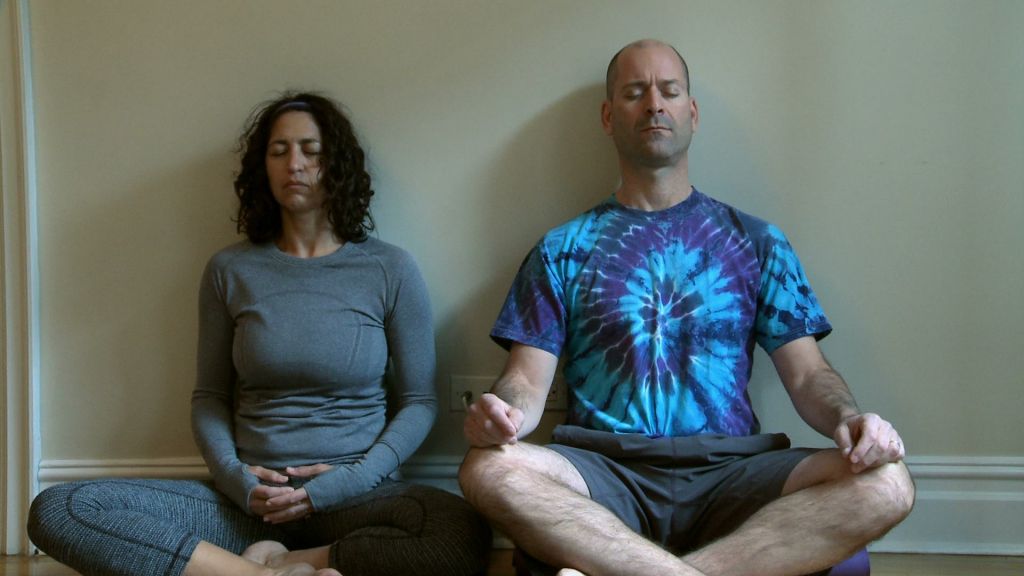
Though his discovery brings him euphoria, it also creates complications in his life. Bram’s family is not exactly thrilled abut the prospect of his new stricter observance. His down-to-earth wife Miriam, who finds fulfillment in yoga, insists she doesn’t want to change her current lifestyle. It’s clear she fears her husband’s religious fervor in a scene when Bram schleps her and the kids to visit his long lost Hassidic relatives in Brooklyn.
Though he has stopped eating his beloved lobster, Miriam continues to eat it in front of him. His children express disappointment that he will no longer have bacon for breakfast and don’t understand why he won’t have it anymore. Clearly, his greatest obstacle will be convincing his family and friends that he hasn’t gone nuts.
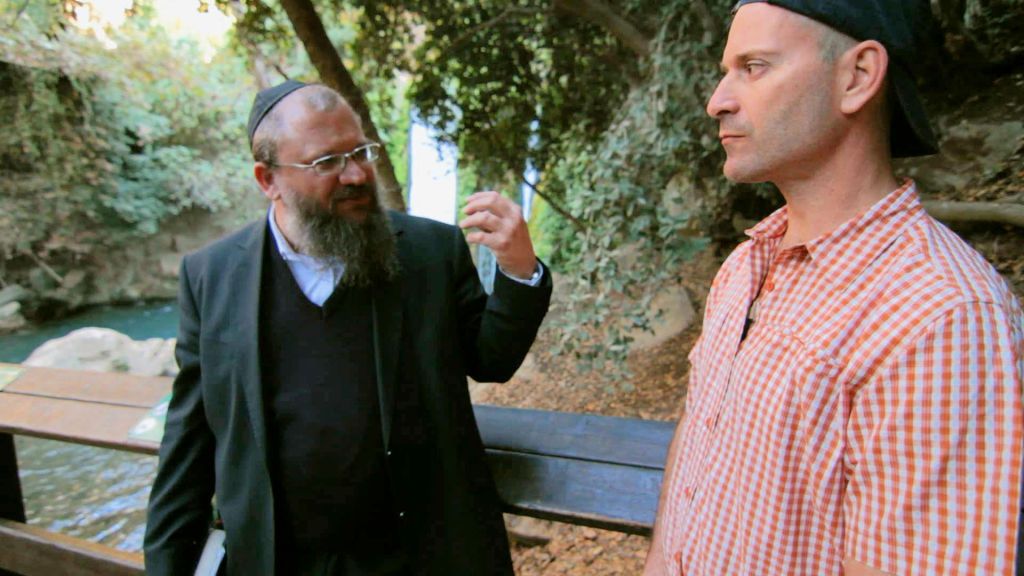
Even some rabbis aren’t happy about his passion: They warn him that studying Kabbalah for someone without a foundation in Jewish text is like eating dessert before the main dish, meaning that Bram ought to spend his time on learning the basics first. In truth, many Jews believe that Kabbalah is intended to be kept esoteric and reserved only for scholars over the age of 40.
Such wrinkles only serve to make Bram’s story far more compelling.
Kabbalah has generated a lot of publicity in recent years. Most notably, the Los Angeles Kabbalah Center has drawn celebrity followers such as Madonna, who is mentioned several times in the film but does not appear in it, Demi Moore and Ashton Kutcher who held their wedding at the center, Britney Spears and other names generally associated with movie mastheads. The film includes interviews with Kabbalah Center groupies, but it’s obvious that Bram’s journey is a more serious one that involves serious evolution.
‘How do you balance a normal life with a deeper religious commitment?’
Bram said he made the film to introduce the concept of Kabbalah to a wider audience, but viewers who expect a deep explanation of what Kabbalah is and what is says may end up disappointed. Although there are numerous rabbis who appear in the film to explain the study of Kabbalah, we ultimately end up learning a lot more about Bram and his journey.
The film is successful as a tale about a modern soul who searches for spirituality and then attempts to incorporate it into his life. After returning home from a spiritually uplifting trip to Israel, Bram muses, in a scene set against the backdrop of a Manhattan skyline, “How do you balance a normal life with a deeper religious commitment?” That is a universal question that is certainly worthy of discussion.
Bram says he’s learned to not be pushy when it comes to his family. “You can’t force this on people. It’s much better when you live your own life and be the best person you can be. That’s the best motivator for other people to want to be what you are.”
It seems to be working: Miriam, who never wanted to take on any Jewish rituals before, recently purchased kosher meat and lit Shabbat candles. She said she’s pleased to see the changes in her husband, who is more relaxed and patient.
“Steven finds meaningful ways to observe holidays and pray without asking us to change our lifestyle,” she said. “He is more self aware and his spiritual perspective provides a sense of grounding for our family.”
Learning Kabbalah, Bram observed, has helped him become a better person.
“I used to be upset when a taxi cut me off or a waiter didn’t give me a good table. I’m more relaxed now about the little things. I realize these things are minute compared to the larger things in the world.”









The Times of Israel Community.