

Sharansky: The free world has betrayed democratic dissidents
Icon of Soviet Jewry liberation movement faults West for confusing elections with true democracy, says Obama’s indecision on Syria led to opposition’s radicalization
 Add ToI as a Preferred Source on Google
Elhanan Miller is the former Arab affairs reporter for The Times of Israel
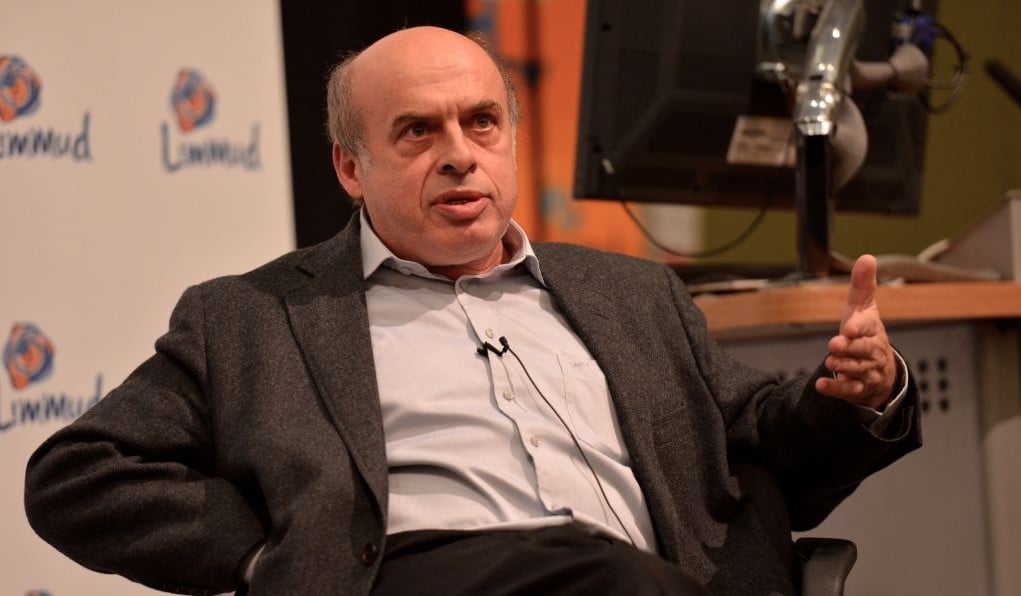
Back in the Soviet era, some experts claimed that Homo sovieticus, the archetypal “Soviet man,” was inherently obedient and passive, utterly incapable of producing a democratic regime. That theory, Sharansky contended in his 2004 book, “The Case for Democracy,” crumbled to the ground with the collapse of the Soviet Union in 1991.
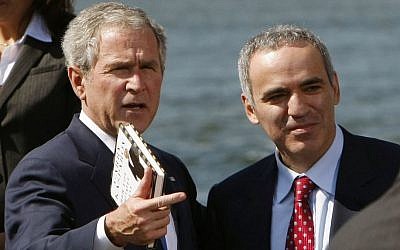
Democracy as a political system is tailored to everyone, the most iconic of Soviet Jewish refuseniks argued. And his idea that every nation on the globe is potentially capable of achieving democracy deeply influenced US president George W. Bush, who invaded Iraq in March 2003 as Sharansky’s book — co-authored with current Israeli ambassador to the US Ron Dermer — was being written.
A decade later, as Arab Spring nations from Egypt to Syria seem as far as ever from attaining democratic rule, Sharansky believes his ideas are as true as the day he first articulated them.
“What have I written which was found to be untrue?” he asked in an interview. “In the Arab Spring, the only force with a clear strategy was the Muslim Brotherhood. The free world didn’t have any strategy,” the former Israeli interior minister and current chairman of the Jewish Agency said, speaking to The Times of Israel on the sidelines of the Limmud Conference at Warwick University in the UK.
Nine years in a Soviet gulag and nine more in Israel’s political arena (which he jokingly says were no less taxing) have not dulled the glimmer in Sharansky’s eye. Or the fire of his vision. His critique is focused on the West, which in its “obsession” to support the Muslim Brotherhood in Egypt neglected the democratic forces that began emerging in the country.
“I want a consistent policy of supporting democratic dissidents. There were so many opportunities, but almost all were missed,” he said.
‘From the point of view of the free world, there should be no difference between Assad and the Muslim Brotherhood coming to power in Syria’
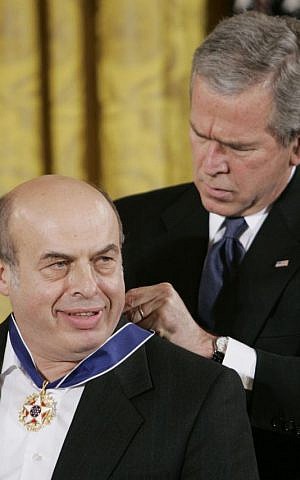
Bush told the Washington Times in 2005 that Sharansky’s book offered “a glimpse of how I think about foreign policy.” According to Sharansky, Bush’s sense that “democracy was not an American invention” led him to meet with over 100 democratic dissidents from around the world, an inclination which is sorely lacking in the US and Europe today.
“What was saving us [the refuseniks] in the Soviet Union? It was the fact that all these important American people were supporting us in every speech. They knew our names.”
The president and the dissident disagreed, however, on whether free elections should be the first step imposed by the West on fledgling democracies.
“Bush didn’t agree [with me] that democracy isn’t about elections. Democracy is free elections and a free society. We should not be blinded by the fact that elections happened in some countries and automatically call those countries democracies. That’s the lesson from Egypt,” Sharansky said, adding that the creation of civil society institutions must precede the ballot box.
Obama’s fatal indecision on Syria
Sharansky is particularly critical of the Obama administration’s inconsistency on Syria. America’s indecision on how to treat Assad has caused the opposition movement there to radicalize; now it can hardly be dealt with.
“When the [uprising] against Assad began, 90 percent of the opposition was democratic. Today 90 percent of the opposition is fundamentalist,” he said. Obama’s “red lines” on Syria’s chemical weapons were ignored almost as soon as they were uttered.
“In this situation, the only forces which can succeed are those which are already well-established: either civil dictatorships or fundamentalists… From the point of view of the free world, there should be no difference between Assad and the Muslim Brotherhood coming to power in Syria.”
The West’s “betrayal” of democratic dissidents in Iran’s 2009 Green Revolution has sent an extremely negative message to democratic Arab oppositionists in the Middle East today, Sharansky argued. If no democratic forces emerged in the Arab world, the West should simply stay out.
“We should not try to choose between ‘our dictator’ and ‘not our dictator,'” he said.
‘Aliyah and Diaspora Jewish education are not mutually exclusive’
In 2009, after a long career in politics where he served as the head of the Russian immigrant party Israel Ba-Aliyah and as minister of housing and construction, the interior, and Jerusalem affairs, Sharansky — now a member of Likkud — decided he needed a change.
Prime Minister Benjamin Netanyahu wanted him to run for political office alongside him, and was surprised when Sharansky politely declined.
“He was absolutely shocked, because Jewish Agency chairmen usually want to run for Knesset or [get a job in] government. It’s usually the next step of their career. But I said I’m not interested and asked him to support my candidacy for head of the Jewish Agency.”
As head of the large pre-state Jewish organization, Sharansky wished to strengthen the bond between Jews in Israel and the Diaspora — despite his longstanding criticism of the Jewish Agency, an organization he says was “built for the challenges of yesterday.”
“I know very well how powerful it is to have an organization which is the only table in the world where [the Israeli] government meets with Orthodox, Conservative and Reform Jews and community leaders. We sit and take decisions together.”
The uniqueness of the Jewish Agency lies in the fact that it is both a semi-official Israeli organization and one that functions independently from government. Funding by Jewish communities worldwide is matched by the Israeli government.
In the past, Sharansky noted, the Jewish Agency tended to act rather whimsically when dealing with Diaspora Jews; either demanding immediate aliyah or focusing solely on community building.
“As a result, Jews were falling between the cracks, because ‘we [the Jewish Agency] want an immediate solution and you’re not ready for this, so you’re not interesting for us’.”
“Instead of these immediate agendas we have to see things as a process, because life is a process … If you want more aliyah there must be more connected Jews. For there to be more connected Jews, you must strengthen their Jewish identity. No doubt for me personally, the highest development of your Jewish identity is aliyah.”
The practical manifestation of this philosophy was Sharansky’s canceling of the traditional separation between the aliyah and education departments in the Jewish Agency.
“Our departments now deal with products: Israel Experience, education projects, Tikun Olam [international aid] projects. These are the tools we have to draw people closer to their tradition and to the state of Israel. As a result, our shlichim (emissaries) have to think integration… They all have to deal with all these programs and see them as one process.”
‘Run for president? I am not a politician’
With the seven-year term of President Shimon Peres ending next summer, Sharansky did not deny rumors that he is eyeing the most coveted public office in Israel. He assessed, however, that since he has little clout in the Israeli parliament — whose 120 members choose the president — his chances of winning the position are next to nil.
“This process is very political,” he said after an atypically long pause. “It’s not journalists who decide who will be president and I am not in politics. It’s not even serious to start discussing it. The question is decided deep inside the political world, which I left.”



The Times of Israel Community.