

Start-up oracle Yossi Vardi and his not-so-smart phone
He is the ultimate authority on Israel’s start-up ecosystem, but Israel’s ‘tech guru’ has some contrarian ideas on what constitutes start-up success
 Add ToI as a Preferred Source on Google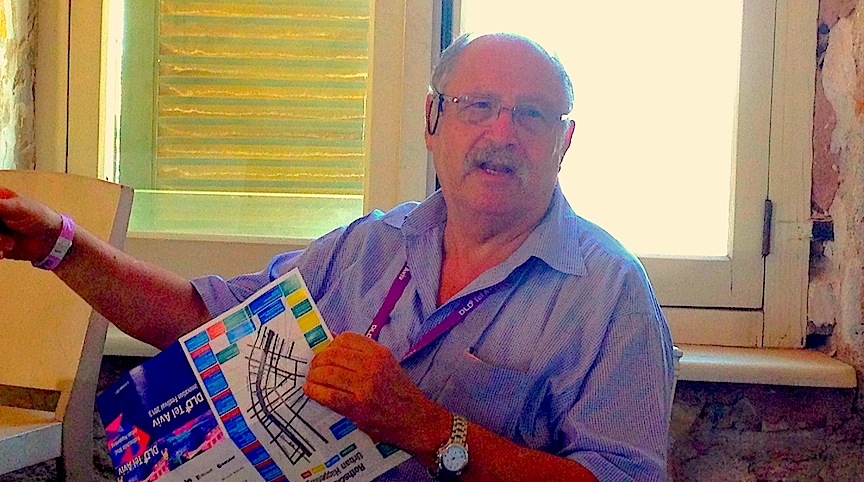
Herzl and Ben-Gurion may be the fathers of modern Israel, but the father of the Start-Up Nation is without a doubt Yossi Vardi. Now 71, Vardi struck it rich with the first big Israeli-invented app of the Internet era, when he and his partners sold ICQ in 1998 for over $400 million. As a result, he has attained the status of “tech guru,” an ultimate oracle of wisdom regarding the start-up and tech scene in Israel.
Vardi is happy to share his insights, as he did Tuesday at a special press event for the foreign press at the third annual DLD (Digital Life Design) festival in Tel Aviv, which saw the cream of the high-tech world descending on Tel Aviv for dozens of conferences, meetings, and workshops. For entrepreneurs, though, the question is: Can they trust the insights of a tech guru walking around with a 5-year-old cellphone?
“I am happy you came to Israel to cover a tech event, instead of the things Israel is usually known for,” Vardi told about two dozen journalists from Europe, India, China, and the US. “We have over 1,100 people from abroad at this event, which shows that there is great interest in Israel beyond the usual headlines we get in the world media.”
Vardi, along with DLD founder and director Stephanie Czerny and Burda Media publisher and chairman Hubert Burda, sponsors the Israeli version of the show. The main DLD event takes place in Munich and there are also DLD-related events in New York, Beijing, San Francisco, London, Moscow, New Delhi, Rio de Janeiro, and Hong Kong, all of which discuss current and future trends in not just tech, but in science, culture, fashion, leisure, and much more.
Among the attendees/sponsors of the Israeli event this year were tech giants like Google, Amazon, Yahoo, AOL, GM Yandex, Orange, Microsoft, and Facebook, among others. Several of the companies, like Facebook, held mini-events for developers and investors. “Over 500 people came to the Facebook event, and the company said it was the largest they have ever held outside of the US,” Vardi said. “These companies are not here to sell to Israel’s markets, which are very small, but to take advantage of Israel’s technology expertise.”
But it’s start-ups that are the focus of DLD, and Vardi had plenty of advice for fledgling companies — some of it surprising. One of the things that makes Israel so successful, said Vardi, is that it sometimes isn’t.
“Israelis are not afraid to fail, and this is one of the Israeli start-up ecosystem’s great strengths,” he said. “In India failure is taboo, in Germany it is an embarrassment, and in Japan, they have a system — called harakiri — to ensure that failure is dismissed from the gene pool. In Israel it is an honor to succeed, but not an embarrassment to fail. If you are afraid to fail, you won’t take risks. You cannot succeed in a start-up in a society that fears failure.”
One major concern for many Israeli investors is the seeming rush by Israeli start-ups to sell their technology to a multinational. While some companies — such as Mellanox and Teva — try to maintain their Israeli identity, growing organically until they turn into a large established tech company, the large majority of start-ups actively seek to “sell out” and become acquired by a foreign multinational. Israel’s economy, many in the investment community and the government believe, would be far better off if it grew its own multinationals instead of transferring some of the world’s most innovative technology to foreign companies.
Vardi, though, doesn’t see it this way. “There is a big debate regarding early exits,” he said. “I don’t think this is necessarily a bad thing, because it gives entrepreneurs and opportunity to consolidate their success. Some economists believe that we are losing jobs” because some of the functions of an acquired company are often transferred abroad, “but I have seen studies that say that the large majority of tech jobs come from companies that are a year old or less, the exact start-up stage that Israel’s ecosystem thrives on.”
“However, I accept that not all agree with me,” he quipped, “I once asked sexologist Dr. Ruth Westheimer about this, and she said she was against early exits,” without delving into the matter.
Vardi also commented on the “Round A” crisis that plagues many start-ups — their ability to easily get angel or seed funding while running into a brick wall when they try to get the next round of funding. Many in the start-up community have tried to blame this on the way Israeli venture capital firms are structured or managed, but Vardi said that more often than not, the fault lies not with the investors but with the start-ups themselves.
“Many start-ups die simply because they do not have a good product or service,” he said. “I myself have invested in 80 start-ups. Of these, 22 went through successful exits, but 27 of them closed down. Companies fail not because of competition, but because of poor execution.”
With that, Vardi said, you need a little luck. “There is money out there for good products, however.”
About how he became a guru, Vardi waxed self-deprecating.
“ICQ was my greatest success and I became a ‘genius’ when I sold it — but to tell you the truth, when I built it with my partners I had no idea what it would be good for. I may have a reputation as a technology expert, but if you think I am, take a look at this,” he told the reporters, pulling out his phone. Not an iPhone or an Android device, but a Palm Treo, the last model of which was manufactured in 2008.








The Times of Israel Community.