

The unanswered questions of Agnieszka Holland
The Polish filmmaker talks about the Holocaust, her movies, and the themes she returns to time and again
 Add ToI as a Preferred Source on Google
Jessica Steinberg, The Times of Israel's culture and lifestyles editor, covers the Sabra scene from south to north and back to the center
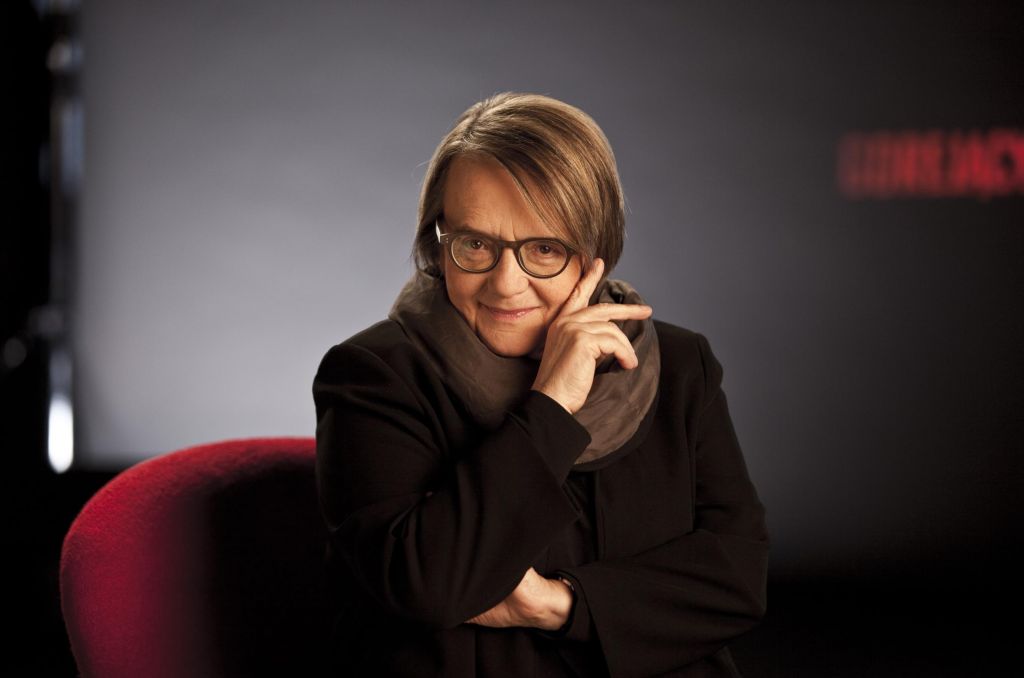
For Agnieszka Holland, the purpose of filmmaking has always been to pose questions. Born in Warsaw, Poland, in 1948 to a Catholic mother and a Jewish father, both of whom were involved in the Warsaw Ghetto Uprising — her Catholic mother belonged to the Polish underground — Holland’s existential questions, and the movies generated as a result of those questions, have often been about the Holocaust.
She was raised in post-war Poland, where her father, an avid Communist, died during a police interrogation when she was 13 years old. After attending Prague’s Film and TV School, she began directing her own films in the late 1970s, often leaning toward stories with a heavy political slant based on her own life experience as well as examining the painful stories and issues of the Holocaust. She is perhaps best known for her 1991 film “Europa, Europa,” which was nominated for an Academy Award for best adapted screenplay. Her 1985 film, “Angry Harvest,” was nominated for best foreign-language film at the Academy Awards as well.
Holland was in Israel last week to accept a Lifetime Achievement Award from the Jerusalem Cinematheque at the annual Jewish Film Festival, followed by a screening of “Burning Bush,” her 2013 three-part miniseries created for HBO about a Prague history student during the 1969 Soviet occupation of Czechoslovakia.
She sat last week with The Times of Israel and talked about the challenges she seeks in her films and whether she feels satisfied with any of the answers she’s received in 40 years of filmmaking.
There’s a decided backlash in Israel against certain things Holocaust-related, perhaps a kind of tiredness about the subject. Do you sense that as well?
The Holocaust begs so many questions, that you can never just say it was resolved. I personally feel that it doesn’t belong to the past. It belongs to the present, it’s a virus in the system. I see it in Europe; there’s some kind of deprivation of the guilt because of Israeli politics, which offers some excuse not to feel guilty anymore. But it’s part of historical politics.
Then what does the continued conversation of the Holocaust mean for you?
The first generation was silent and then started to talk, maybe too much, which was the second generation as well. Now the third and fourth generations are making tattoos and doing reconstructions. In Poland, they are reconstructing the deportations to the camps. It’s totally absurd. It is difficult to wake up empathy and sometimes the films — if they really touch the core — can do that for a little while, they can change things, maybe a bit.
How about you? Do you ever tire of rehashing the questions of the Holocaust, reconfiguring its stories and tragedies on the screen?
The Holocaust is a kind of tool. It’s attractive to filmmakers for generations because it’s a source of incredibly dramatic stories, like the Greek tragedies or the Bible, or great mythical stories. The only thing that bothers me is the sentimentalization and moralization that takes place and is difficult to avoid when putting something into a fictional structure. And most people are only interested in stories of survivors. There were, how many, 5 percent of the Jews who survived and the rest were killed? You can’t get money to make a movie where everyone’s dead. It’s only acceptable when the victims are heroes, martyrs. It’s like a natural catastrophe. You don’t want to see the tsunami film where everyone dies, you want to see Naomi Watts surviving. (See clip below of “Canals,” a 1957 Polish film mentioned by Holland in which the characters all die, but as martyrs.)
http://www.youtube.com/watch?v=SzxXvVJSMoc&feature=share&list=PL116A5F5954C65ED6
How have you handled the survivor-versus-victim conundrum in your own films?
It was easier in my first movies because I was touching on new subjects. My heroine dies in “Angry Harvest”; she doesn’t survive. And “Europa, Europa” was very ambiguous, while “In Darkness” was the most conventional, opening the subject of Gentiles and Jews, and both sides so full of stereotypical hatred, and how you can survive it, and come to human solidarity, and I show that it doesn’t pay off. But I actually didn’t want to make that movie, I thought it was a much tougher sell, so I created impossible conditions, like it could only be in Polish, Yiddish and German, but they still went for it. I was afraid it would fall flat, and when it didn’t, it was such a relief.
How do you find some relief, some respite, after those emotionally intense filming experiences?
I do TV episodes. After “Burning Bush,” I immediately flew to New Orleans to do the finale of “The Killing.” That’s my break. It’s not funny, but it’s funnier. It’s some kind of escape.
How about Israeli films? Are you following the ongoing development of the local film industry?
There’s a lot of politics and dilemmas, and I like what’s alive and personal. I really enjoyed “Fill the Void,” seeing the Orthodox world from the inside, and I enjoy Joseph Cedar’s work, and “Waltz with Bashir.”
Where do you look for inspiration?
Michael Haneke is the most interesting filmmaker for me. I don’t connect to everything he does, but I always want to see what he’s doing. I’m interested in his work, in his subjects. The questions he’s asking are the questions I ask myself. I like crazy American movies, like the Coen Brothers, Wes Anderson, Quentin Tarantino and Thomas Paul Anderson. I like the freedom they have, touching on subjects in unconventional ways.
I’m always afraid with political cinema, that it will be boring in its political correctness, and too heavy for going to see a movie. We are in a time when we need provocations. People are settling into their positions and we have to convince them that convinced is boring, that we need to shake things around, but it’s not always easy to finance the provocations.






The Times of Israel Community.