

On Israel’s sandy ground, major dreams for minigolf
There may be no Hebrew word for ‘putting,’ but two entrepreneurs believe that if they build the courses, the players will come
 Add ToI as a Preferred Source on Google
Jessica Steinberg, The Times of Israel's culture and lifestyles editor, covers the Sabra scene from south to north and back to the center
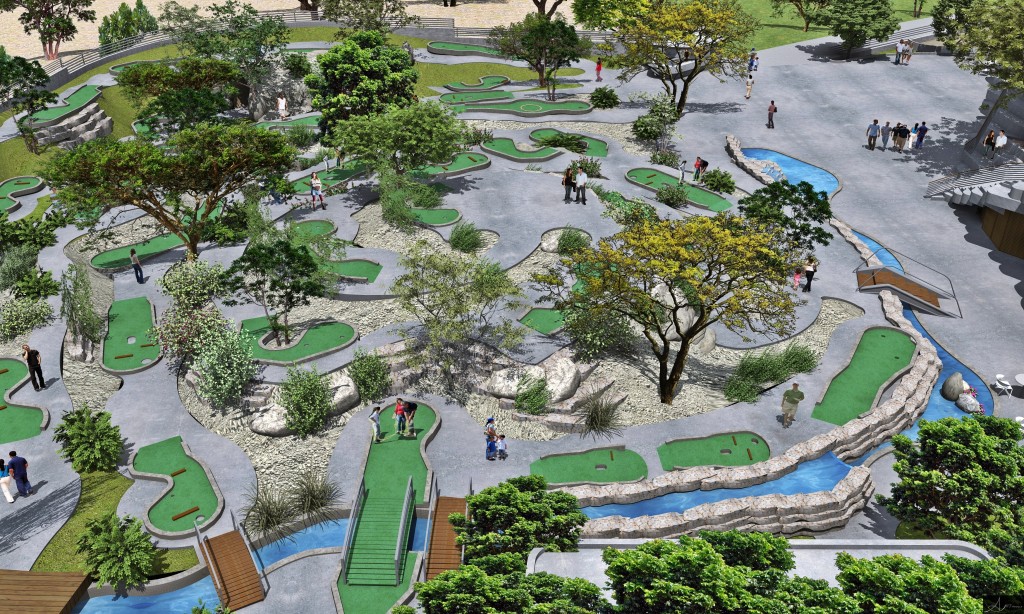
Somewhere in the intersection between “If you will it, it is no dream” and “If you build it, they will come” lie Noam Zeichner’s plans for a miniature golf complex on the sandy dunes of Ashdod.
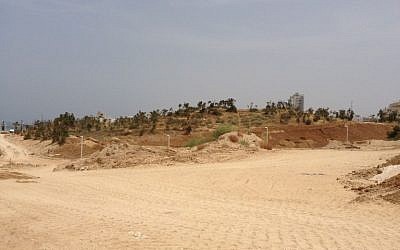
“There’s no word for theme park (or putting) in Hebrew because there’s nothing like it,” said Zeichner, standing on the sandy ground that he hopes will soon be home to Hole #2 of his Psagot Golf club. “But this is what the public needs.”
Miniature golf. The game of Astro turf and waterfalls, windmills and rolling hills, all built to Lilliputian scale.
Zeichner believes that if he builds miniature golf parks in Israel — in Eilat, Tel Aviv, Acre and beyond — Israelis will come play. Not just kids, either, but their parents as well, who will rent out his party room for company gatherings and family celebrations. The plans don’t end with his 5,000-square meter, two-course (18-hole and 36-hole) complex that will include real waterfalls, putting cages and a restaurant, all overlooking the Ashdod shoreline.
He’s also working with the World Minigolf Sport Federation (WMF), the official international organization promoting miniature golf as a competitive sport, and, looking toward helping to establish minigolf as an Olympic sport. One day.
“More than 55 countries worldwide acknowledge minigolf as a sport,” said Zeichner, who recently hosted Dr. Gerhard Zimmermann, the WMF president, in Israel. “When that number reaches 70, minigolf will go to the Olympics.”
Minigolf at the Olympics? As a real sport? Well, anything’s possible.
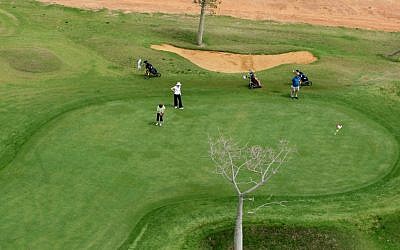
Or, perhaps Zeichner is confusing golf and minigolf, commented Gili Peleg, CEO of the Ga’ash Golf Club, a nine-hole executive course that opened 13 years ago on the grounds of Kibbutz Ga’ash in the country’s center.
“Golf and minigolf are not the same thing at all. It’s like saying that golf’s training area is minigolf,” said Peleg, whose family owns the golf club. “It’s true that golf in Israel hasn’t completely caught on. So maybe if you don’t play golf, you’d see minigolf as the way to golf, another game with grass, holes and a small ball, and that’s the image you have.”
Still, golf is an expensive sport and minigolf isn’t, which is why Zeichner isn’t the only minigolf entrepreneur out there.
Meet South African contractor Grant Crankshaw, who has plans to build the iPutt miniature golf course in Ra’anana, and chuckles when he hears about Zeichner’s Olympic dreams.
“I’m quite respectful of golf as a sport, and minigolf is essentially the short game in which kids can get the same score as adults, which is the surprise factor,” said Crankshaw, who plans on building iPutt according to international standards. “If adults don’t find it technically challenging, you’re losing your audience. You want the granddad who is a golfer to come and lose to his grandkid. But this is a business, and I want to make money from it.”
Not surprisingly, it takes quite a bit of cash to build a proper miniature golf course. Crankshaw figured he needs $1.5 million to build his planned three-and-a-half dunam course situated next to Ra’anana Park, the largest green space in the Sharon region. Zeichner, who is planning for a larger space, mentioned a range of $1.8 million to $2.5 million.
Both men have been waiting for approval on the land allocation from the respective municipalities. Crankshaw took part in a city tender and will start looking for investors if he succeeds, while Zeichner said he should receive his final approval and begin building in about a month.
A serial entrepreneur and engineer who has filed “dozens” of patents, including a mooring system for offshore fish production, Zeichner’s plans include building minigolf courses in Eilat, Acre and Tel Aviv. He said he is “nervous” about not having raised funds yet, but didn’t seem overly concerned.
“Are you married to an entrepreneur?” he asked me. “This is what we do.”
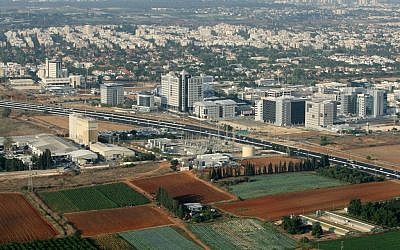
Crankshaw came up with his own minigolf dream years back, when his then-11-year-old son would wander Ra’anana’s streets with his friends, lacking any decent destination. He remembered playing endless rounds of miniature golf with his friends in Johannesburg, and decided to approach several local municipalities, including Kfar Saba, Even Yehuda, Rehovot and Ra’anana, all of which were interested in the idea.
When the economic crash came, he lost his investors and decided to focus solely on Ra’anana, eventually entering the municipal tender for a particular plot of land.
“I’m like a rabid dog,” said Crankshaw of his golf course aspirations. “I’m waiting it out, and once I build it, they’ll come. The question is just how many.”
Ah, the stuff Zionist dreams are made of.



The Times of Israel Community.