

Live updates (closed)
 Add ToI as a Preferred Source on Google
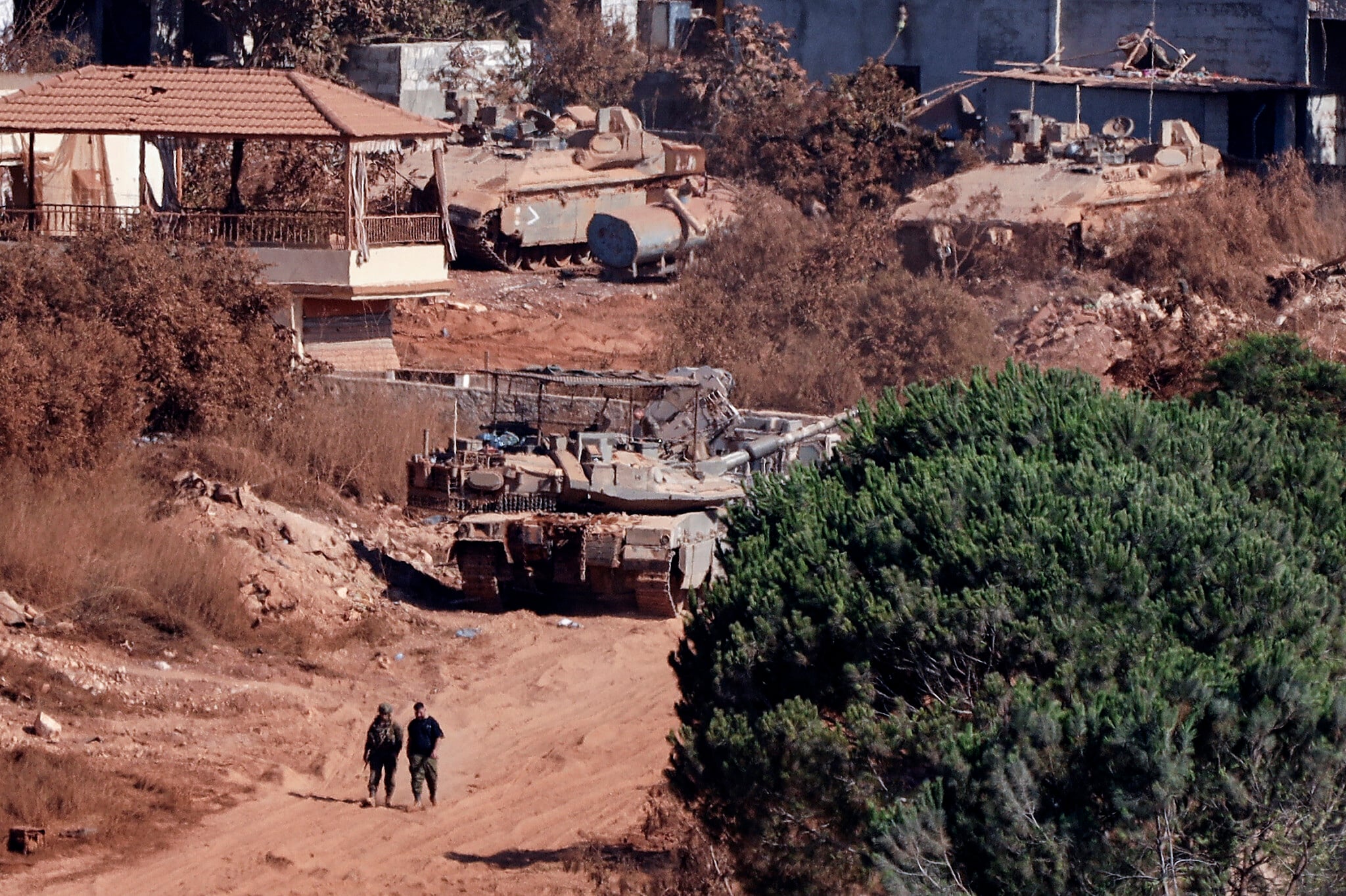
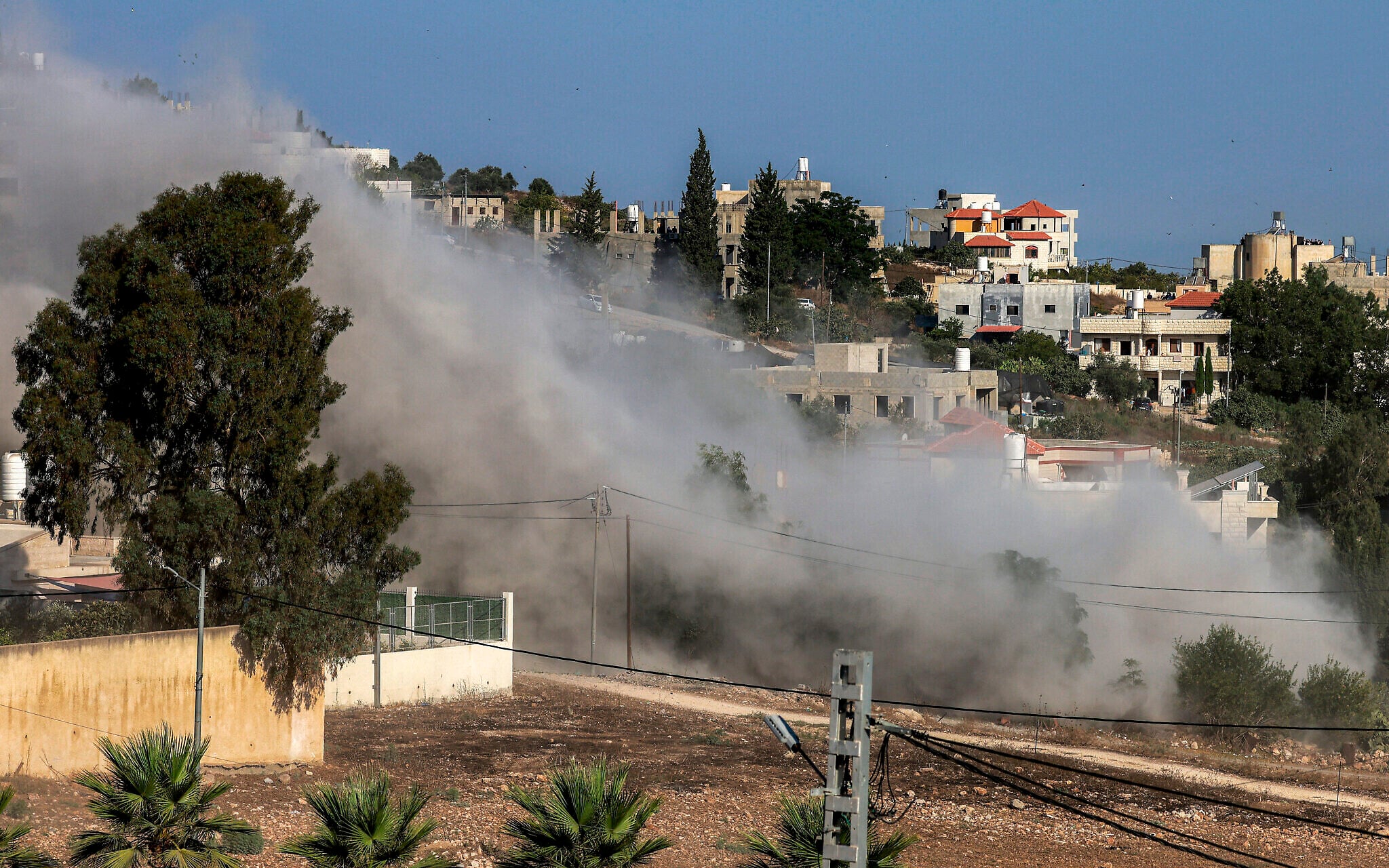
IDF: Gazans crossed ‘Yellow Line’ and stole pipes, shots fired at them yielded no confirmed hit
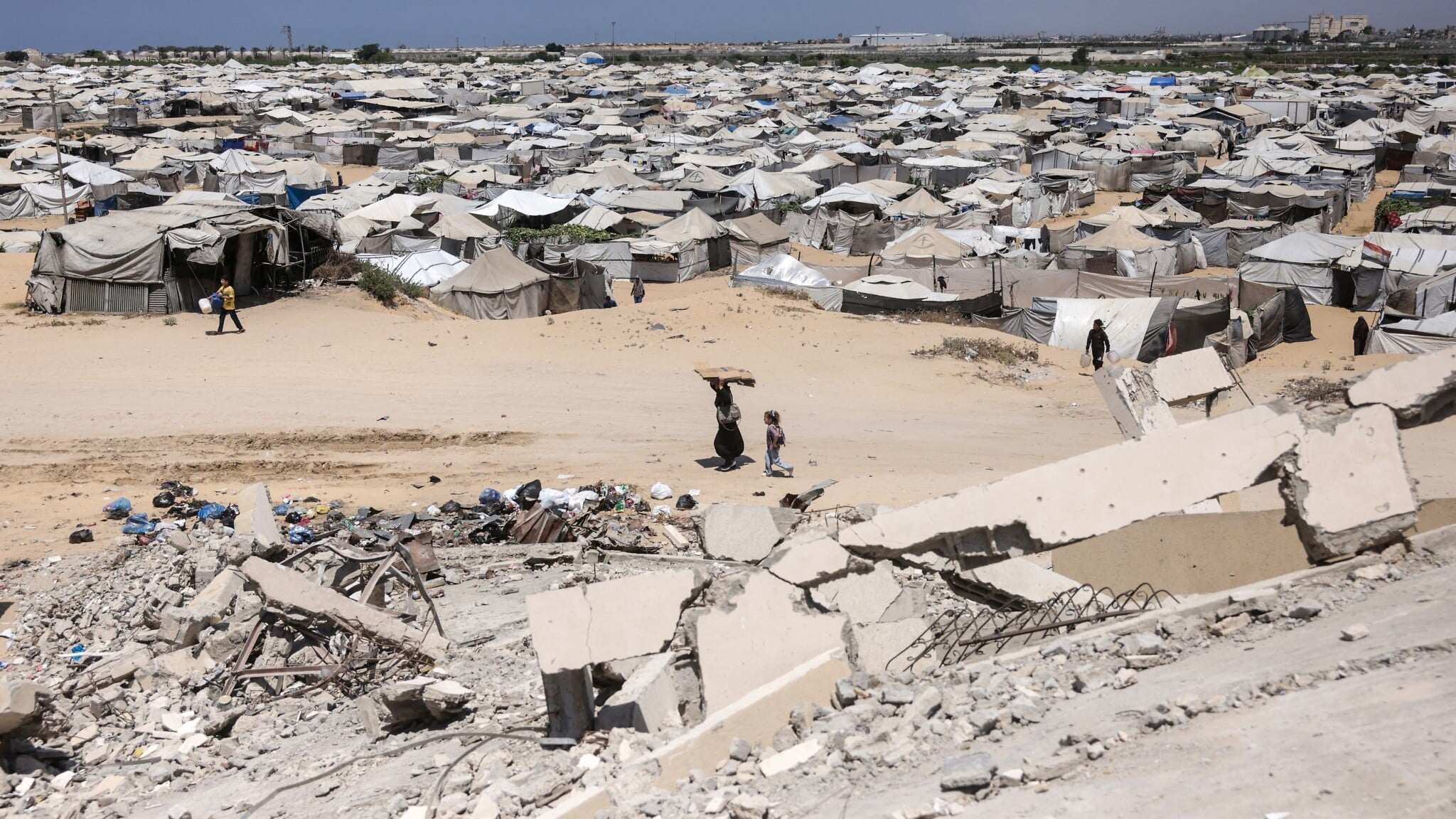
Several Palestinians crossed the IDF’s “Yellow Line” in the Gaza Strip overnight and stole plastic pipes used by the army for engineering activity, the military says.
The incident took place some 3.5 kilometers deep into the Strip.
The IDF says that during operations near the Yellow Line, “several plastic pipes intended for engineering activities were left behind.”
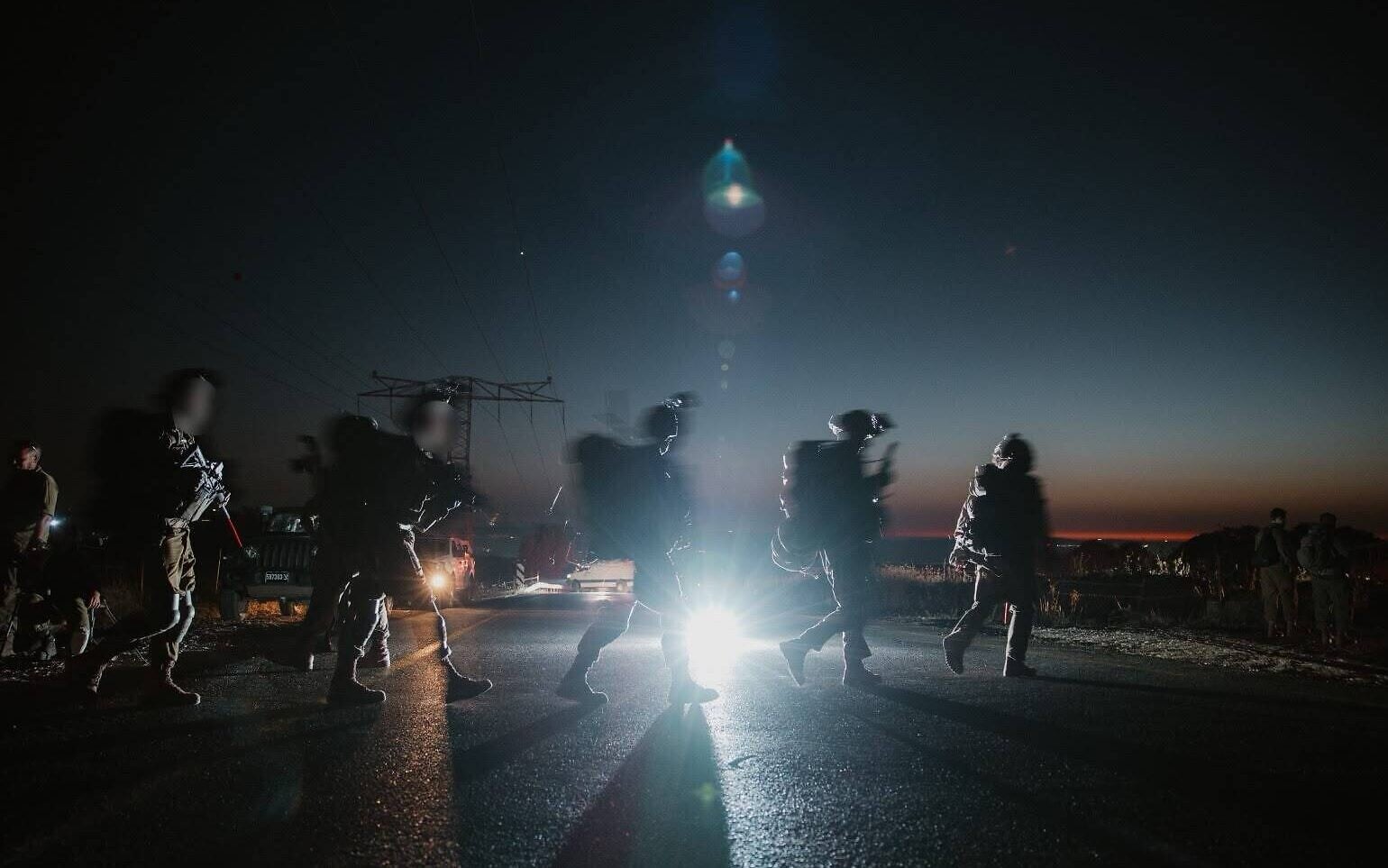
Later, troops spotted several Palestinians approaching the area and fired warning shots to disperse them, the army says.
However, the IDF says that “no hit was identified” and the suspects stole several pipes.
“The incident was investigated, and lessons were learned,” the military says.
The army adds that “any approach to the Yellow Line is met with warning fire toward the suspects in accordance with the rules of engagement.”
US military confirms it fired on a ship in Gulf of Oman to enforce blockade of Iranian ports
The US military confirms an earlier report that its forces fired on a Panamanian-flagged ship in the Gulf of Oman that tried to evade the American blockade on Iranian ports, a move that comes as US President Donald Trump tries to keep economic pressure on the Islamic Republic.
US Central Command says the vessel had ignored warnings to stop, prompting an American helicopter to fire missiles into the engine room of the M/V Vela Nova, disabling the ship. US Central Command’s statement does not say whether the ship’s crew suffered any casualties.
Central Command says it has redirected 55 commercial vessels attempting to run the blockade, disabled three non-compliant vessels and boarded two. The US Navy currently has more than 15 warships, including two aircraft carriers and an amphibious assault ship, stationed in the waters of the Arabian Sea.
Man falls to his death in work accident in Rahat
A man in his 30s fell from a height and died this evening in a work accident at a factory in Rahat, first responders say.
Police say they are investigating, and that the accident in the southern Bedouin town has been reported to the Labor Ministry.
The worker suffered penetrating wounds after falling from a “high installation,” and was taken to a local clinic where he was pronounced dead, according to police and the Magen David Adom ambulance service.
Hostages Square becomes the official name of Tel Aviv plaza that was the epicenter of a yearslong struggle
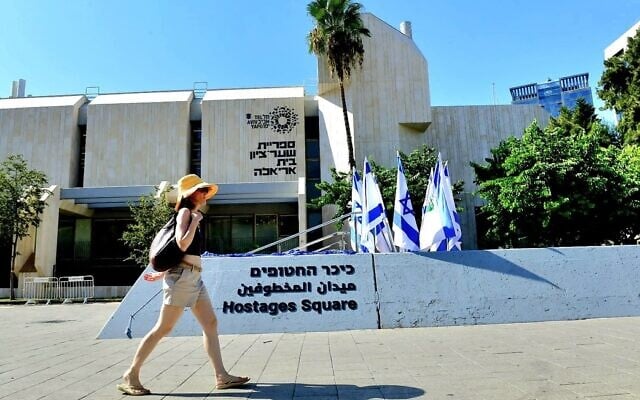
A new sign is unveiled as the Tel Aviv Municipality officially renames the plaza in front of the Tel Aviv Museum of Art as Hostages Square, August 11, 2026. (Tel Aviv Municipality/Kfir Sivan)
The Tel Aviv Municipality announces that the plaza in front of the Tel Aviv Museum of Art, which was the epicenter of the yearslong struggle to return the hostages kidnapped by Hamas on October 7, 2023, is now officially known as Hostages Square.
That name, while very commonly used throughout the public struggle, had been unofficial until now.
The municipality says on Facebook that the decision “is meant to ensure that this chapter in Israel’s history — from October 7, 2023, until the return of the last hostage, Ran Gvili, on January 26, 2026 — will be remembered for generations.”
Calling the struggle “brave and determined,” the municipality says it is proud to have hosted it, saying the square became “a center of solidarity and of one unwavering demand: to bring them, everyone, home.”
IDF condemns ‘reprehensible’ settler outposts in Palestinian villages, doesn’t say why it hasn’t dismantled them

Settlers outside the home of Youssef Hassan in the West Bank village of Qusra, south of Nablus, August 10, 2026. (Courtesy)
The Israeli military says it condemns the “illegal, reprehensible and unacceptable” establishment of settler outposts inside Palestinian villages in the West Bank in recent days, but does not say why it hasn’t yet dismantled them or why, in a recent example, troops prayed with civilians rather than removing them from the area.
On the outskirts of Qusra, south of Nablus, a Palestinian family has been prevented from entering or leaving since Sunday due to the settlers outside. Soldiers were filmed on Sunday arriving at the structure erected by the settlers and praying with them.
This evening, a Palestinian Red Crescent ambulance arrived, evacuated a girl whose family wanted her to receive medical treatment, and brought some food to the two besieged families there.
Last month, settlers surrounded a home in the nearby village of Jalud for more than two weeks, after which the family living there fled, and settlers took over the property. Settlers remain in the Jalud home to this day, and its owners have been unable to return.
“In recent weeks, several reports have been received of Israeli civilians entering and taking control of Palestinian homes and land in the areas of Qusra and Jalud. This is illegal, reprehensible and unacceptable activity that harms the residents of the areas and disrupts their daily lives,” the IDF says in a statement.
The military says that following these incidents, “and in light of reports of disturbances, a closed military zone order was issued in the area for anyone who is not a resident of the area.”
The army says that it “strongly condemns incidents of this kind” and that “should it be determined that IDF reservists or active-duty soldiers are involved in such incidents, they will face disciplinary action.”
Regarding an incident in Qusra yesterday, where soldiers prevented a Palestinian ambulance carrying a foreign journalist from approaching the family’s home, the army says that the ambulance entering the closed military zone had been coordinated, but “upon the ambulance’s arrival at the checkpoint, IDF soldiers identified Israeli civilians inside who attempted to enter the area subject to the closed military zone order under the ambulance’s cover.”
“As a result, the IDF soldiers operating at the checkpoint conducted an inspection of the ambulance. Subsequently, the ambulance was inspected by the Israel Police,” the military says.
Since a deadly clash in the village of Tell last month, Israeli settlers have established 13 illegal outposts in the area. Two were demolished overnight by Israeli authorities.
A military source says the demolitions of the illegal structures are intended “to curb this serious phenomenon, to protect residents and maintain order.”
However, the IDF does not explain why the outposts have yet to be demolished.
Report: Barkat alleged to have co-led Likud effort to replace Netanyahu after Oct. 7
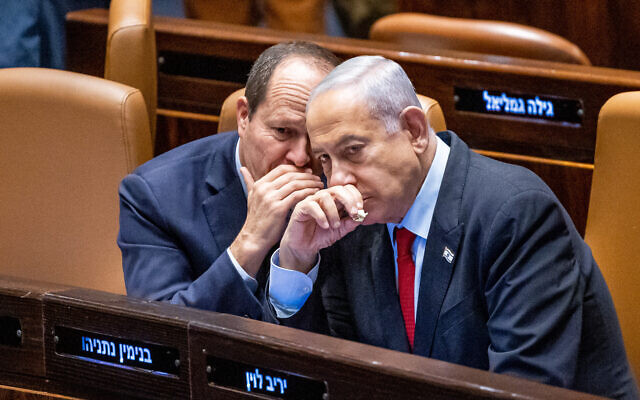
Prime Minister Benjamin Netanyahu (right), and Economy Minister Nir Barkat in the Knesset on February 22, 2023. (Yonatan Sindel/Flash90)
Economy Minister Nir Barkat allegedly co-led a failed effort to replace Prime Minister Benjamin Netanyahu through a no-confidence vote immediately following Hamas’s October 7, 2023, onslaught, Channel 12 news reports.
The network claims another co-leader of the push was Likud MK Yuli Edelstein, who has now left the party to form a rival faction named “Unity.”
The report says Netanyahu now sees next week’s Likud primaries as an opportunity to settle scores and promote loyalists, with his insistence on securing the right to reserve as many candidates of his choosing at the top of the list — currently likely to be 10 in the top 29 — intended in part to weaken Barkat.
Yemen’s Houthis claim to attack Saudi ship carrying military equipment in Bab el-Mandeb
Yemen’s Iran-aligned Houthis have attacked a Saudi ship carrying military equipment in Bab el-Mandeb, Houthi-run news agency Saba reports.
There is no immediate Saudi confirmation.
The Houthis said on July 20 they would impose a naval blockade on Saudi Arabia in the Red Sea in response to what they described as a Saudi siege on Yemen, an allegation Riyadh has denied.
2 Likud MKs said to mull quitting primaries over guaranteed slots for Netanyahu loyalists
Two Likud lawmakers are considering dropping out of the party’s primary race in protest of reserved slots granted by Prime Minister Benjamin Netanyahu to several senior figures, the Kan public broadcaster reports.
According to the network, the unnamed MKs are angered by Netanyahu’s decision to guarantee places on the party’s Knesset slate for Defense Minister Israel Katz, Foreign Minister Gideon Sa’ar and Likud Central Committee chair Haim Katz.
Earlier today, the Likud secretariat approved Netanyahu’s decision to grant spots to Sa’ar and Israel Katz, while freezing the vote on Haim Katz.
Despite the reported tension within the Likud, Israel Katz is not expected to relinquish his reserved slot, the report says. The party is also reportedly seeking to unveil another candidate for a guaranteed place before the upcoming primaries.
The Kan report comes alongside a Channel 12 report shedding light on dissent within Likud, including a failed effort by party lawmakers – allegedly led in part by Economy Minister Nir Barkat – to replace Netanyahu through a no-confidence vote immediately following Hamas’s October 7, 2023, onslaught.
Channel 12 says Netanyahu now sees the primaries as an opportunity to settle scores and promote loyalists, with his decision to reserve a slot for tech entrepreneur Oren Dobronsky reportedly intended in part to weaken Barkat.
Israeli intel on Iranian assassination plot spurred decision to sneak Trump off Air Force One — report
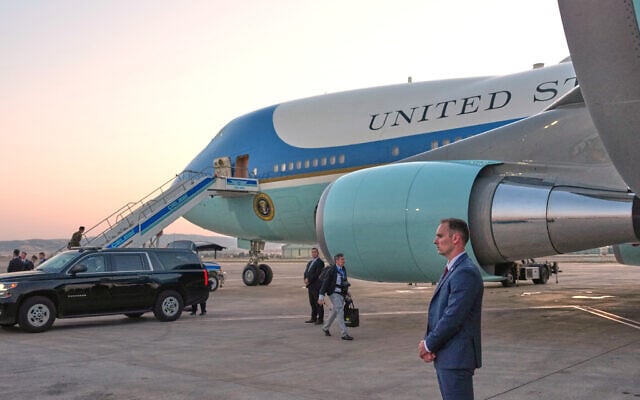
A catering truck is visible parked on the opposite side of Air Force One on the tarmac after US President Donald Trump boarded the plane following the NATO summit at Ankara International Airport in Ankara, Turkey, July 8, 2026. (AP Photo/Alex Brandon)
Israel told the United States about the Iranian assassination threat that caused the US Secret Service to take President Donald Trump off Air Force One and transfer him in a catering truck to a military plane as he prepared to fly out of Turkey last month, The Wall Street Journal reports, citing an unnamed US official.
Israeli intelligence indicated that Iran had been plotting to use shoulder-to-air missiles to take down Trump’s plane, according to the report.
Senior Trump aides, including Secretary of State Marco Rubio, remained on the plane despite the threat, says the official.
Last month, the WSJ reported that Israeli intelligence had indicated a new plot was in development to assassinate the US president, but did not provide details.
Two US officials told Channel 12 news at the time that the information related to general dialogue between Iranian officials on potentially assassinating the US president, rather than a specific plot.
Report: AG expected to charge Netanyahu aides with security offenses in Qatargate affair

Left to right: Jonatan Urich and Eli Feldstein at a court hearing in the Tel Aviv District Court on July 14, 2026. (Avshalom Sassoni/Flash90); Prime Minister Benjamin Netanyahu's former aide Yisrael Einhorn. (KAN screenshot).
Attorney General Gali Baharav-Miara is expected to decide that Prime Minister Benjamin Netanyahu’s aides Jonatan Urich and Eli Feldstein should face national security charges in the so-called Qatargate affair, Channel 13 news reports.
According to the network, a former senior Mossad official suspected in the case is also expected to be charged, pending a hearing.
The Shin Bet and Mossad have yet to submit their final assessments of the affair, but Justice Ministry officials cited by Channel 13 believe there is “sufficient evidence” to charge the suspects with contact with a foreign agent.
Urich and Feldstein are suspected of doing PR work for the Qatari government through an American lobbying company from 2022 to October 2024, at the same time as they worked as media advisers to Netanyahu.
Channel 13 previously reported that the Mossad would be responsible for determining whether Urich, Feldstein and fellow Netanyahu adviser Yisrael Einhorn should face national security charges.
Mossad chief Roman Gofman, who previously served as Netanyahu’s military secretary, could face a conflict of interest due to his ties to the suspects, according to the report. Officials are reportedly examining whether he should be barred from signing the agency’s assessment.
Erdan and Edelstein’s new party unveils its name: ‘Unity’

Likud MK and ex-minister Yuli Edelstein (left) and former Likud minister Gilad Erdan hold a press conference in Tel Aviv to announce the establishment of a new right-wing party, August 6, 2026. (Avshalom Sassoni/Flash90)
Former Likud veterans Gilad Erdan and Yuli Edelstein announce that “Unity” is the name of their new political party.
The right-wing party has vowed to make universal IDF service a cornerstone of their platform and promised to join only a broad consensus government, not a narrow government formed by either the pro-Netanyahu or anti-Netanyahu blocs.
Erdan announces the name at an event in Beit Shemesh, explaining that this is “not because we agree on everything, but because we have no other choice.”
“Unity is enlistment by everybody. Unity is common responsibility. Unity is our way, unity is our commitment, and unity is our name, and we will fight for it without compromise.”
Israel and Venezuela renew consular relations for first time since 2009
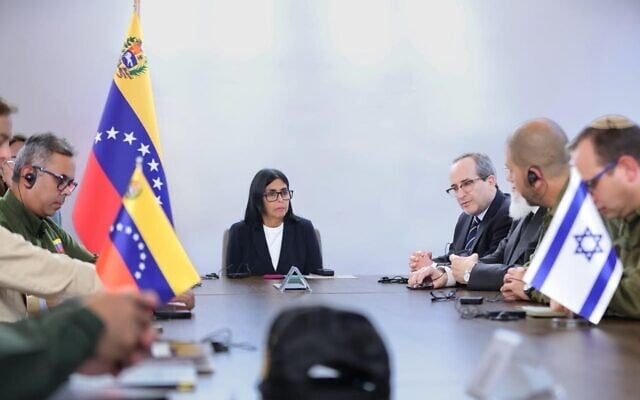
Venezuela's acting President Delcy Rodriguez center, meeting with Israeli representatives in a photo released on July 22, 2026. (IDF Spokesperson)
Foreign Minister Gideon Sa’ar and his Venezuelan counterpart Félix Plasencia agree to renew consular relations between the two countries, according to Sa’ar.
The two countries have not had any sort of diplomatic relations since 2009.
Rounds of talks in recent weeks “resulted in an agreement to establish a coordination mechanism that will enable the provision of consular services to citizens of both countries,” says Sa’ar’s office.
The two countries also agree to continue cooperating in emergency response and recovery efforts after a deadly double earthquake in Venezuela in June.
Venezuela severed diplomatic relations with Israel under then-president Hugo Chávez, amid deteriorating relations between Chávez’s government and Israel.
But since Delcy Rodríguez was installed as the country’s president after the United States captured the previous leader, Nicolás Maduro, in January, officials have sharply changed their tone regarding the Jewish state.
Ties have also warmed since Israel sent humanitarian assistance following the earthquake. An Israeli aid delegation was dispatched to Venezuela, which provided professional assistance to the country’s emergency response and recovery efforts.
US insists ‘positive direction of travel’ after hiccup during last week’s Israel-Lebanon talks

IDF soldiers are seen at a memorial site on the border with Lebanon in northern Israel, June 28, 2026. (AP Photo/Ohad Zwigenberg)
WASHINGTON — The US insists that talks between Israel and Lebanon are heading in the right direction after officials from both countries recognized setbacks during last week’s talks in Rome.
Those talks ended early on their second day, amid an escalation in southern Lebanon between Israel and Hezbollah. Beirut is also frustrated with the pace of Israeli withdrawals, feeling that Jerusalem is dragging its feet ahead of October elections, while Israel argues that verification of Hezbollah disarmament must be completed first.
Nonetheless, a State Department spokesperson insists that the three days of talks last week were “constructive” and saw the sides reach understandings on the parameters that need to be met for verifying that a particular area has been cleared of Hezbollah infrastructure in order to “unlock future pilot zones.”
Pilot zones are the areas where the Lebanese Armed Forces (LAF) have deployed in south Lebanon after Israel has withdrawn. So far, two such zones exist, with the ultimate goal being that the pilot zones will be replicated to the point where Israel has completely pulled out of southern Lebanon.
Commenting on last Wednesday’s escalation in southern Lebanon, which saw a Hezbollah explosive lethally detonate on Israeli forces, sparking major IDF retaliatory strikes, the State Department notes that the sides de-escalated within 24 hours thanks to a trilateral military deconfliction cell that the US, Israel and Lebanon set up earlier on in their negotiations.
During last week’s talks, US negotiators pulled Lebanese counterparts aside to discuss “delivering timely support for reconstruction,” the State Department spokesperson says, referring to the several dozen southern Lebanese villages flattened by Israel on the grounds that they were riddled with Hezbollah infrastructure.
“At the next round of technical talks, Lebanon will present detailed roadmaps for securing new areas as implementation proceeds in the current pilot zones,” the State Department spokesperson says.
“We need to work through important details, including who verifies the LAF’s clearance operations. Once those details are clear, the process will move much faster,” the spokesperson continues.
The next round will take place at the beginning of September in Rome, but the sides will continue holding conversations in their respective capitals in the interim.
Israel and Lebanon still need to agree on a list of countries that will serve on a third-party committee tasked with verifying that pilot zones have been fully demilitarized.
An official familiar with the matter told The Times of Israel yesterday that Israel is rejecting the inclusion of countries that have sought to act against it in international forums.
The State Department spokesperson reiterates Washington’s opposition to extending the mandate of the UNIFIL observer force, which it — like Israel — believes has not done a sufficient job in preventing Hezbollah’s rearmament.
“Both sides face political constraints. We are working through them methodically because shortcuts produce the same failed outcomes we have seen for decades. The direction of travel remains positive, and nobody is dragging their feet on implementation,” the State Department spokesperson stresses.
“We are not naive about the difficulties. Hezbollah is trying to sabotage the process, and both Israel and Lebanon are democracies under domestic political stress. But the fact that the teams sat together, communicated directly, and generated options is itself a structural change. The process is designed to absorb those constraints and still move forward, first by making the pilot zones work, then by expanding,” the State Department adds.
Another Palestinian family is trapped by settlers since Sunday: ‘If we run out of food, we’ll leave’
Settlers outside the home of Youssef Hassan in the West Bank village of Qusra, south of Nablus, August 10, 2026. (Courtesy)
Qusai Abu Ridi, a Palestinian who moved into his brother’s home on the outskirts of Qusra four months ago, has been trapped there with his son by settlers since Sunday.
He tells The Times of Israel that no one has been able to enter or leave the house because of an outpost settlers established near the entrance. According to Abu Ridi, it is the same outpost that has also left Youssef Hassan’s family trapped in their adjacent home for days.
Hassan’s home, where he lives with his wife and their two young daughters, has been blocked by settlers since Sunday. Journalists and activists who have attempted to reach the family in recent days have been prevented from doing so by settlers and IDF troops.
The IDF told The Times of Israel earlier today that the area of Qusra where the homes are located has been under a closed military zone order since June, barring Israelis and foreign nationals from entering due to the establishment of outposts in the area. The IDF did not respond when asked why troops have not removed the settlers from the area despite the order.
Abu Ridi said his brother, who owns the house, lives in the United States. He moved into the property after settler attacks in which security cameras were smashed and further damage was caused, saying he wanted to stay there to protect the house.
He and his 18-year-old son have now been trapped inside since Sunday, he said.
Abu Ridi says settlers have cut the home’s water and electricity lines in recent days. He adds that from the house, he can see IDF troops coming and going from the area where the settlers are gathered several times a day.
“Even someone in prison is given food. We have no food,” he says. “In the end, if they don’t provide us with food, we’ll leave.”
Meanwhile, the left-wing Yesh Din organization sent an urgent appeal today to IDF Central Command chief Maj. Gen. Avi Bluth, demanding that the outpost be evacuated, that its residents be prevented from remaining there, and that the safety of the Palestinians trapped in their homes be ensured.
Top Iranian official: Even if deal with Oman reached, we won’t open Hormuz until US gives in to all our demands
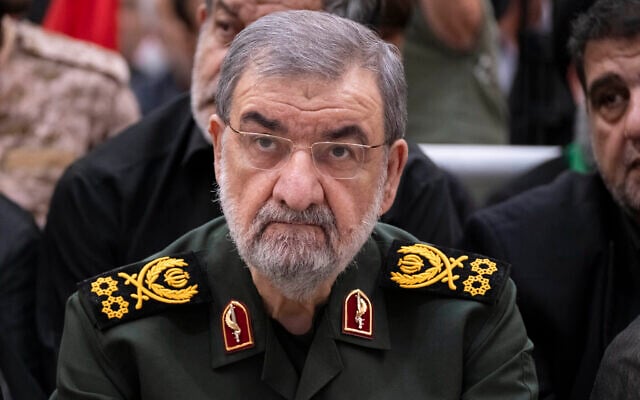
Mohsen Rezaei, former commander of Iran's Islamic Revolutionary Guard Corps, who was named on August 9, 2026, as the secretary of Iran's Supreme National Security Council, attends a ceremony at Ayatollah Ruhollah Khomeini's shrine in southern Tehran, on June 4, 2026. (Photo by Morteza Nikoubazl/NurPhoto)
Iran will not open the Strait of Hormuz until the US gives in to its terms, says the head of Iran’s National Security Council.
The US must end the war — including in Gaza and Lebanon — release frozen Iranian assets, and meet the rest of Iran’s conditions, says Mohsen Rezaei, according to the semi-official Tasnim outlet.
A potential agreement on the strait between Iran and Oman will not guarantee the opening of the strait, he says.
Netanyahu thanks Colombia for recognizing Israeli sovereignty over Golan, neglects to mention deadly quake
Prime Minister Benjamin Netanyahu posts a video thanking Colombia for recognizing Israeli sovereignty over the Golan Heights, but does not mention the deadly earthquake that hit the South American country this week.
“The nation is with Colombia,” he says, echoing the 1990s slogan “The nation is with the Golan” that called for Israel not to give up the plateau.
“The Israeli flag flies here,” he says, pointing at a map of the Golan, “and it will continue to fly here. Because this is our land.”
Yesterday, Colombia became the second country after the US to recognize Israel’s control over the Golan.
The announcement came just days after the inauguration as the nation’s president of pro-Israel lawyer Abelardo de la Espriella, who has pledged to move the Colombian embassy to Jerusalem and restore once-vibrant ties, which soured during the Gaza war under former president Gustavo Petro. The inauguration was attended by Foreign Minister Gideon Sa’ar, amid a push for closer relations with Latin America.
It also came just hours after a powerful 7.4 magnitude earthquake struck western Colombia, killing at least 170 people and injuring hundreds more, prompting Israel to offer its assistance.
Qatar, Saudi Arabia and Syria all condemned the recognition.
העם ???????? עם קולומביה ????????! pic.twitter.com/2eO9t1n69j
— Benjamin Netanyahu – בנימין נתניהו (@netanyahu) August 11, 2026
UK calls for end to settler violence, urges Hamas to give up arms, stresses ‘shared interest’ in stopping nuclear Iran
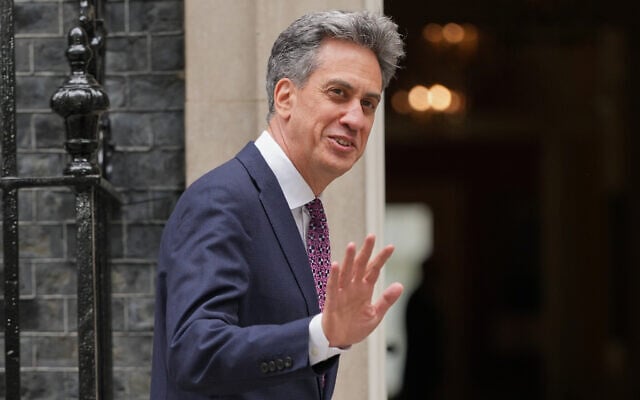
Ed Miliband, Britain’s new foreign secretary, arrives for a Cabinet meeting in Downing Street in London, July 21, 2026. (AP Photo/Kirsty Wigglesworth)
British Foreign Secretary Ed Miliband holds his first phone call with Foreign Minister Gideon Sa’ar, calling it “frank and constructive.”
He says he brought up “the sharp escalation of settler violence and settlement expansion, as well as the dire humanitarian situation in Gaza.”
“I said Israel must crack down on violence in the West Bank, and must immediately end blockages on aid into Gaza,” says the UK readout.
The IDF calls accusations that it is stopping aid to Gaza “biased, recycled and misleading claims that are detached from the reality on the ground, promoted by interested parties as part of an effort to defame Israel and create a false impression of a humanitarian crisis in the Gaza Strip.”
Miliband says he stresses that Hamas must give up its weapons, the IDF should withdraw, and US President Donald Trump’s 20-point-plan should move forward.
They also discuss their “vital shared interest in ensuring that we never see a nuclear Iran,” and the need to stamp out antisemitism.
Qatar: Israel ‘dragging its feet’ on Gaza plan, should be pressured; Arab states to announce steps

Majed al-Ansari, spokesman for Qatar's Foreign Ministry, speaks onstage during Global Citizen NOW: Impact Sessions on September 24, 2025, in New York City. (ROB KIM / Getty Images via AFP)
Qatar accuses Israel of “dragging its feet” by rejecting the Board of Peace roadmap for Gaza, and says it has been doing so throughout the war in the Strip.
Foreign Ministry spokesman Majed al-Ansari says that Qatar hopes that the international community will pressure Israel to implement the second phase of the US-backed 20-point plan for Gaza.
Hamas has agreed to the plan, says Ansari, and now responsibility lies with Israel.
Ansari says that practical steps will be announced by Qatar, Jordan, the United Arab Emirates, Indonesia, Pakistan, Turkey, Saudi Arabia and Egypt to move the Gaza plan forward.
On US-Iran talks, Ansari says that the priority is to ensure freedom of navigation in the Strait of Hormuz, and to restore the pre-war situation in the waterway. Any future arrangements around the strait, he says, should be based on “regional concurrence and full respect for international law.”
Court orders release of settler accused of attack on Palestinians after 38 days in custody
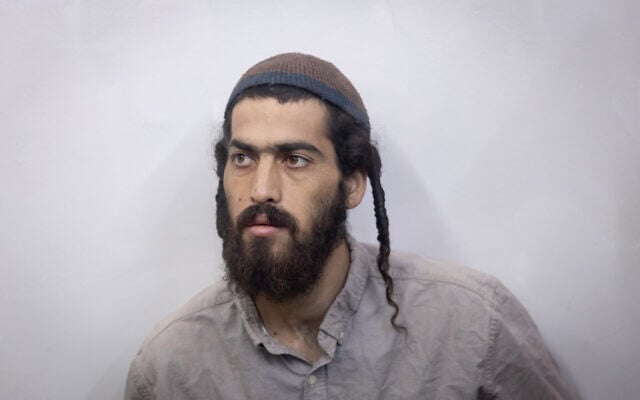
Administrative detainee Tal Yinon Dardik arrives at the Jerusalem District Court for a hearing on Central Command chief Maj. Gen. Avi Bluth’s appeal against a decision to release him, August 11, 2026. (Chaim Goldberg/Flash90)
The Jerusalem District Court orders the immediate release without restrictive conditions of Tal Yinon Dardik, a suspect in an attack on Palestinians in March, who has been in custody for 38 days over administrative orders against him.
However, Dardik will still be bound by IDF Central Command chief Maj. Gen. Avi Bluth’s measures barring him from entering any areas of the West Bank except for the community of Modiin Illit, and requiring him to report to the local police station twice a day.
On Sunday, the court rejected Bluth’s attempt to stop Dardik from serving house arrest in his illegal outpost in the West Bank.
Amid Bluth’s attempts to restrict Dardik’s movements due to his alleged participation in a violent attack on Palestinians earlier this year, Defense Minister Israel Katz ordered officials not to renew his detention, and called on the IDF to find an alternative solution. Katz then vowed on a TV show to replace Bluth, sparking widespread outcry and leading the defense minister to attempt to backtrack from his remarks.
Syria says IAEA will announce ‘significant progress’ on nuclear file
Syria will host a delegation from the International Atomic Energy Agency in the coming days to announce “significant progress” on the issue of nuclear materials, Syria’s Atomic Energy Commission says, without providing further details.
Since the ouster of president Bashar al-Assad in late 2024, Syria’s new authorities have committed to working with the United Nations’ nuclear watchdog to address the legacy of nuclear activities during decades of Assad family rule.
Syria is not known to hold operational stockpiles of nuclear material for a weapons program, but Israel bombed a suspected Syrian nuclear reactor in 2007 in the country’s eastern province of Deir al-Zor.
The IAEA said last year that it had found traces of uranium in its investigation into that site. The traces were found at one of three unnamed locations “that were allegedly functionally related” to the site of interest in Deir al-Zor.
In June, IAEA chief Rafael Grossi said that as soon as conditions allow, the agency planned to conduct further work in the area to “achieve full clarity regarding past nuclear activities in Syria.”
Citing Israeli and US officials, Axios reported yesterday that the IAEA would soon remove nuclear material stored at a clandestine site in Syria after the administration of US President Donald Trump reaches understandings with both Syria and Israel.
Syria has not commented on the removal of nuclear materials. A Syrian official with knowledge of the matter tells Reuters that discussions with the IAEA on the nuclear material file as a whole are still underway, and that “no final agreement has been concluded.”
“Consultations are underway on establishing an international support group to coordinate the necessary technical and legal assistance,” the official says.
The Syrian official says Syria is consulting with the IAEA to fulfill its own obligations and that “there is no Israeli role in this process.”
US rights groups sue Trump over ICC sanctions
Rights groups sue US President Donald Trump over his sanctions targeting the International Criminal Court, saying the measures block victims of war crimes from pursuing justice.
The Trump administration, which rejects the ICC’s authority, has imposed travel bans and asset freezes on several judges and prosecutors, primarily over their investigations into key US ally Israel.
In a New York court filing, four groups including Human Rights Watch say the sanctions should be struck down as they violate laws including First Amendment free speech protections.
“This is an unlawful abuse of power constituting a frontal attack on the rule of law, the independence of judges, prosecutors, and lawyers, basic precepts undergirding the international legal order, and the principle of equal access to justice,” the lawsuit states.
The 101-page complaint claims the restrictions “cause grave damage to the ability to bring to justice the perpetrators of genocide, war crimes, and crimes against humanity.”
The US sanctions, issued under an executive order Trump signed in February 2025, have targeted eight judges, three prosecutors, a UN expert and three human rights organizations.
Haredi men picket youth guidance center they accuse of promoting IDF service
Several dozen Haredi men and boys protested today in front of a Bnei Brak youth professional guidance center that they accuse of promoting military service in the IDF’s designated ultra-Orthodox tracks.
The protesters briefly blocked the car of the Netivim Center’s community director, Elazar Miara, until officers intervened to get him out, a police spokesperson tells The Times of Israel.
There were no arrests, and the protest has dispersed, the spokesperson says.
בני ברק: קיצוניים במחאה מול מרכז ייעוץ והכוון שלטענת המפגינים מכוון צעירים גם לשירות צבאי. (אלי הירשמן) pic.twitter.com/Albm4rofWT
— זירת החדשות (@ZiratNews) August 11, 2026
Houthi attack killed 3 Pakistanis and an Indonesian, Yemen says

The navigation bridge of a sunken vessel is all that is seen at the surface of the water in the Port of Mokha, the day after an attack by the Houthis on the city Mokha, held by Yemen’s internationally recognized, Aden-based government on August 10, 2026. (Khaled ZIAD/AFP)
Houthis fired missiles on a vessel in the Bab el-Mandeb today and killed four people, Yemeni authorities say.
A previous death toll given for the attack was three.
The Transportation Ministry of Yemen’s internationally recognized government says the dead include three Pakistani nationals and an Indonesian.
The ministry says in a statement that the Houthis fired three ballistic missiles on the Yemeni commercial vessel.
They are the first known deaths from Houthi attacks on shipping off Yemen in the latest bout of fighting in the Arab country.
With the Strait of Hormuz effectively shut down by Iran, there has been a renewed focus on the Red Sea and Bab el-Mandeb Strait at Yemen’s southern tip, which is an alternate route for Saudi Arabia to ship its oil.
Democratic US senators probe alleged coordination between ICE and Iran to deport detainees
US Democratic senators Richard Blumenthal and Adam Schiff are requesting access to all potential communications between two private immigration detention centers and Iranian diplomats, according to two letters shared with The Associated Press.
Iranian asylum seekers sued last month, alleging that the Department of Homeland Security endangered them by sharing details of their application records with the Iranian government.
The applicants said they were forced to meet with Iranian Interests Section officials who had confidential information about their claims of persecution in Iran for converting to Christianity, for their sexuality or for participating in the Women, Life, Freedom protests against the Iranian government, according to court filings.
“These allegations that ICE shared asylum application records with the Iranian government are FALSE,” a DHS statement said.
Hungary parliament elects former supreme court head Andras Baka as president
Hungary’s parliament elects Andras Baka, a former head of the Supreme Court, as the country’s next president, a symbolic step in Prime Minister Peter Magyar’s effort to dismantle former premier Viktor Orban’s bastions of power.
Baka is elected to the largely ceremonial role with the votes of the governing center-right Tisza party. Members of the opposition Fidesz party did not take part in the election.
Houthis hit Red Sea port city, threatening regional shipping
Iranian-backed Houthi rebels renew attacks on government-controlled areas in Yemen as the violence threatens to reignite civil war and raises fears over new threats to regional shipping lanes.
Yemen’s military says the rebels targeted the government-held port city of Mokha and the central province of Marib with missiles and drones but does not provide further details. The Houthis also hit Mokha with missiles and drones over the weekend and killed at least seven people, it says.
The escalation by the Houthis against government forces in Yemen and oil facilities in neighboring Saudi Arabia aims to threaten the kingdom’s alternative route for shipping its oil. The attacks could reignite Yemen’s civil war following a 2022 truce, and open a new front in the Middle East war.
New York rabbis implore Mamdani to tone down rhetoric against Israel
New York rabbis from different denominations say they asked New York City Mayor Zohran Mamdani to tone down his anti-Israel rhetoric during a private meeting at City Hall last night.
Mamdani has repeatedly assailed Israel in recent months as antisemitic hate crimes have climbed.
Mamdani spoke with 10 rabbis, including progressives who are critical of Israel, who told him that the comments were harmful.
“There was no tiptoeing around the elephant in the room,” Rabbi Jonathan Leener, the head of a liberal Modern Orthodox synagogue, tells The New York Times. “The mayor’s comments have ramifications, and he needs to be aware of how, in the current climate, that just adds to the temperature and creates an environment that I think a lot of Jews feel vulnerable in.”
“Everyone agreed that the current course can’t go on,” Rabbi Rick Jacobs, the head of the Union for Reform Judaism, tells The Forward. “The way he vilifies Israel, and so constantly, is really causing harm.”
IDF says it targeted Hamas sniper who posed ‘immediate threat’ to troops in Gaza
A Hamas sniper who “posed an immediate threat” to Israeli troops in the northern Gaza Strip was targeted a short while ago, the military says.
The IDF says the terror operative was spotted by troops of the 99th Division near the “Yellow Line.”
“Immediately after the identification, the troops fired toward [the operative] to remove the threat,” the IDF says, adding that a “hit was identified.”
Last week, the military tightened its policy for “targeted elimination” strikes — as opposed to strikes against immediate threats — in the Gaza Strip.
US fired on Panama-flagged ship that tried to break blockade of Iranian ports — report
A US military helicopter has fired at the rudder of a Panama-flagged ship after its crew ignored warnings from personnel working to enforce a naval blockade on Iranian ports, the Wall Street Journal reports, citing a US official.
There are no immediate reports of casualties from the incident, the report says, adding that the ship appears to be trying to transfer its crew to another civilian vessel after the attack.
British maritime risk management group Vanguard and a maritime security source said earlier that, according to initial assessments, the Panama-flagged container ship Vela Nova was believed to have been hit by a missile when sailing through the Gulf of Oman.
US and Iran are close to some sort of arrangement, Pakistani defense minister tells Bloomberg
The United States and Iran are close to “some sort of an arrangement,” Pakistan’s defense minister, Khawaja Asif, tells Bloomberg News in an interview.
“Things are shaping up again in favor of a peace arrangement or a deal,” Asif tells Bloomberg. “The signals in the last two-three days are that we are close to some sort of an arrangement,” he adds.
Likud secretariat approves reserved spots for Israel Katz and Sa’ar, freezes vote on Haim Katz’s spot
The Likud secretariat approves Prime Minister Benjamin Netanyahu’s decision, announced overnight, to grant guaranteed spots on the party’s electoral list to Foreign Minister Gideon Sa’ar and Defense Minister Israel Katz ahead of the primary later this month.
However, following a ruling by an internal Likud court, the secretariat freezes a vote on giving a guaranteed spot to Likud Central Committee chair Haim Katz, whom the tribunal noted is running in the party’s August 17 primary, creating a conflict of interest.
Israel Katz and Sa’ar will be given reserved placements separate from the eight slots set aside for candidates of Netanyahu’s choosing, the Likud announcement said, meaning that in total, 10 of the first 29 spaces on the ruling party’s slate will go to hand-picked candidates rather than to those elected by the party’s roughly 140,000 members at the upcoming August 17 primary.
According to the Kan public broadcaster, Netanyahu also approved shortening the requirements for length of party membership in order to allow Ze’ev Elkin, a member of Sa’ar’s New Hope party, which is merging with Likud, and former Otzma Yehudit MK Almog Cohen to run in the primary.
Syria condemns Colombian recognition of Israeli sovereignty over the Golan Heights
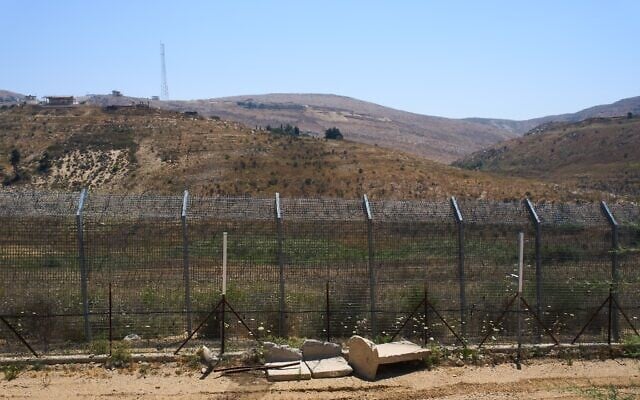
The border between Syria and the Israeli-controlled Golan Heights town of Majdal Shams is seen July 21, 2026. (AP Photo/Ariel Schalit)
Syria rejects Colombia’s recognition yesterday of Israeli sovereignty over the Golan Heights, saying that the plateau is “an integral part of its territory, and that the Colombian government’s statement constitutes a flagrant violation of the UN Charter.”
The statement also calls for the end of Israeli attacks and military presence inside Syria, and stresses that “it will continue to use all legitimate diplomatic and legal means to defend its sovereignty, territorial integrity and its established rights, and to work to restore its occupied territories.”
Ex-Mossad chief says ‘we toured’ Iran’s Fordo nuclear site ‘many times’
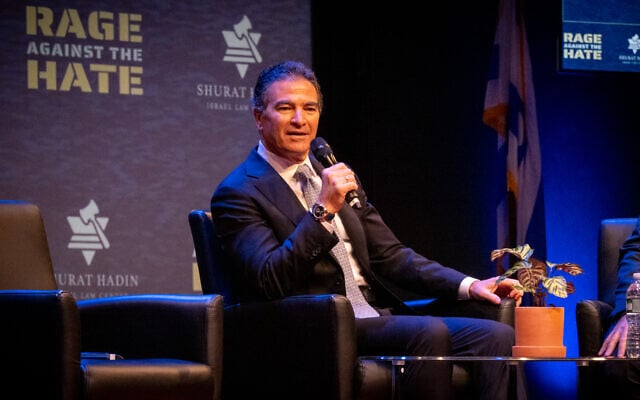
Former Mossad chief Yossi Cohen speaks at a Shurat HaDin conference in New York City, October 27, 2025. (Luke Tress/Times of Israel)
Former Mossad director Yossi Cohen speaks of having toured Iran’s Fordo uranium enrichment facility several times in the past.
“We toured the Fordo nuclear site many times in order to understand the site,” he is quoted by Hebrew media outlets as saying at the Galilee Forum in Safed, without saying when the visits were or who exactly toured the site.
“Its bombing by the Americans was the fulfillment of all my dreams,” he adds.
The site, along with the Isfahan and Natanz facilities, was severely damaged by US strikes during the 12-day war between Israel and Iran in June 2025.
Reports have said the 440 kilograms of highly enriched uranium stored in the facilities was buried, but Israel believes that Iran transferred some of it to the Pickaxe Mountain site after that war.
Cohen also states “that 60% enriched uranium is still far from a bomb,” appearing to contradict experts such as David Albright, who say 60% enriched uranium can potentially be further enriched to weapons grade in a matter of weeks or even days.
Cohen has spoken publicly about Mossad activity against Iran in the past. Days after stepping down as Mossad chief in 2021, he gave an extraordinary interview on Israeli television in which he provided details of such activity. He intimated that his agency blew up Iran’s underground centrifuge facility at Natanz, gave a precise description of the 2018 operation in which the Mossad stole Iran’s nuclear archive from safes in a Tehran warehouse, confirmed that Iran’s assassinated top nuclear scientist Mohsen Fakhrizadeh had been in Mossad’s sights for years, and said the regime needs to understand that Israel means what it says when it vows to prevent Iran attaining nuclear weapons.
Speaking on Ilana Dayan’s “Uvda” (Fact) documentary show on Channel 12, Cohen indicated that he was deeply familiar with Iran’s various nuclear sites, and said that, if given the opportunity, he would take Dayan to the underground “cellar” at Natanz, where, he said, “the centrifuges used to spin.”
In first for Arab world, Lebanon’s parliament abolishes death penalty
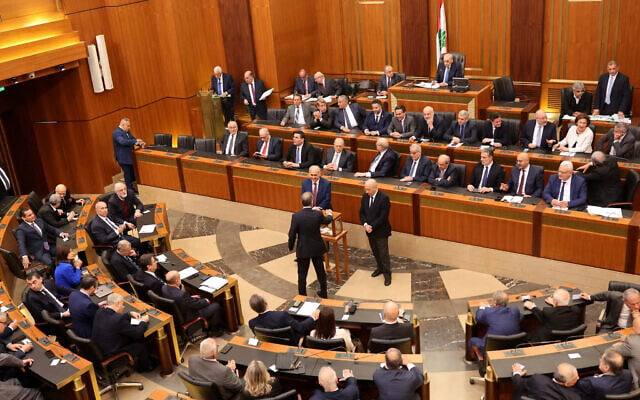
Illustrative: Lebanese lawmakers attend a parliamentary session to elect a president, in Beirut, on January 9, 2025. (ANWAR AMRO / AFP)
BEIRUT, Lebanon — Lebanon’s parliament abolishes the death penalty, making it the first country in the Arab world to replace the sentence with life imprisonment with aggravated hard labor.
The tiny Mediterranean country has committed to an unofficial moratorium on executions since January 2004. However, dozens of death sentences since then have been issued, but later suspended or commuted.
A majority of Lebanon’s 128-member parliament votes in favor of ending the death penalty, with the exception of the parliamentary bloc of Hezbollah.
Justice Minister Adel Nassar, who was in Parliament, calls it a “historic step” for the country.
Rights groups that have called for formalizing the moratorium or ending the death penalty altogether have also celebrated the vote.
Qatar says Iran-Oman talks on Hormuz management in advanced stage
Talks between Oman and Iran on the future of shipping in the Strait of Hormuz are now in an advanced stage, Qatar’s foreign ministry spokesperson says in a briefing.
Police: 6 settlers arrested for allegedly attacking officers who detained Jewish extremist suspects
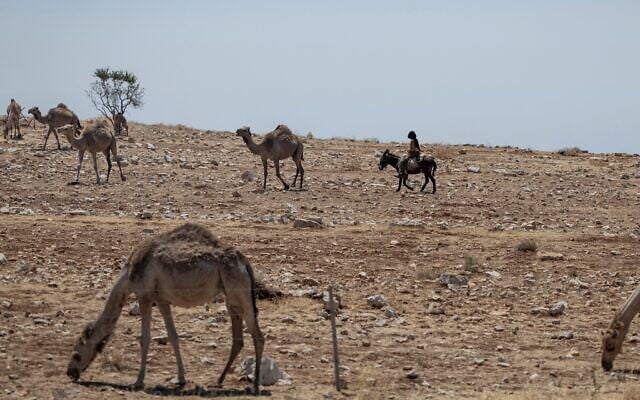
An Israel right-wing settler rides his donkey as he herds his camels close to a road in the West Bank, east of the Palestinian city of Ramallah on June 22, 2026 (ilia YEFIMOVICH / AFP)
Police announce the arrest this morning of six settlers on suspicion of attacking Border Police officers in the West Bank in June.
The suspects live in the northern West Bank, and their ages range from 17 to 23, police say. They allegedly fled after assaulting officers in the central West Bank while the officers detained other suspects in acts of Jewish extremist violence.
Police chief says there’s been a ‘drastic drop’ in Arab community homicides
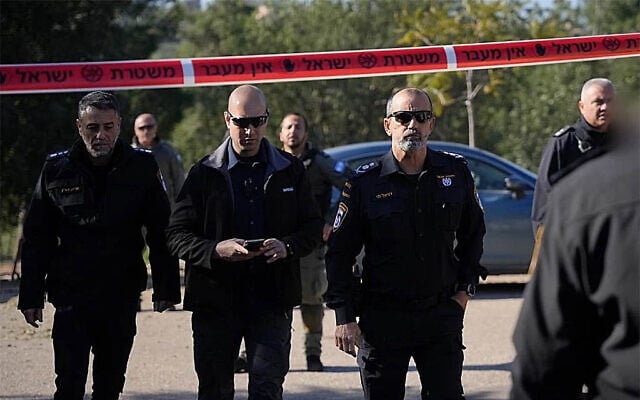
Israel Police Chief Commissioner Daniel Levy at the site of a triple homicide in Suweid Hamira, February 5, 2026. (Israel Police)
Police chief Daniel Levy said at an officer conference yesterday that there has been a “drastic drop” in murders in Arab communities, the Walla news site reports.
“We see a drop in shootings in Arab society — there’s been a drastic drop in the monthly murder rate. We’re in the best period in the past five years,” the news site quotes Levy as saying.
Figures released by the Abraham Initiatives coexistence watchdog on Thursday, after the killings of 57-year-old Ziyad Bashara in Taybe and 20-year-old Ayman Jaramneh in Muqeible, indicated 2026 still had the highest-ever number of Arab homicide victims up to that point.
But the figures also showed a drop in the rate of increase over 2025 — the bloodiest calendar year on record, with 252 Arab homicide victims.
According to the figures, the killings of Bashara and Jaramneh brought to 160 the number of Arab homicide victims this year, up from 156 Arab homicide victims by the same point in 2025 — a 2.5 percent rise.
On July 12, after the killing of 32-year-old Ibrahim al-Zayuti in Jaffa, the Abraham Initiatives said his death brought this year’s number of Arab homicide victims to 155 — a 16% rise over the 134 victims by the same point in 2025.
The six killings since July 12 are fewer than the number that the Abraham Initiatives recorded in every calendar month since August 2022, non-inclusive.
That year had seen 116 homicides in Arab communities, 10 fewer than in 2021, which at the time was the bloodiest on record, according to the Abraham Initiatives.
The number of homicides more than doubled in 2023 and has since remained at similar levels. The period coincides with the tenure of National Security Minister Itamar Ben Gvir, who took office in late 2022. The coexistence watchdog has accused him of gutting a program put in place by the previous government to combat crime in Arab communities.
IDF denies carrying out drone strike in Lebanon’s Nabatieh
The IDF denies carrying out a strike in the Nabatieh area after Lebanese media reported that two people were hurt and an ambulance was damaged in the area.
In response to a query, the military says that “following a review, no IDF strike in the area is known.”
Three killed in Houthi attack on cargo ship in Bab el-Mandeb Strait
A deck cargo ship has been attacked by Yemen’s Iran-aligned Houthis in the Bab el-Mandeb Strait, killing three of its crew members, two sources from the Yemeni coast guard and two military officials in the government say.
Maritime security sources tell Reuters a cargo ship is believed to have been targeted in the Red Sea, but the fate of the crew was unclear.
Israeli mother and daughter missing in Vienna since Friday

Mali (L) and Liel Yahalomi. (Israeli Embassy in Austria)
Israel’s embassy in Austria is seeking help to find an Israeli mother and daughter, Mali and Liel Yahalomi, who have been missing in Vienna since Friday.
The embassy requests anyone with information to call +436763672304 or the local police.
IDF demolishes home of Palestinian who killed soldier during clash in West Bank’s Tell
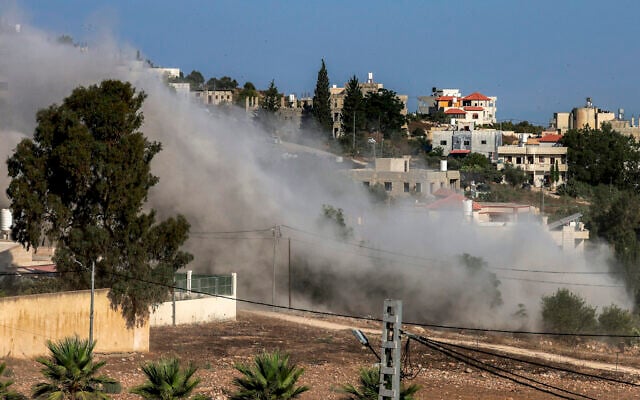
Smoke rises during an Israeli controlled-demolition from the home of Palestinian Farouk Ramadan, who opened fire with a gun snatched from an Israeli security officer during a deadly gunbattle involving settlers and Palestinians on July 24, in the West Bank village of Tell, on August 11, 2026. (Jaafar ASHTIYEH/AFP)
Israeli forces demolished the home of a Palestinian who opened fire during a deadly clash in the West Bank village of Tell last month.
During the July 24 incident, Tell resident Farouk Ramadan snatched a gun from an Israeli security officer amid a confrontation between residents of the village and a group of Israelis who were hiking through the area.
Ramadan opened fire with the stolen rifle, killing IDF officer Maj. Yuval Ezra, 27. Civil defense squad member Master Sergeant (res.) Benayahu Mellet, 32, was also killed in the incident, although an IDF probe found that he may have been hit by other Israelis who returned fire on the gunman.
Ramadan was killed by Ezra, and three other Palestinians were also shot dead in the incident.
The military says that troops, including members of Ezra’s unit — the 411th Artillery Battalion — operated in Tell overnight and this morning to demolish Ramadan’s home.
As a matter of policy, Israel demolishes the homes of Palestinians accused of carrying out deadly terror attacks.
בתוך פחות משלושה שבועות: כוחות הביטחון הרסו את בית המחבל שביצע את פיגוע הירי בו נפלו רס״ן יובל עזרא ז״ל וסרן (מיל׳) בניהו מלט ז״ל בכפר תל
לכל הפרטים????https://t.co/NFv1hUYcdT pic.twitter.com/xk8SQh9puZ
— צבא ההגנה לישראל (@idfonline) August 11, 2026
Syrian court sentences Bashar al-Assad to death in absentia over civil war atrocities
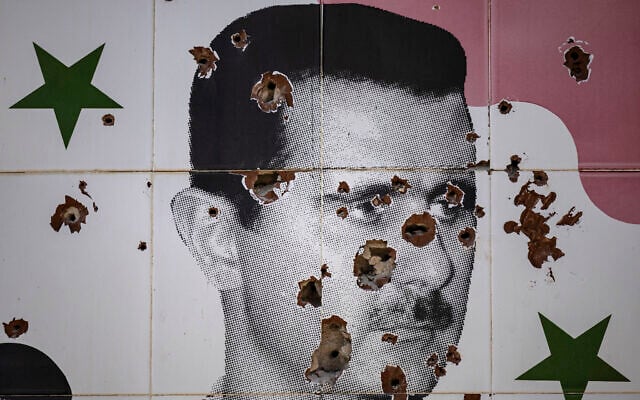
Bullet holes deface a mural depicting the toppled Syrian president Bashar al-Assad in Adra town on the northeastern outskirts of Damascus, Syria, December 25, 2024. (Sameer Al-Doumy / AFP)
DAMASCUS, Syria — A Syrian court sentences former ruler Bashar al-Assad to death in absentia, after convicting him over charges of “war crimes” and “crimes against humanity” during the country’s civil war.
The ruling against Assad, who fled with his family to Moscow as Islamist-led forces closed in on Damascus in December 2024, is the first under the transitional authorities who this year began trying figures from the former government, both in person and in absentia.
The court also sentenced Assad-era official Atif Najib, who was arrested in January last year, to death for “crimes against humanity” committed when he was head of political security in Daraa province, the cradle of the country’s 2011 uprising.
The court convicted Najib, a cousin of ousted ruler Assad, of crimes including murder, “the intentional killing of children under 15,” and “torture leading to death.”
Israeli drone strike reportedly hits vehicle near Lebanon’s Nabatieh
Lebanese media reports that a vehicle was targeted in an Israeli drone strike on the outskirts of Nabatieh this morning.
غارة إسرائيلية تستهدف سيارة عند أطراف مدينة النبطية قرب حي الجامعات pic.twitter.com/nnFcTeJf91
— Sawt Beirut International (@SawtBeirut) August 11, 2026
Lebanon’s National News Agency adds that an ambulance team from the Hezbollah-linked Islamic Health Authority, Islamic Message Scouts Association, and other medical personnel was hit by a second strike while transporting an injured person in the area.
The IDF has not yet commented.
مسيّرة إسرائيلية استهدفت فرق إسعاف في حي الجامعات بالنبطية أثناء نقل إصابة ما أدى إلى أضرار في عدد من سيارات الإسعاف#ملحق pic.twitter.com/6tlIelJPIL
— Mulhak – ملحق (@Mulhak) August 11, 2026
First reserve battalion in IDF’s Haredi Hasmonean Brigade declared operational
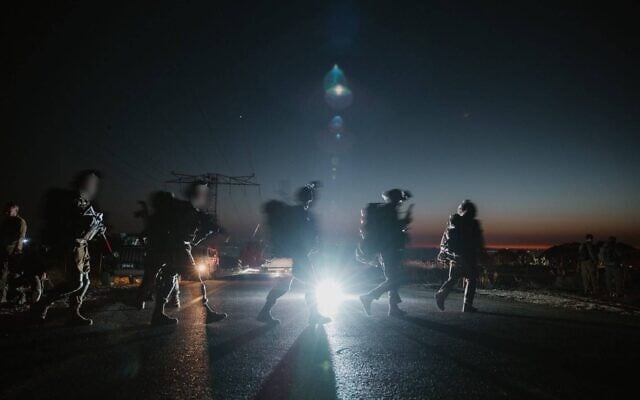
Troops of the Hasmonean Brigade's Shimon Reserve Battalion conduct a drill in the Golan Heights, in a handout photo published by the military on August 11, 2026. (Israel Defense Forces)
The IDF’s Hasmonean Brigade for ultra-Orthodox troops has declared its first reserve battalion operational, following a recent drill in the Golan Heights.
The brigade’s Shimon Reserve Battalion carried out its first-ever battalion-level exercise last week, completing its “official establishment and preparation for operational activity,” the military says.
The battalion is composed of soldiers who completed the Shlav Bet (Stage B) track, in which older people who previously received exemptions from service draft for the first time, as well as Haredi soldiers from other parts of the military.
“As part of their training, the recruits underwent full combat training adapted to the Haredi way of life at the Hasmonean training base, and the battalion will later also absorb graduates of the brigade’s standing army service track,” the IDF says.
In the coming months, the Shimon Battalion is expected to be called up for operations on the northern front, “according to operational needs,” the military adds.
The establishment of the brigade is part of the military’s efforts to expand the enlistment of ultra-Orthodox men, as it faces personnel shortages caused by the war.
It also aims to demonstrate, despite opposition to enlistment from leading Haredi rabbis, that military service can go hand in hand with ultra-Orthodox observance.
Likud MK Illouz resigns from Knesset month after ditching ruling party, says PM ‘must go home’
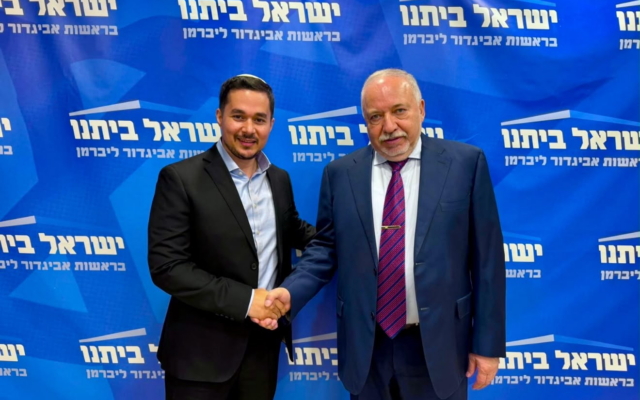
MK Dan Illouz (L) stands with Yisrael Beytenu chair Avigdor Liberman after joining the party following his resignation from Likud, on August 5, 2026. (Yisrael Beytenu)
Likud MK Dan Illouz submits his resignation from the Knesset exactly one month after announcing his departure from Prime Minister Benjamin Netanyahu’s ruling party, which he has claimed sold out its principles to hang onto power.
In a letter to Knesset Speaker Amir Ohana, the freshman legislator notes that less than 20 years ago he immigrated to Israel from Canada “out of deep Zionism,” leaving behind “family, friends, and a secure career, and boarded a plane without knowing what awaited me.”
“The 25th Knesset served during one of the most difficult periods known to the state. Hostages, the fallen, bereaved families, and a home torn apart from within. In it, I led Zionist, national, and liberal struggles out of complete faith, even when the pressure was immense and the personal toll heavy. I paid it willingly, and I am proud of every single one of these struggles,” Illouz says, in a reference to his efforts to stymie his party’s push to exempt Haredi yeshiva students from conscription.
Illouz, who has since announced he will run in the next election as part of Avigdor Liberman’s hawkish Yisrael Beytenu opposition party, is set to be replaced by Shabtai Katash, a Chabad Hasid and member of the Lod religious council.
Illouz’s resignation will take effect within 48 hours.
In a post on X, Illouz explains that he waited to resign to prevent Katash from entering the Knesset during the battle over conscription, writing that had he “resigned earlier, a Haredi MK on behalf of Likud would have entered the Knesset in my place, adding another vote for the draft exemption laws promoted by Netanyahu, Goldknopf and Deri.”
“As long as I served in the Knesset, I acted to block this legislation,” he says, adding that “Netanyahu failed and did not take responsibility. He must go home.”
MK Gotliv pans Likud for ‘disgraceful move’ granting Katz reserved spot on slate

Likud MK Tally Gotliv speaks to the media outside the Jerusalem District Court, August 6, 2026. (Chaim Goldberg/Flash90)
Likud MK Tally Gotliv slams her party’s decision to give Defense Minister Israel Katz a guaranteed spot on the party’s electoral slate ahead of the primary later this month, calling it “a disgraceful move that mocks Likud voters.”
The firebrand MK mocks Katz as “deeply afraid of the primary results and rightly so.”
Prime Minister Benjamin Netanyahu’s Likud party announced early Tuesday that Katz, alongside Foreign Minister Gideon Sa’ar and Likud Central Committee chair Haim Katz, will be granted guaranteed spots on the party’s slate.
The three men will be given reserved placements separate from the eight slots already set aside for candidates of Prime Minister Benjamin Netanyahu’s choosing, the Likud announcement said, meaning that in total, 11 of the first 29 spaces on the ruling party’s slate will go to handpicked candidates rather than to those elected by the party’s roughly 140,000 members in the August 17 primary.
The premier’s push for reserved slots was based in part on concerns that the primary could elevate candidates who are highly popular among the Likud base — including Gotliv and ministers Shlomo Karhi and May Golan — but who internal party polling suggests are less appealing to moderate right-wing and swing voters whose support could prove decisive in the upcoming national election.
The announcement of Sa’ar, Katz and Katz’s reserved spots came less than a day after the Tel Aviv District Court rejected a petition backed by Netanyahu to strike down a ruling by the party’s internal tribunal that canceled a Likud Central Committee vote that would have allowed sitting and former Knesset members, ministers and deputy ministers to compete for slots reserved for regional districts in the upcoming August 17 primaries.
For decades, Likud’s reserved spots for districts have only been available for new MKs, acting as a diversifying tool that gives new figures a chance to make it into the Knesset. But following public opinion polls that consistently show Likud getting around 22-24 seats in the October 27 election, significantly down from its current 32, Netanyahu heavily campaigned for the Likud Central Committee to approve a change that would let current and former lawmakers, ministers, and deputy ministers vie for those spots.
Katz, who came in at number 11 in the last Likud primary in 2022, told the Ynet news site that he opposed the existence of guaranteed spots on the party list.
Ebola suspected in man who recently returned from DR Congo
A man who visited the Democratic Republic of the Congo is suspected to be suffering from a case of the Ebola virus, the Health Ministry says in a statement.
After returning from the trip several days ago, he sought medical attention when he developed a fever, the ministry says.
He is undergoing testing, and results are expected within a day, according to the ministry.
Palestinian family trapped in home for third day; IDF reportedly prevented ambulance from reaching them overnight
A Palestinian family living on the outskirts of the village of Qusra, south of Nablus, has been trapped in its home for a third day as settlers block the entrance to the house.
The father, Youssef Hassan, tells The Times of Israel that the family is expected to run out of food today and that his two-year-old daughter needs to see a doctor.
Haaretz reported yesterday that settlers blocked journalists from reaching the area, while overnight, soldiers were filmed preventing a Palestinian ambulance carrying a foreign journalist from approaching the family’s home.
The IDF has yet to respond to a Times of Israel request for comment.
RIGHT NOW: settlers and army are blocking the ambulance from approaching the house with the children
We are detained by the army https://t.co/Q3xIYVAUBR pic.twitter.com/zEQnkatkwo
— Andrey X (@the_andrey_x) August 10, 2026
Influencer Yoseph Haddad scuffles with anti-Israel GOP activist during podcast recording
Footage shows Arab Israeli influencer Yoseph Haddad in a physical confrontation with Dennis Feitosa, an anti-Israel Republican Party activist, while being hosted on the Digital Social Hour podcast in Los Angeles.
Haddad was being hosted on the podcast in a debate-style format where he was set to debate 10 anti-Israel activists one after another.
In the studio, Feitosa calls Haddad a “genocidal asshole” and appears to try to egg him onto a physical confrontation by putting his arm around him. Haddad pulls his arm off.
In another part of the clip, Feitosa grabs Haddad’s hand from across the table, and Haddad then grabs Feitosa’s head and tries to slam it into the table before others in the room try to separate them.
The fighting appears to continue out in the parking lot, where others present try to keep the two separated.
I was attacked by a groyper in the U.S… he just didn’t realize he had picked a Golani soldier!
I came today to take part in a filmed debate against a group of anti-Israel activists, with the person debating me constantly changing. At one point, a man who was clearly a groyper… pic.twitter.com/Tk1s0tlbmB— יוסף חדאד – Yoseph Haddad (@YosephHaddad) August 11, 2026
Liberman says Katz should be fired for primaries campaign video: ‘He needs to take a boom, boom to the head’
Yisrael Beytenu chairman Avigdor Liberman blasts Defense Minister Israel Katz over a video the latter posted for the upcoming Likud primaries, saying he should be fired for it.
The video shows a montage of Israeli strikes over the past few years of war, along with an upbeat song with the lyrics, “Israel Katz, boom, boom, boom, boom, boom, boom, boom, boom, boom, boom, boom, boom” repeating over and over, and a post urging Likud members to vote for the defense minister.
ישראל כ"ץ. בום בום בום. הצביעו 121 בפריימריז pic.twitter.com/5yorHxIWFG
— ישראל כ”ץ Israel Katz (@Israel_katz) August 10, 2026
The video was posted before the party announced that its secretariat will be asked to approve three additional reserved slots on the party’s electoral list, among them Katz.
“I would expect that the first statement this morning, after that stupid video that harms our efforts in the international arena, and also harms the IDF … is the firing of the defense minister,” Liberman tells 103FM.
Instead, the ruling party made the announcement on the reserved spots, he laments.
“I think he needs to take a ‘boom, boom’ to the head,” Liberman says, referencing the video.
“This is not a defense minister that is concerned with defense. This is a defense minister that works just for his primaries and for members of the Likud Central Committee. There is no concern for the security of the citizens of Israel,” he says.
Only six vessels traveled through Hormuz yesterday, shipping data shows

Small boats line the shore as cargo ships and other commercial vessels appear anchored in the Strait of Hormuz off Bandar Abbas, Iran, July 27, 2026. (Razieh Poudat/ISNA via AP)
NEW DELHI, India — Shipping traffic through the Strait of Hormuz fell to six yesterday, compared with a 10-day average of about 11 vessels, shipping data showed, amid fading hopes of a peace deal between the US and Iran.
Four commodity vessels, including two empty oil product tankers, entered the waterway, data from Kpler shows as of 0420 GMT. Two vessels — a small tanker laden with liquefied petroleum gas and another carrying residual fuels — exited the Strait, the data showed.
In pre-war days, about 130 to 140 ships typically transited the strait.
Yesterday, 25 vessels transited the Bab el-Mandeb Strait on the Red Sea, broadly unchanged when compared with the 10-day average of nearly 24 ships, Kpler data shows.
South Carolina Republicans set to elect replacement for late senator Lindsey Graham

Republican US Senator Darline Graham of South Carolina speaks at a South Carolina Republican Senate candidate stump event ahead of the special GOP primary to replace her late brother, Senator Lindsey Graham, in Lexington, South Carolina, August 1, 2026. (AP Photo/Meg Kinnard)
COLUMBIA, South Carolina — Just two months after nominating pro-Israel stalwart Lindsey Graham to return to the US Senate, South Carolina Republicans are casting ballots today in a special primary to pick a replacement following the sudden death of the president’s close ally.
Graham’s sister, Darline Graham, a political unknown tapped to serve out the final months of her brother’s term, is trying to overcome skepticism about her lack of experience in her campaign to replace him. She picked up US President Donald Trump’s swift endorsement, though the rare open Senate seat has attracted a broad field, including some of the state’s top Republicans.
For decades, South Carolina voters have reliably returned Lindsey Graham to Washington despite periodic primary challengers who accused the dealmaker and foreign policy hawk of being insufficiently conservative.
Tuesday’s contest features one of Lindsey Graham’s foes from earlier this year, as well as two US House members, as well as Mark Sanford, the former governor and congressman who is seeking a political comeback in a field crowded with familiar faces.
Three Israeli settlement activists illegally crossed Syrian border overnight, found and detained by IDF
Three Israeli settlement activists illegally crossed the border into Syria overnight, before being returned to Israel by the IDF, the latest in a series of such incidents.
The military says the trio arrived in the Mount Hermon area and crossed the border.
IDF troops who were dispatched to the scene located the civilians, returned them to Israeli territory, and detained them, the military says, adding that they were handed over to the police for further handling.
The activists, who call themselves the Bashan Pioneers, call for the establishment of settlements in the southern Syria area.
There has been an increase in attempts by the activists to cross the border into Syria in recent months.
“The IDF strongly condemns the incident, which constitutes another serious disruption of operational activity and poses a danger to the safety of IDF troops operating in the area,” the military says.
The IDF adds that “law enforcement authorities are required to bring those involved to justice and to prevent those individuals from repeatedly engaging in this behavior, which constitutes a criminal offense.”
There have been no charges filed against the Bashan Pioneers members, and despite their illegal actions, they have also received support from coalition lawmakers.
Next round of Israel-Lebanon talks to take place in early September, official says
WASHINGTON — The next round of US-mediated talks between Israel and Lebanon will take place in early September, an official familiar with the matter tells The Times of Israel.
The official acknowledges that last week’s round of talks in Rome did not go very smoothly, as Beirut is pushing for additional Israeli withdrawals from southern Lebanon while Jerusalem argues that verification of Hezbollah disarmament must be completed first.
In the weeks leading up to the next round, the US is pushing the sides to agree on a list of countries that will take part in the verification mechanism, with Israel rejecting the inclusion of countries that have sought to act against it in international forums, the official says.
The sides are also holding side negotiations on the identification and return of remains of Lebanese and Israeli Jews in exchange for Lebanese detainees, the official adds.
Trump secretly flew out of Turkey on smaller plane, not old Air Force One, due to Iranian threat — Washington Post
US President Donald Trump secretly flew out of Turkey last month on a smaller plane than previously known due to an assassination threat from Iran, the Washington Post reports.
According to an anonymous US official speaking to the Post, Trump boarded an Air Force One jet in Ankara on July 8, but then moved into a catering container attached to the plane.
The container then ferried him to a smaller C-32A aircraft that flew him to Britain, while media and some officials were led to believe Trump was still on the bigger jet.
The Iranian threat had previously been reported by US media as the reason that Trump did not fly out of Turkey aboard the new Boeing 747-8, gifted to the United States by Qatar, which he had used to fly into the country.
Trump, who was in Ankara for a NATO summit, said at the time he would be taking the older Boeing 747 so that members of the US military at an airbase in Britain could tour the new plane.
However, several US media outlets, including the New York Times, reported that a threat from Iranian proxy forces had prompted the switch.
Queried by AFP about the Washington Post report, the White House sends a statement defending the new plane’s safety.
“The new Air Force One is a state-of-the-art aircraft that has been fitted with high-level security protocols that ensure the safety of the President and his staff,” Communications Director Steven Cheung says in the statement.
“As the President has said recently, there are many enemies of America who have their sights on him, and we use every tool at our disposal to address those threats.”
The same statement had been used by the White House last month when questions about the aircraft’s safety first surfaced.
Video in the Washington Post’s report shows a catering truck lowering from the older Air Force One jet, minutes after Trump walked up stairs into the plane.
The catering vehicle can then be seen transiting in the distance to the smaller C-32A aircraft.
After both planes landed in the United Kingdom, Trump was videotaped coming down the steps from the larger jet, before making his way to the new retrofitted Air Force One.
It was unclear how he had made the transfer back to the larger plane, the Post says.
Hebrew reports claim two Arab states plotting to sign diplomatic deals with Israel to trick it as they plan for war
Israel suspects that two Arab states are plotting to attack Israel by lulling it into a false sense of security through fake diplomatic agreements, according to two separate reports published in the past day by the Kan public broadcaster and Channel 12.
According to the reports, the two countries — neither of which is identified by name — would sign diplomatic agreements with Israel to “anesthetize” the Jewish state and remove any unwanted scrutiny.
They would then be free to plan a major attack on Israel and launch it at a time of their choosing, having pulled the wool over Jerusalem’s eyes, the reports claim.
According to Channel 12, officials from one of the Arab states approached their counterparts in the other about the idea and encouraged it to join forces.
The alleged plot appears to be modeled on the October 7, 2023, attack, the Kan public broadcaster reports, but would be on an even larger scale. Hamas, led by Yahya Sinwar, launched the deadly invasion after years of working to fool Israel into thinking it no longer desired armed conflict.
The reports come at a time when US President Donald Trump is openly pushing for more countries in the region to normalize relations with Israel by entering the Abraham Accords, first signed by the United Arab Emirates and Bahrain in 2020.
Drone attack targets oil facility in Libya for the third time in two days
Libya’s National Oil Corporation says that a drone fell near a main oil tank and pipeline network at the Zawiya Oil Refining Company’s oil blending plant, the third such attack in two days.
No casualties or damage were reported, NOC says, adding it could declare force majeure and completely halt refinery operations if the attacks continue.
Haredi activists ramp up Likud recruitment in bid to influence ruling party from within
Ultra-Orthodox activists are ramping up the recruitment of Haredim to join Prime Minister Benjamin Netanyahu’s Likud ahead of the party’s upcoming primaries, part of a years-long concerted effort to build political power within the ruling party and influence its policies, according to a Channel 12 report.
The report estimates that 7,000 of Likud’s roughly 140,000 members are Haredi, with nearly all of the major Hasidic groups now represented within the party.
Haredi public relations strategist and Likud operative Yossi Rosenbaum, who has been recruiting members to the party since 2004, tells Channel 12 that his bloc now numbers in the “thousands” and that he can bring several thousand voters to the polls.
The trend is driven partly by dissatisfaction with traditional Haredi political representatives, primarily United Torah Judaism but also Shas, and a belief that membership in the ruling party offers a more effective means of advancing their interests.
Even figures formally affiliated with the Haredi parties are participating in the effort, including an unnamed Bnei Brak city councilman representing Agudat Yisrael, a UTJ faction, who also runs an organized bloc of Likud voters.
Likud politicians, in turn, are increasingly courting the Haredi public, with Netanyahu, ministers including Israel Katz, Yariv Levin, Gideon Sa’ar, Shlomo Karhi and lawmakers David Bitan, Boaz Bismuth, Hanoch Milwidzky, Moshe Saada among others regularly attending Haredi events as they campaign for support ahead of next week’s primaries.
The upcoming race is expected to be unusually tight, with the party projected to drop to 23 seats and Netanyahu granted an unprecedented eight slots on the slate for handpicked candidates, significantly reducing the number of realistic spots available to primary contenders. As a result, a bloc of several thousand Haredi voters could prove decisive.
Likud to grant reserved slots on party list to Sa’ar, Israel Katz, Haim Katz, on top of 8 spots already granted to PM for chosen candidates
Prime Minister Benjamin Netanyahu’s Likud announces that the party’s secretariat will be asked to approve three additional reserved slots on the party’s electoral list, in addition to the eight reserved slots already granted to the prime minister for candidates of his choosing.
The three additional slots will be reserved for Foreign Minister Gideon Sa’ar, Defense Minister Israel Katz, and Likud Central Committee Chair Haim Katz, the announcement says.
Justifying the decision — which was announced just after 1 a.m. on Tuesday and will be brought to the secretariat for approval later in the day — the Likud announcement notes that Sa’ar had been guaranteed a reserved slot under the terms of the merger between his New Hope party and Likud.
The party says Israel Katz will receive a reserved spot on the list “to allow him to deal with security needs and not engage in politics at this time,” and that Haim Katz will receive a reserved spot due to his post as the chair of the Likud Central Committee.
It is unclear from the statement, though, why the three were not simply allocated three of the eight reserved spots already granted to Netanyahu.
The decision, if approved, would give Netanyahu control over 11 of the top 30 spots on the Likud list, ahead of the October 27 election.
The announcement comes hours after Netanyahu’s first pick for his eight reserved slots, entrepreneur Oren Dobronsky, caused an uproar after it was discovered that he had called US President Donald Trump a “morally corrupt piece of shit” less than two months ago.
Report: Israel holding bodies of 1,700 Palestinians, including some not involved in attacks
Israel is reportedly holding on to the bodies of roughly 1,700 Palestinians, including some who were not involved in attacks against Israelis.
Citing two sources familiar with the matter, Haaretz says the bodies are being used as bargaining chips for future hostage negotiations, even though Hamas no longer holds any Israeli captives.
The vast majority of the bodies belong to Palestinians who carried out attacks against Israelis, Haaretz says, without specifying the breakdown of how many of the bodies were from Gaza compared to the West Bank.
The policy is backed by Shin Bet chief David Zini and the IDF but has faced pushback from the Shin Bet’s legal adviser, who has argued that Israel has no legal justification for holding onto the bodies of Palestinians not involved in attacks.
The IDF says that it won’t comment on internal deliberations, and the Shin Bet declines to comment on the matter.


read more: