

Japan publisher reprints Charlie Hebdo cartoons
Pictures showing the Prophet Muhammad have his face pixelated to prevent offense to Muslims
 Add ToI as a Preferred Source on Google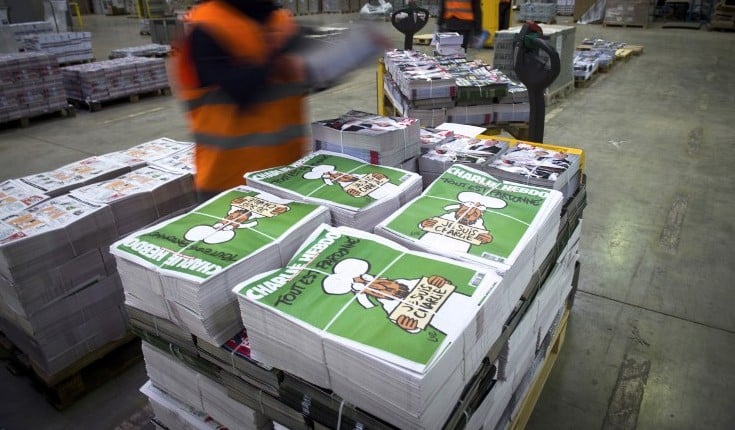
TOKYO, Japan — A small Japanese publisher on Tuesday issued 3,000 copies of a book of cartoons by French satirical magazine Charlie Hebdo, including controversial drawings of Muhammed.
“Are You Charlie? Isuramu heito ka fushi ka (Is it satire or hate against Islam)” is an attempt to spark debate in Japan on the nature of free speech, said Akira Kitagawa, the head of Tokyo-based Dai-san Shokan.
About 40 cartoons were reproduced with Japanese language translations, including those mocking the pope, French President Francois Hollande and Japan’s 2011 Fukushima nuclear crisis.
However, drawings featuring the Prophet Muhammed show his face pixellated. No other characters were depicted in this way.
“There were suggestions that blurring the images would make a bit of a difference for Muslims,” Kitagawa told AFP.
“There are other opinions that it does not make much difference, though,” he added.
Japan’s small Muslim population has protested the publication, saying printing the cartoons is an “insult.”
But Kitagawa says his project comes down firmly on the side of saying that the cartoons are unnecessarily provocative.
“This is a book, clearly, saying Charlie Hebdo is not good,” he told AFP. “It does not make sense that Muslims get angry over this.”
There was a small police presence outside the Tokyo office of the publisher.
Japan does not have much of a tradition of satirical cartoons, something some commentators have put down to the value placed on harmony and a societal emphasis on not upsetting people.
Japanese people were aghast at the attacks on Charlie Hebdo’s office and a Jewish deli which killed 17 people, with many expressing bewilderment at how believers could turn to violence in the name of religion.
Most people in Japan practice a pick-and-mix of imported Buddhism and native Shintoism, depending on the occasion, although few would describe themselves as devout.
Dai-san Shokan has a history of courting controversy, having previously reprinted leaked data on an anti-terrorism probe by police, with much of the information concentrating on Muslims in Japan.
The publishing house also issued the Japanese translation of a biography of Crown Princess Masako in 2007.
“Princess Masako: Prisoner of the Chrysanthemum Throne,” originally written by Australian journalist Ben Hills, drew protests from the Japanese government.










The Times of Israel Community.