

On Sukkot, turning oy into the season of joy
Finding the energy to build a temporary home for a temporary family of guests is not always the easiest thing to do
 Add ToI as a Preferred Source on Google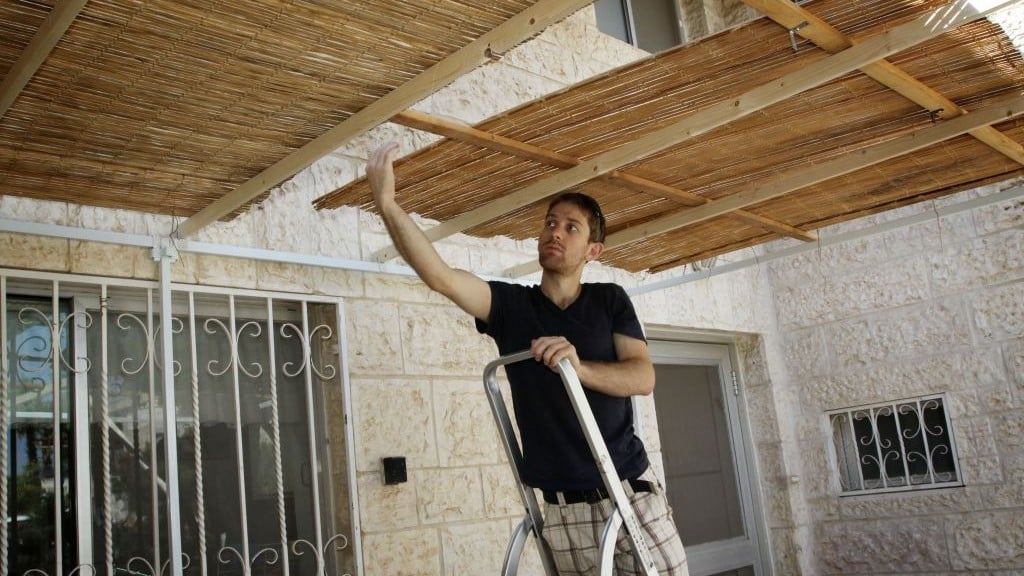
LOS ANGELES (JTA) — In open opposition to Kohelet (Ecclesiastes), which tells us on Sukkot “there is nothing new under the sun,” I decided to build a solar sukkah this fall. To energize my plan, I went to the 99 Cent Store to buy some solar yard lights to adapt for use on the roof.
However, while driving home and accessing the construction work required for the upcoming holiday, I realized that my sukkah was not the only thing that was low energy.
I had put up our sukkah umpteen years in a row, and this year I was thinking about giving the shack building a rest. The solar idea was nice, but in the end it wasn’t enough — just an artificial way of rekindling my interest in what had become an annual task.
Couldn’t we just manage an invite from a couple of the families we had invited into our sukkah in previous years?
Not an option: Among our friends there was a sukkah shortage. Over time, it seems, people get so used to visiting your sukkah that they lose touch with building their own.
Sukkot is supposed to be “the season of our joy,” but after the chest pounding, shofar blowing and pleading for my life, the joy this year was hard to find. Was there a way to reset my spiritual clock and get my sukkah built?
Psychology tells us that motivation comes in two forms: “intrinsic,” an internal desire to perform a particular task that gives us pleasure, like knowing that putting up a sukkah is a mitzvah, and “extrinsic,” factors external and unrelated to a particular task, but a kind of reward, like praise from friends for putting up a sukkah
Searching for motivation, I read where a college rabbi at Duke had run a program called “Sex and the Sukkah.” It certainly piqued my interest (though I was confused as to whether the motivation was extrinsic or intrinsic). Apparently sex is part of the mitzvah of dwelling in the sukkah. But we don’t even sleep out there, and my wife wondered nervously about the neighbors.
With our children in their 20s, the motivation of putting up the sukkah for them was missing, too. Balancing on a ladder in our shaky shack just so we could hang the decorations they made in school was no longer a starter.
Hanging signs of their more recent achievements — term papers, pay stubs and renderings (one of them is studying to be an architect) — was an interesting updating of the tradition, but I didn’t think the public display would be appreciated.
Since with each day the pile of weathered boards and rolls of bamboo seemed to be receding farther and farther into the depths of my garage, and wondering if others might be having a similar problem, I sat down to interview a psychologist.
“A lack of motivation and apathy could be a sign of depression,” said Rae Freed, a clinical social worker in private practice in Los Angeles who sees patients of all ages. Depression could show itself through “a lack of energy, fatigue, in difficulty in making a decision or lack of focus.”
As we talked about the social component of the sukkah — inviting over guests — Freed suggested that potential sukkah builders might think the effort requires “too much energy to participate in a social interaction.”
“That sounded about right,” I thought, thinking of the effort it took in past years to call people to negotiate the “right” night.
Freed also spoke about seasonal depression that comes with the shortening of days from a Jewish point of view.
“You build up to the High Holy Days, spending time with family, and afterwards feel the loss,” she said.
“Especially when they live on the other side of the county or have passed away,” I thought.
Over time, “age and strength” become factors as well, Freed said.
“Yeah, that too,” I thought, then asked, “How do you get over it?”
For Freed, simply pretending and putting on a “mask of joy” was not going to cover it. She countered my question with questions: “Ask yourself, how did you feel in the past when you did that? Was it positive?”
“Having guests over did make me feel good,” I thought.
‘Having guests over did make me feel good’
Explaining further, Freed suggested that even if you don’t feel like doing something, it might be motivating to remember the pleasure the activity brought, especially the communal associations.
Recall the “memories of earlier Sukkots,” said Freed, who pleasantly recalled that she had spent her teen years living in an art deco hotel run by her father that catered to vacationing Jews in south Miami Beach, Fla.
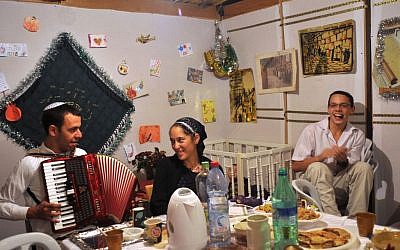
I remembered having in several groups of people the previous year. It was kind of like running a sukkah hotel — tons of work, yet they sang, played instruments and filled our evenings with camaraderie.
“People feel alone and isolated if they are not surrounded by family,” Freed said, and suggesting the sukkah is a way of “bringing together a temporary family.”
“A temporary structure for a temporary family,” I thought.
Later, thinking over Freed’s words, my low energy thoughts dissipated. Going into the recesses of my garage, I found what it would take to build my sukkah.










The Times of Israel Community.